
Science
NASA’s Hubble Reveals Stunning Light Effects in Egg Nebula

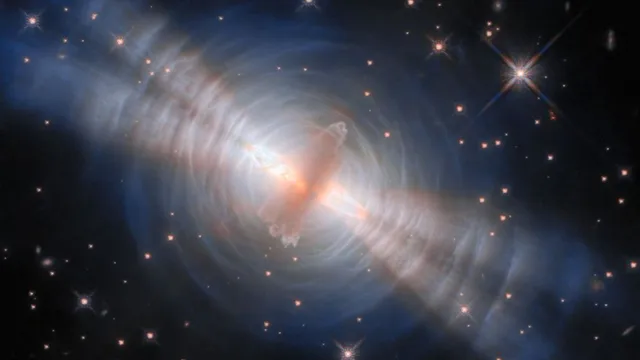
NASA’s Hubble Space Telescope has recently captured breathtaking images of the Egg Nebula, showcasing a captivating interplay of light and shadow created by newly formed stardust. This nebula, situated in the constellation Cygnus and approximately 1,000 light years away, features a central star enveloped in a dense cloud of dust, resembling an opaque egg yolk encasing a bright core.
The light emitted by the dying star does not escape uniformly. Instead, it bursts through small gaps in the surrounding dust, producing brilliant beams that carve smoky lobes and ripple patterns into the cloud. This unique perspective allows scientists to observe, almost in real time, how stars similar to our Sun shed their outer layers before transitioning into planetary nebulae.
Unveiling the Mysteries of the Egg Nebula
Known as one of the youngest and closest preplanetary nebulae documented, the Egg Nebula offers invaluable insights into stellar evolution. NASA and European Space Agency (ESA) scientists note that the light currently observed is not from glowing gas but rather starlight reflecting off the thick dust that continues to obscure the central star.
The striking twin beams of light are moving rapidly, pushing through older layers of material expelled in previous phases. Over time, these layers have formed faint, curved arcs. The remarkable symmetry of these patterns suggests the possibility of an unseen companion star or even multiple companions, which may be influencing the dynamics of gas and dust ejection through gravitational interaction.
This phase in the star’s lifecycle is notably brief. Scientists estimate that the dusty disc surrounding the star was expelled in just a few hundred years, a fleeting moment in cosmic timescales. For the time being, the nebula reflects light rather than generating its own, a process that will change once the core fully emerges and heats the surrounding gas.
Implications for Stellar Evolution
Hubble’s long-term observations reveal that these controlled stellar outbursts signify more than just the end of a star’s life. The dust and material released during this phase ultimately disperse into space, contributing to the formation of future stars and planetary systems. As such, the Egg Nebula serves as both a fascinating subject of study and a critical component in understanding the lifecycle of stars.
The insights gained from Hubble’s observations enhance our understanding of the cosmos and the intricate processes that govern stellar evolution. With each new image, scientists unlock further secrets of the universe, helping to chart a course for future explorations. The Egg Nebula stands as a testament to the beauty and complexity of celestial phenomena, inviting further inquiry and admiration from the scientific community and the public alike.

Albert Camus’ Insightful Quote on Human Identity Resurfaces

Drone Strikes and Missile Attacks Disrupt UAE Amid Rising Tensions

Japanese Yen Rises Sharply Against US Dollar Ahead of Key Decisions

Priyanka Chopra and Nick Jonas Avoid Near Miss en Route to Oscars

Gujarat Vaccinates Over 11 Lakh Infants in Major Health Drive

Alexandre Singh Wins Oscar, Celebrates Immigrant Heritage

Lok Sabha Speaker Issues Warning Over Placards in Parliament

Global Electrosurgical Devices Market Expands to $10.2 Billion by 2034

North Zone Dominates Cricket; SJAM-1 Shines in Table Tennis

SBI Announces QIP Floor Price at ₹811.05 Per Share

Cept Unveils ₹3.1 Crore Urban Mobility Plan for Sustainable Growth

Comparing Subscription Prices: Spotify, Apple Music, and YouTube Music in India

New Blood Group Discovered in South Indian Woman at Rotary Centre

Konkani Cultural Organisation to Host Pearl Jubilee in Abu Dhabi

Torrential Rains Cause Flash Flooding in New York and New Jersey

Nothing Headphone 1 Review: A Bold Contender in Audio Design

Air India Crash Investigation Highlights Boeing Fuel Switch Concerns

Broad Advocates for Bowling Change Ahead of Final Test Against India
-
 World1 year ago
SBI Announces QIP Floor Price at ₹811.05 Per Share
-
 Lifestyle1 year ago
Cept Unveils ₹3.1 Crore Urban Mobility Plan for Sustainable Growth
-
 Science1 year ago
Comparing Subscription Prices: Spotify, Apple Music, and YouTube Music in India
-
 Science1 year ago
New Blood Group Discovered in South Indian Woman at Rotary Centre
-
 Top Stories1 year ago
Konkani Cultural Organisation to Host Pearl Jubilee in Abu Dhabi
-
 World1 year ago
Torrential Rains Cause Flash Flooding in New York and New Jersey
-
 Science1 year ago
Nothing Headphone 1 Review: A Bold Contender in Audio Design
-
 Top Stories1 year ago
Air India Crash Investigation Highlights Boeing Fuel Switch Concerns
-
 Sports1 year ago
Broad Advocates for Bowling Change Ahead of Final Test Against India
-

 Business1 year ago
Indian Stock Market Rebounds: Sensex and Nifty Rise After Four-Day Decline
-

 Sports1 year ago
Cristian Totti Retires at 19: Pressure of Fame Takes Toll
-

 Politics1 year ago
Abandoned Doberman Finds New Home After Journey to Prague