
Science
NASA Unveils Dramatic Changes in Interstellar Comet 3I/ATLAS

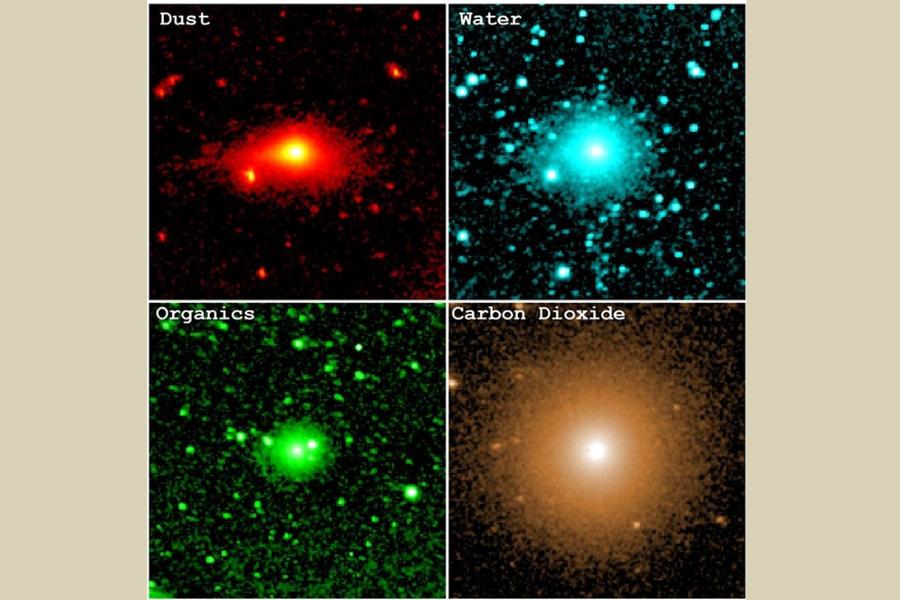
NASA has reported significant findings regarding interstellar comet 3I/ATLAS, which has undergone remarkable changes as it nears the end of its journey through the solar system. Observations from the SPHEREx space telescope have revealed a powerful outburst of gas, dust, and complex molecules, providing scientists with a rare chemical insight into materials formed around a distant star.
Significant Brightening and Chemical Diversity
The comet was observed by SPHEREx in December 2025, nearly two months after its closest approach to the Sun, which occurred on October 18, 2025. During this time, the comet exhibited a dramatic increase in brightness, attributed to a surge in activity as subsurface ices began to warm and erupt into space. The findings were detailed in a research note by mission scientists, who detected organic molecules including methanol, cyanide, and methane.
Carey Lisse, the study’s lead from the Johns Hopkins Applied Physics Laboratory in Laurel, Maryland, noted, “Comet 3I/ATLAS was full-on erupting into space in December 2025, causing it to significantly brighten. Even water ice was quickly sublimating into gas in interplanetary space.” Lisse emphasized that the comet’s composition is revealing a mix of early solar system materials, which include organic molecules, soot, and rock dust.
Delayed Sublimation and Ejection of Materials
Scientists understand that a comet’s peak activity does not always align with its closest approach to the Sun. In the case of 3I/ATLAS, the data from SPHEREx suggest that the deeply buried ices began sublimating weeks later, resulting in the observed outburst. Earlier observations in August 2025 indicated a coma primarily comprised of carbon dioxide, with smaller amounts of carbon monoxide and water. By December, the coma demonstrated increased activity and a more diverse chemical profile, fueled by erupting subsurface materials.
Phil Korngut, the mission’s instrument scientist at Caltech in Pasadena, California, explained that the comet had been exposed to cosmic rays throughout its long journey through interstellar space. This exposure likely formed a crust processed by radiation. With the Sun’s energy penetrating the comet, the pristine ices beneath the surface warmed, resulting in the release of chemicals that had not been exposed to space for billions of years.
The data further indicate that the comet is ejecting relatively large rocky particles rather than fine dust. Observations revealed a small, pear-shaped dust tail, suggesting that the ejected materials include BB-sized chunks too heavy to be displaced far from the nucleus by solar radiation pressure.
SPHEREx’s unique design, which includes a near-polar low-Earth orbit, allows it to scan the entire sky in infrared wavelengths. Launched on March 11, 2025, the mission has successfully completed its first of four planned all-sky infrared maps, observing the universe in 102 infrared colours.
Yoonsoo Bach, the deputy study lead from the Korea Astronomy and Space Science Institute, expressed excitement over the findings. “Our unique space telescope is gathering unprecedented data from across the universe. In this case, our galaxy delivered a piece of a faraway star system to us only a few months after launch, and SPHEREx was ready to observe it. Science is sometimes like that: You’re in the right place at the right time.”
Comet 3I/ATLAS was initially discovered on July 1, 2025, by the NASA-funded ATLAS (Asteroid Terrestrial-impact Last Alert System) survey telescope in Rio Hurtado, Chile. It was quickly identified as an interstellar object due to its high velocity and unusual trajectory. NASA has since deployed multiple missions to track the comet, refine its trajectory, and analyze its composition, underscoring the agency’s commitment to studying comets, asteroids, and near-Earth objects that traverse the solar system.

Albert Camus’ Insightful Quote on Human Identity Resurfaces

Drone Strikes and Missile Attacks Disrupt UAE Amid Rising Tensions

Japanese Yen Rises Sharply Against US Dollar Ahead of Key Decisions

Priyanka Chopra and Nick Jonas Avoid Near Miss en Route to Oscars

Gujarat Vaccinates Over 11 Lakh Infants in Major Health Drive

Alexandre Singh Wins Oscar, Celebrates Immigrant Heritage

Lok Sabha Speaker Issues Warning Over Placards in Parliament

Global Electrosurgical Devices Market Expands to $10.2 Billion by 2034

North Zone Dominates Cricket; SJAM-1 Shines in Table Tennis

SBI Announces QIP Floor Price at ₹811.05 Per Share

Cept Unveils ₹3.1 Crore Urban Mobility Plan for Sustainable Growth

Comparing Subscription Prices: Spotify, Apple Music, and YouTube Music in India

New Blood Group Discovered in South Indian Woman at Rotary Centre

Konkani Cultural Organisation to Host Pearl Jubilee in Abu Dhabi

Torrential Rains Cause Flash Flooding in New York and New Jersey

Nothing Headphone 1 Review: A Bold Contender in Audio Design

Air India Crash Investigation Highlights Boeing Fuel Switch Concerns

Broad Advocates for Bowling Change Ahead of Final Test Against India
-
 World1 year ago
SBI Announces QIP Floor Price at ₹811.05 Per Share
-
 Lifestyle1 year ago
Cept Unveils ₹3.1 Crore Urban Mobility Plan for Sustainable Growth
-
 Science1 year ago
Comparing Subscription Prices: Spotify, Apple Music, and YouTube Music in India
-
 Science1 year ago
New Blood Group Discovered in South Indian Woman at Rotary Centre
-
 Top Stories1 year ago
Konkani Cultural Organisation to Host Pearl Jubilee in Abu Dhabi
-
 World1 year ago
Torrential Rains Cause Flash Flooding in New York and New Jersey
-
 Science1 year ago
Nothing Headphone 1 Review: A Bold Contender in Audio Design
-
 Top Stories1 year ago
Air India Crash Investigation Highlights Boeing Fuel Switch Concerns
-
 Sports1 year ago
Broad Advocates for Bowling Change Ahead of Final Test Against India
-

 Business1 year ago
Indian Stock Market Rebounds: Sensex and Nifty Rise After Four-Day Decline
-

 Sports1 year ago
Cristian Totti Retires at 19: Pressure of Fame Takes Toll
-

 Politics1 year ago
Abandoned Doberman Finds New Home After Journey to Prague