
Science
Astronomers Unveil Stunning View of Milky Way’s Core

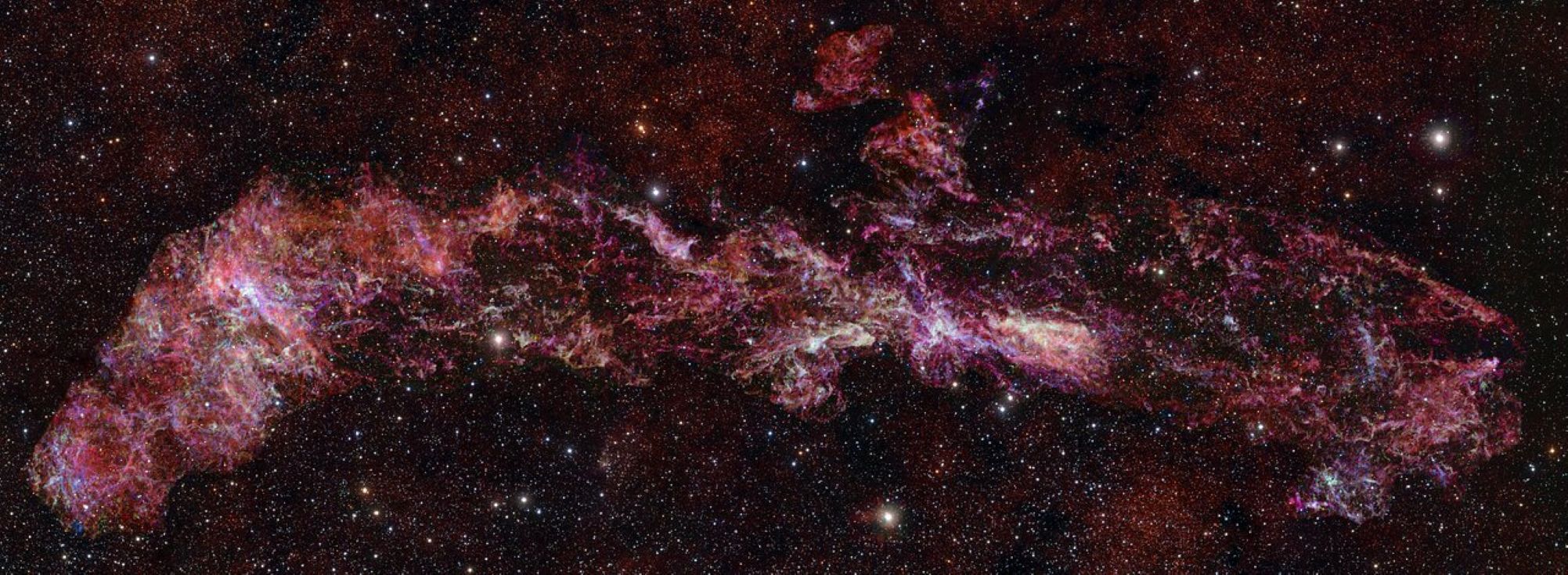
A groundbreaking new image of the Milky Way’s core has been unveiled, revealing a complex tapestry of cold gas filaments that are pivotal to star formation. Utilizing the Atacama Large Millimeter/submillimeter Array (ALMA) located in Chile’s Atacama Desert, astronomers have produced the largest image from ALMA to date, depicting an area spanning the width of three full Moons side by side. This extraordinary mosaic illuminates the chaotic environment surrounding the supermassive black hole at the center of our galaxy.
The region, known as the Central Molecular Zone (CMZ), extends over more than 650 light-years and is characterized by dense clouds of gas and dust. This unique galactic nucleus is the only one accessible for detailed study from Earth. The recent survey, titled the ALMA CMZ Exploration Survey (ACES), focuses specifically on cold molecular gas, revealing a rich assortment of molecules including simple compounds like silicon monoxide and more complex organics such as methanol, acetone, and ethanol.
According to Ashley Barnes, an astronomer at the European Southern Observatory (ESO), the CMZ is “a place of extremes, invisible to our eyes, but now revealed in extraordinary detail.” The data collected showcase structures that range from extensive filaments stretching dozens of light-years to minute gas clouds enveloping individual stars.
Steve Longmore, the leader of the ACES project and professor of astrophysics at Liverpool John Moores University, highlights the significance of this environment. He states, “The CMZ hosts some of the most massive stars known in our galaxy, many of which live fast and die young, ending their lives in powerful supernova explosions.” By examining star formation in such a tumultuous setting, astronomers aim to validate existing theories about how stars emerge under chaotic conditions.
The final image exceeded the team’s expectations. “We anticipated a high level of detail when designing the survey, but we were genuinely surprised by the complexity and richness revealed in the final mosaic,” notes Katharina Immer, an ALMA astronomer at ESO. This new insight into the CMZ not only enhances our understanding of star formation but also provides a glimpse into the early days of galaxies like our own, when stars formed rapidly in hostile environments.
Future advancements in technology will further enhance these studies. The upcoming ALMA Wideband Sensitivity Upgrade and the ESO’s Extremely Large Telescope are set to allow astronomers to delve even deeper into the CMZ. This will enable the resolution of finer structures and the exploration of more intricate chemical processes, ultimately enhancing our comprehension of the interplay between stars, gas, and black holes.
The research findings were documented in a series of papers to be published in the Monthly Notices of the Royal Astronomical Society, providing a comprehensive overview of the ACES data. The implications of this research extend beyond mere aesthetics. By investigating the CMZ, scientists hope to unravel the intricate history of galaxy formation and evolution, revealing stories written in gas, dust, and starlight, now brought to light in vivid detail.

Albert Camus’ Insightful Quote on Human Identity Resurfaces

Drone Strikes and Missile Attacks Disrupt UAE Amid Rising Tensions

Japanese Yen Rises Sharply Against US Dollar Ahead of Key Decisions

Priyanka Chopra and Nick Jonas Avoid Near Miss en Route to Oscars

Gujarat Vaccinates Over 11 Lakh Infants in Major Health Drive

Alexandre Singh Wins Oscar, Celebrates Immigrant Heritage

Lok Sabha Speaker Issues Warning Over Placards in Parliament

Global Electrosurgical Devices Market Expands to $10.2 Billion by 2034

North Zone Dominates Cricket; SJAM-1 Shines in Table Tennis

SBI Announces QIP Floor Price at ₹811.05 Per Share

Cept Unveils ₹3.1 Crore Urban Mobility Plan for Sustainable Growth

New Blood Group Discovered in South Indian Woman at Rotary Centre

Konkani Cultural Organisation to Host Pearl Jubilee in Abu Dhabi

Torrential Rains Cause Flash Flooding in New York and New Jersey

Nothing Headphone 1 Review: A Bold Contender in Audio Design

Indian Stock Market Rebounds: Sensex and Nifty Rise After Four-Day Decline

Air India Crash Investigation Highlights Boeing Fuel Switch Concerns

Broad Advocates for Bowling Change Ahead of Final Test Against India
-
 World12 months ago
SBI Announces QIP Floor Price at ₹811.05 Per Share
-
 Lifestyle1 year ago
Cept Unveils ₹3.1 Crore Urban Mobility Plan for Sustainable Growth
-
 Science12 months ago
New Blood Group Discovered in South Indian Woman at Rotary Centre
-
 Top Stories1 year ago
Konkani Cultural Organisation to Host Pearl Jubilee in Abu Dhabi
-
 World1 year ago
Torrential Rains Cause Flash Flooding in New York and New Jersey
-
 Science1 year ago
Nothing Headphone 1 Review: A Bold Contender in Audio Design
-
 Business1 year ago
Indian Stock Market Rebounds: Sensex and Nifty Rise After Four-Day Decline
-
 Top Stories1 year ago
Air India Crash Investigation Highlights Boeing Fuel Switch Concerns
-
 Sports12 months ago
Broad Advocates for Bowling Change Ahead of Final Test Against India
-

 Sports12 months ago
Cristian Totti Retires at 19: Pressure of Fame Takes Toll
-

 Politics12 months ago
Abandoned Doberman Finds New Home After Journey to Prague
-

 Lifestyle1 year ago
Villagers Unite to Raise ₹45 Lakh for Water Solutions in Vadgam