
Politics
Gandhi’s Connection to Cartoons: A Legacy of Non-Violent Satire

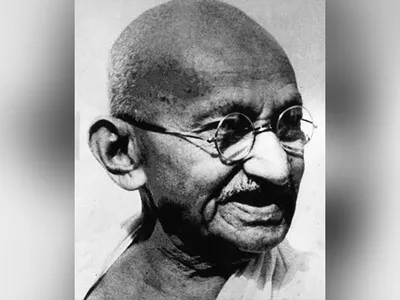
Mahatma Gandhi’s engagement with cartoons and satire played a significant role in shaping his approach to non-violent resistance. A poignant reminder of this connection surfaced in a 1968 cartoon by American cartoonist Bill Mauldin, created after the assassination of Martin Luther King Jr.. The cartoon depicted Gandhi reaching out in solidarity, saying, “The odd thing about assassins, Dr King, is that they think they’ve killed you.” This artwork highlights the enduring impact of visual satire in keeping alive ideals of peace, freedom, and civil disobedience long after the figures who embodied them have passed.
The power of political cartoons in India has a rich history, particularly during the country’s struggle for independence. Notable examples include Abu Abraham’s cartoon of President Fakhruddin Ali Ahmed signing the Emergency proclamation from a bathtub, and RK Laxman’s depiction of the Common Man crushed under headlines proclaiming a rosy state of affairs. These illustrations served as biting critiques of governmental power, showcasing how satire can articulate dissent effectively.
Gandhi’s interaction with cartoons began even before he returned to India. While in South Africa, he was actively involved in anti-apartheid efforts and published the weekly newspaper Indian Opinion. In this publication, he frequently reproduced British cartoons from various sources, inviting readers to explore the underlying messages and linguistic equivalents for terms like “passive resistance” and “civil disobedience.” According to Ritu Gairola Khanduri in her book *Caricaturing Culture in India* (2014), this exercise aimed to encourage readers to critically examine the visual narratives presented to them.
Gandhi understood the ethical implications of cartooning. In 1939, he expressed his disapproval of a cartoon depicting Mohd Ali Jinnah by the renowned cartoonist Shankar, stating in a note that the cartoon was “in bad taste and contrary to fact.” Gandhi emphasized that while Shankar’s work was artistically sound, it lacked the accuracy and sensitivity expected from a cartoonist. Despite this criticism, Gandhi later acknowledged Shankar’s talent, questioning whether the cartoonist had contributed to the fame of *Hindustan Times* or vice versa.
This blend of moral seriousness and appreciation for satire characterized Gandhi’s relationships with various cartoonists, including David Low. Low often portrayed Gandhi alongside a goat, a humorous nod to the leader’s preference for goat’s milk. During a meeting in London, Gandhi expressed his disappointment at the limited number of cartoonists in India, hoping to foster an environment where satire could thrive.
Gandhi’s fondness for humor provided him with a lens through which to view conflict and injustice. He famously remarked, “If I had no sense of humour, I would long ago have committed suicide.” This perspective shone through during the Second Round Table Conference in 1931, where he chose to wear his traditional dhoti and sandals despite the inclement weather. When questioned about his attire for a meeting with King George V, he quipped, “The King had enough on for both of us.”
Gandhi’s physical appearance also made him a frequent subject for caricaturists. His distinctive features, such as large ears, drew playful comparisons, with poet Sarojini Naidu affectionately referring to him as “Mickey Mouse.” When a French cartoonist exaggerated his ears in a caricature, Gandhi humorously remarked that he had never seen himself in a mirror, making him unaware of his appearance.
The visual identity Gandhi cultivated during the freedom movement remains potent today. His frail figure, round spectacles, dhoti, shawl, walking stick, and charkha have become iconic symbols of resistance and hope. The essence of Gandhi’s image has been invoked in various contexts, from addressing corruption to promoting peace, demonstrating the lasting influence of his visual legacy.
Cartoonists continue to call upon Gandhi’s image during critical moments, reflecting a desire for his moral guidance amid contemporary challenges. This ongoing connection highlights the enduring power of Gandhi’s visual language as a beacon of hope in a world often marred by violence and inequality. The continued relevance of his ideals in the realm of satire underscores the transformative potential of humor as a tool for social change.

Albert Camus’ Insightful Quote on Human Identity Resurfaces

Drone Strikes and Missile Attacks Disrupt UAE Amid Rising Tensions

Japanese Yen Rises Sharply Against US Dollar Ahead of Key Decisions

Priyanka Chopra and Nick Jonas Avoid Near Miss en Route to Oscars

Gujarat Vaccinates Over 11 Lakh Infants in Major Health Drive

Alexandre Singh Wins Oscar, Celebrates Immigrant Heritage

Lok Sabha Speaker Issues Warning Over Placards in Parliament

Global Electrosurgical Devices Market Expands to $10.2 Billion by 2034

North Zone Dominates Cricket; SJAM-1 Shines in Table Tennis

SBI Announces QIP Floor Price at ₹811.05 Per Share

Cept Unveils ₹3.1 Crore Urban Mobility Plan for Sustainable Growth

Comparing Subscription Prices: Spotify, Apple Music, and YouTube Music in India

New Blood Group Discovered in South Indian Woman at Rotary Centre

Konkani Cultural Organisation to Host Pearl Jubilee in Abu Dhabi

Torrential Rains Cause Flash Flooding in New York and New Jersey

Nothing Headphone 1 Review: A Bold Contender in Audio Design

Air India Crash Investigation Highlights Boeing Fuel Switch Concerns

Broad Advocates for Bowling Change Ahead of Final Test Against India
-
 World1 year ago
SBI Announces QIP Floor Price at ₹811.05 Per Share
-
 Lifestyle1 year ago
Cept Unveils ₹3.1 Crore Urban Mobility Plan for Sustainable Growth
-
 Science1 year ago
Comparing Subscription Prices: Spotify, Apple Music, and YouTube Music in India
-
 Science1 year ago
New Blood Group Discovered in South Indian Woman at Rotary Centre
-
 Top Stories1 year ago
Konkani Cultural Organisation to Host Pearl Jubilee in Abu Dhabi
-
 World1 year ago
Torrential Rains Cause Flash Flooding in New York and New Jersey
-
 Science1 year ago
Nothing Headphone 1 Review: A Bold Contender in Audio Design
-
 Top Stories1 year ago
Air India Crash Investigation Highlights Boeing Fuel Switch Concerns
-
 Sports1 year ago
Broad Advocates for Bowling Change Ahead of Final Test Against India
-

 Business1 year ago
Indian Stock Market Rebounds: Sensex and Nifty Rise After Four-Day Decline
-

 Sports1 year ago
Cristian Totti Retires at 19: Pressure of Fame Takes Toll
-

 Politics1 year ago
Abandoned Doberman Finds New Home After Journey to Prague