
Science
Astronomers Unveil Unprecedented Image of Milky Way’s Core

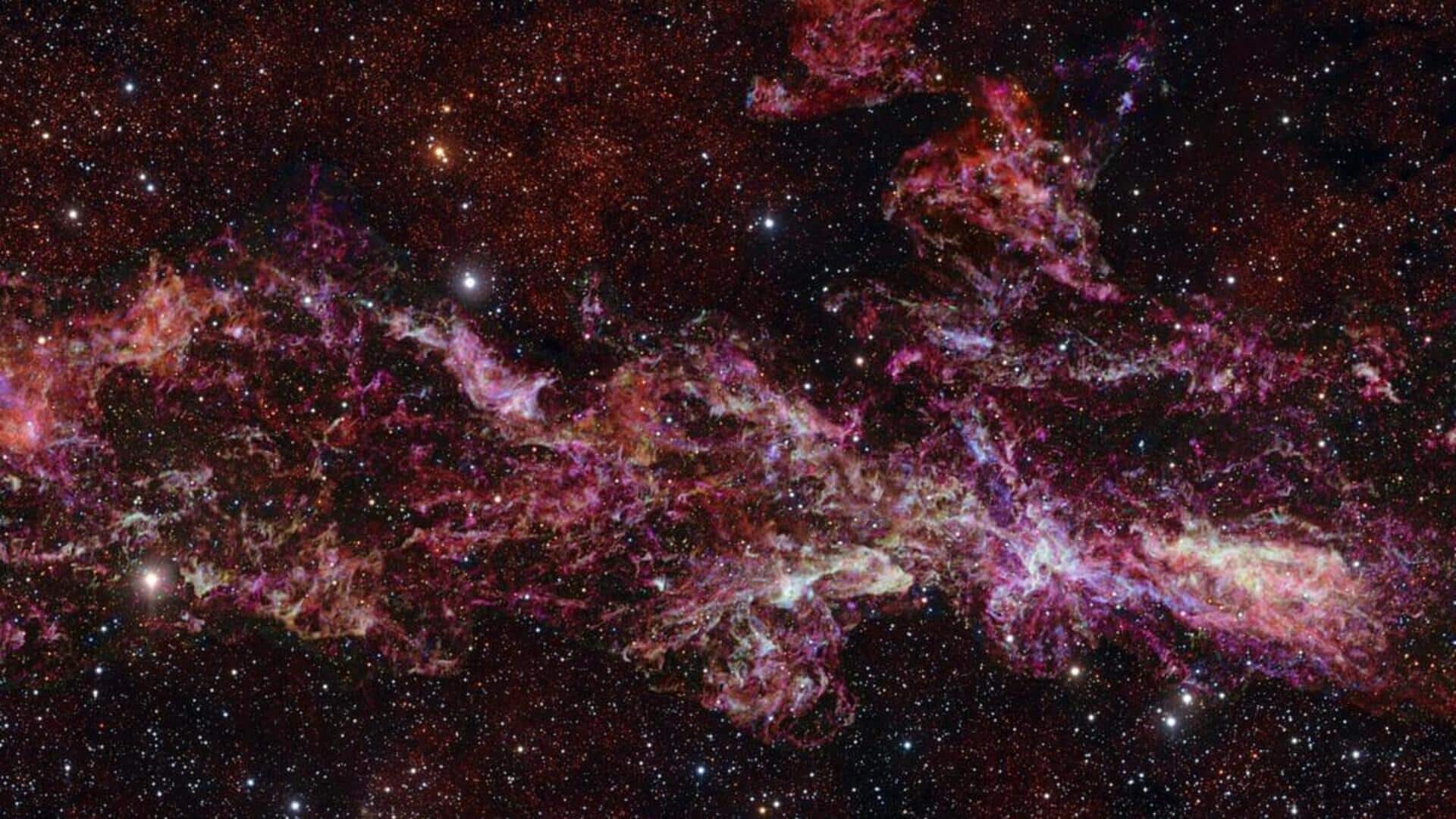
Astronomers have released an extraordinary image that captures the intricate heart of the Milky Way galaxy, revealing a complex tapestry of cosmic gas filaments around its central black hole. This remarkable view was made possible through data obtained from the Atacama Large Millimeter/submillimeter Array (ALMA) observatory, located in Chile. The image showcases the Central Molecular Zone (CMZ), a turbulent region spanning over 650 light-years, filled with cold molecular gas that serves as the building blocks for star formation.
For the first time, researchers have mapped this cold gas in unprecedented detail across the entire CMZ. “It’s a place of extremes, invisible to our eyes, but now revealed in extraordinary detail,” said Ashley Barnes from the European Southern Observatory (ESO). Barnes is part of an international research team focused on exploring this chaotic region.
The observations were conducted as part of the ALMA CMZ Exploration Survey (ACES), which is led by Steve Longmore from Liverpool John Moores University. This survey emphasizes the significance of cold molecular gas, which is essential for star formation. Utilizing ALMA’s advanced radio capabilities, scientists have detected a variety of molecules in this region, including silicon monoxide and complex organic compounds like methanol, acetone, and ethanol.
The dataset illustrates a sophisticated network of filaments that guide gas into dense clumps where stars initiate their formation. While the processes of star formation are understood in the more tranquil outskirts of the galaxy, conditions near the galactic center present a much more chaotic environment. The CMZ houses some of the Milky Way’s most massive stars, which burn intensely for a brief period before culminating in supernovae or even hypernovae.
Researchers propose that the CMZ mirrors the dynamic environments of early galaxies billions of years in the past. By examining star birth in such an intense setting, astronomers aim to refine existing models that explain how galaxies grow and evolve over time.
Groundbreaking Findings and Future Research
The expansive mosaic image was created by combining numerous individual observations, covering a sky area comparable to three full Moons placed side by side. The findings have been compiled into five papers that have been accepted for publication in the Monthly Notices of the Royal Astronomical Society, with another paper currently under review.
With planned enhancements to ALMA and the upcoming Extremely Large Telescope, astronomers assert that this groundbreaking survey is just the initial step in deeper investigations into the dynamic heart of our galaxy. The ongoing research promises to enhance our understanding of cosmic phenomena and the processes that shape our universe.

Albert Camus’ Insightful Quote on Human Identity Resurfaces

Drone Strikes and Missile Attacks Disrupt UAE Amid Rising Tensions

Japanese Yen Rises Sharply Against US Dollar Ahead of Key Decisions

Priyanka Chopra and Nick Jonas Avoid Near Miss en Route to Oscars

Gujarat Vaccinates Over 11 Lakh Infants in Major Health Drive

Alexandre Singh Wins Oscar, Celebrates Immigrant Heritage

Lok Sabha Speaker Issues Warning Over Placards in Parliament

Global Electrosurgical Devices Market Expands to $10.2 Billion by 2034

North Zone Dominates Cricket; SJAM-1 Shines in Table Tennis

SBI Announces QIP Floor Price at ₹811.05 Per Share

Cept Unveils ₹3.1 Crore Urban Mobility Plan for Sustainable Growth

New Blood Group Discovered in South Indian Woman at Rotary Centre

Konkani Cultural Organisation to Host Pearl Jubilee in Abu Dhabi

Torrential Rains Cause Flash Flooding in New York and New Jersey

Nothing Headphone 1 Review: A Bold Contender in Audio Design

Air India Crash Investigation Highlights Boeing Fuel Switch Concerns

Indian Stock Market Rebounds: Sensex and Nifty Rise After Four-Day Decline

Broad Advocates for Bowling Change Ahead of Final Test Against India
-
 World1 year ago
SBI Announces QIP Floor Price at ₹811.05 Per Share
-
 Lifestyle1 year ago
Cept Unveils ₹3.1 Crore Urban Mobility Plan for Sustainable Growth
-
 Science12 months ago
New Blood Group Discovered in South Indian Woman at Rotary Centre
-
 Top Stories1 year ago
Konkani Cultural Organisation to Host Pearl Jubilee in Abu Dhabi
-
 World1 year ago
Torrential Rains Cause Flash Flooding in New York and New Jersey
-
 Science1 year ago
Nothing Headphone 1 Review: A Bold Contender in Audio Design
-
 Top Stories1 year ago
Air India Crash Investigation Highlights Boeing Fuel Switch Concerns
-
 Business1 year ago
Indian Stock Market Rebounds: Sensex and Nifty Rise After Four-Day Decline
-
 Sports12 months ago
Broad Advocates for Bowling Change Ahead of Final Test Against India
-

 Sports12 months ago
Cristian Totti Retires at 19: Pressure of Fame Takes Toll
-

 Politics1 year ago
Abandoned Doberman Finds New Home After Journey to Prague
-

 Science12 months ago
Comparing Subscription Prices: Spotify, Apple Music, and YouTube Music in India