
Science
Engineers Unveil Self-Consuming Rocket Engine for Space Exploration

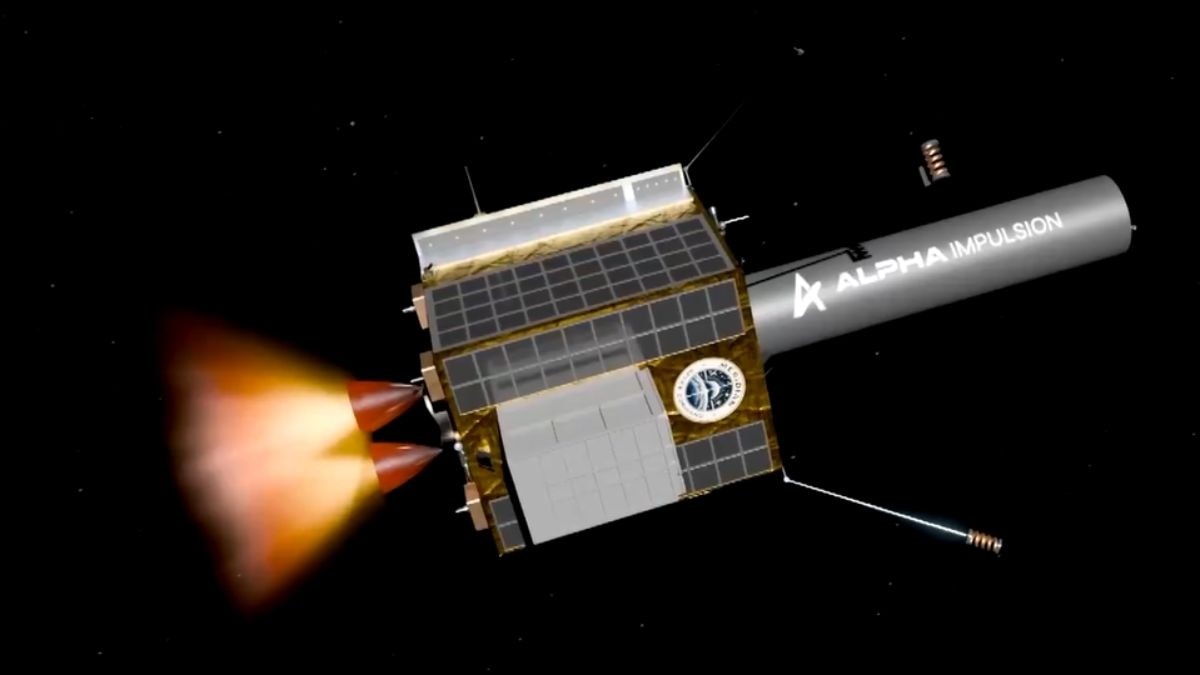
Engineers at the French-Italian startup Alpha Impulsion have developed a groundbreaking rocket engine that consumes its own structure to remain in flight. Known as an autophage engine, this innovative technology has the potential to transform space exploration by significantly reducing the weight of spacecraft, thereby making high-energy missions more affordable and efficient.
Traditionally, rockets face limitations imposed by the rocket equation, which necessitates carrying heavy fuel tanks that become redundant once depleted. The autophage engine addresses this challenge by utilizing a solid fuel rod, essentially a plastic tube filled with oxidizer, as part of its structure. As the engine operates, it gradually consumes this rod, converting its own fuselage into thrust. This unique mechanism allows the spacecraft to lose mass continuously, enhancing its efficiency as it travels.
Revolutionizing Space Missions
A video by Reuters highlights how this self-consuming engine enables spacecraft to achieve exotic orbits—pathways around Earth or other celestial bodies that have previously been considered too complex or costly for small-scale missions. The implications of this technology are particularly significant for countries like India, which has established itself as a leader in low-cost space exploration.
The autophage engine operates by pushing the fuel rod into a hot vaporizer. As the plastic melts and transforms into gas, it combines with the oxidizer and ignites, creating thrust. This process offers precise control over the engine’s power. By adjusting the speed at which the rod is fed into the engine, operators can effectively throttle thrust levels up or down as needed.
This innovation could prove essential for small satellites, or nanosats, which often contend with limited fuel capacities. By eliminating the need for bulky, separate fuel tanks, a self-consuming engine allows up to 90 percent of a rocket’s initial mass to be converted into energy, paving the way for more efficient missions to the Moon and Mars.
The Future of Deep Space Travel
While international organizations such as NASA have long sought solutions to make deep space travel sustainable, the introduction of the autophage engine presents a unique opportunity for advancing small satellite missions. The ability to consume its own structure not only reduces overall mass but also enhances the efficiency of space vehicles, making ambitious missions more feasible.
As space exploration continues to evolve, the developments spearheaded by Alpha Impulsion mark a significant step forward in the quest to explore the solar system. The potential for reduced costs and increased capabilities could open new frontiers in space, making once-unreachable destinations accessible for future generations.

Albert Camus’ Insightful Quote on Human Identity Resurfaces

Drone Strikes and Missile Attacks Disrupt UAE Amid Rising Tensions

Japanese Yen Rises Sharply Against US Dollar Ahead of Key Decisions

Priyanka Chopra and Nick Jonas Avoid Near Miss en Route to Oscars

Gujarat Vaccinates Over 11 Lakh Infants in Major Health Drive

Alexandre Singh Wins Oscar, Celebrates Immigrant Heritage

Lok Sabha Speaker Issues Warning Over Placards in Parliament

Global Electrosurgical Devices Market Expands to $10.2 Billion by 2034

North Zone Dominates Cricket; SJAM-1 Shines in Table Tennis

SBI Announces QIP Floor Price at ₹811.05 Per Share

Cept Unveils ₹3.1 Crore Urban Mobility Plan for Sustainable Growth

Comparing Subscription Prices: Spotify, Apple Music, and YouTube Music in India

New Blood Group Discovered in South Indian Woman at Rotary Centre

Konkani Cultural Organisation to Host Pearl Jubilee in Abu Dhabi

Torrential Rains Cause Flash Flooding in New York and New Jersey

Nothing Headphone 1 Review: A Bold Contender in Audio Design

Air India Crash Investigation Highlights Boeing Fuel Switch Concerns

Indian Stock Market Rebounds: Sensex and Nifty Rise After Four-Day Decline
-
 World1 year ago
SBI Announces QIP Floor Price at ₹811.05 Per Share
-
 Lifestyle1 year ago
Cept Unveils ₹3.1 Crore Urban Mobility Plan for Sustainable Growth
-
 Science12 months ago
Comparing Subscription Prices: Spotify, Apple Music, and YouTube Music in India
-
 Science12 months ago
New Blood Group Discovered in South Indian Woman at Rotary Centre
-
 Top Stories1 year ago
Konkani Cultural Organisation to Host Pearl Jubilee in Abu Dhabi
-
 World1 year ago
Torrential Rains Cause Flash Flooding in New York and New Jersey
-
 Science1 year ago
Nothing Headphone 1 Review: A Bold Contender in Audio Design
-
 Top Stories1 year ago
Air India Crash Investigation Highlights Boeing Fuel Switch Concerns
-
 Business1 year ago
Indian Stock Market Rebounds: Sensex and Nifty Rise After Four-Day Decline
-

 Sports12 months ago
Broad Advocates for Bowling Change Ahead of Final Test Against India
-

 Sports12 months ago
Cristian Totti Retires at 19: Pressure of Fame Takes Toll
-

 Politics1 year ago
Abandoned Doberman Finds New Home After Journey to Prague