
Science
Princeton Researchers Unveil Robotic Swarm That Blooms Like Flowers

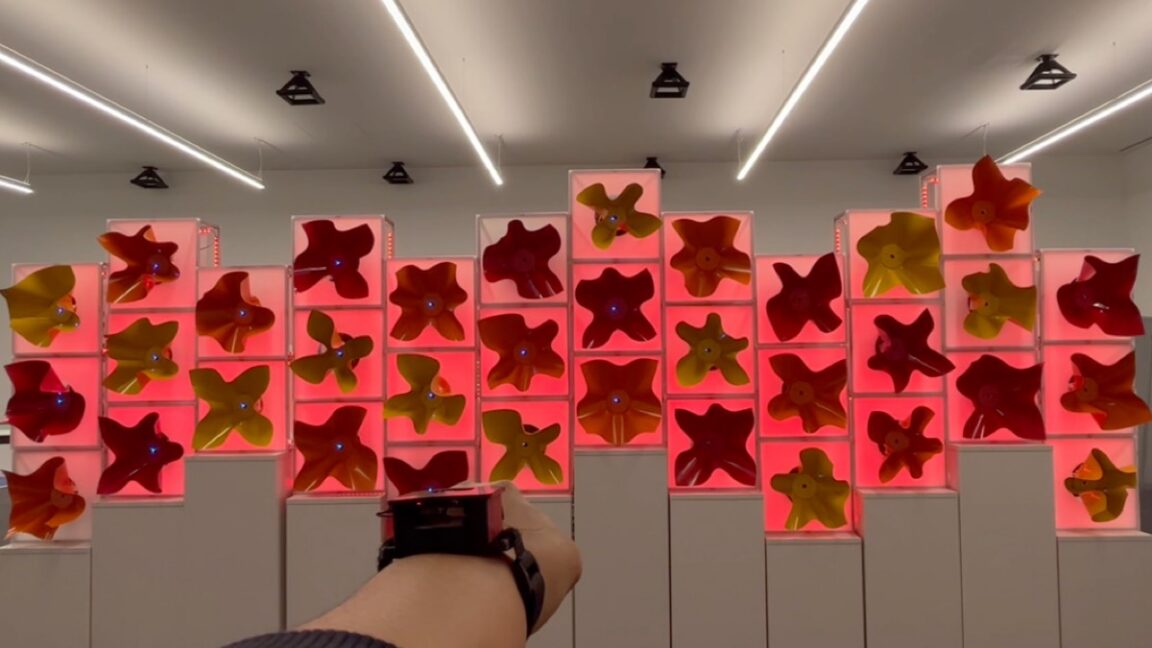
Researchers at Princeton University have developed an innovative swarm of mini-robots that can “bloom” like flowers in response to changing light levels. Their findings, published in the journal Science Robotics, suggest that these robotic swarms could be used in architectural designs, enabling buildings to adapt dynamically to climate conditions and interact creatively with occupants.
The study draws inspiration from “living architectures,” such as beehives and the behavior of fire ants. These creatures demonstrate remarkable collective behavior; when grouped closely, they function as a single entity, capable of both solid and liquid-like properties. For instance, fire ants can link together to form structures, such as floating rafts, which is crucial for survival during floods.
Researchers have long sought to replicate such systems. In 2018, scientists at Georgia Tech created ant-like robots programmed to navigate through magnetic plastic balls, simulating moist soil conditions. This technology has potential applications in mining and disaster recovery, where human involvement may not be feasible.
The authors highlight the contrast between plant adaptability and the static nature of human-made architecture. Plants optimize their shapes to maximize sunlight and nutrient absorption, while conventional buildings, often rigid and inflexible, limit occupants’ ability to respond to environmental changes.
Despite some existing projects that apply swarm intelligence inspired by nature—such as the Al Bahr Towers in Abu Dhabi—there is still a gap in integrating such technologies into dynamic architectural designs. The researchers aim to address this by exploring adaptive facades that utilize biological elements, such as algae panels for energy generation.
Introducing the Swarm Garden
Led by mechanical engineer Merihan Alhafnawi, the team developed a proof-of-concept project called the Swarm Garden. This setup comprises 40 modular robotic units, or SGbots, which communicate over a Wi-Fi network to facilitate collective decision-making. Each robot is equipped with ambient light sensors and proximity sensors, enabling them to respond to their environment and each other.
The Swarm Garden project included two case studies to showcase its capabilities. In the first, 16 SGbots were positioned on an office window, where they operated continuously for three days. The robots extended their plastic sheets to block sunlight during peak hours and retracted them as light levels decreased. Simulations indicated that this arrangement would also function effectively in atrium spaces.
The second case study focused on creative interior design. At a public exhibition in April 2024 at Princeton’s Lewis Center for the Arts, an array of 36 SGbots allowed visitors to interact directly with the technology. Attendees could use hand gestures to make the bots “bloom” or retract their sheets. Additionally, participants wearing wearable devices could trigger LED color changes through arm movements, enhancing interactivity. One co-author even performed a live dance while using a wearable device, further emphasizing the potential of this technology.
Future Prospects and Sustainability
The research team plans to collaborate with architects to assess the practical deployment of Swarm Garden arrays in real-world settings. They aim to explore the use of more sustainable materials, as the current plastic sheets experience significant stress during the blooming process. The authors also suggest that employing kirigami-inspired cuts could reduce the energy required for actuation.
In their concluding remarks, Alhafnawi and her co-authors envision a future where architectural designs are increasingly influenced by living systems. They state, “The Swarm Garden offers a glimpse into that future: an architectural swarm that collectively responds to sunlight and human interaction, enriching spaces through movement, color, and aesthetic appeal.”
This innovative approach not only promises a shift in architectural design but also offers a new way for buildings to interact with their inhabitants, ultimately fostering creativity and expression in urban environments.

Albert Camus’ Insightful Quote on Human Identity Resurfaces

Drone Strikes and Missile Attacks Disrupt UAE Amid Rising Tensions

Japanese Yen Rises Sharply Against US Dollar Ahead of Key Decisions

Priyanka Chopra and Nick Jonas Avoid Near Miss en Route to Oscars

Gujarat Vaccinates Over 11 Lakh Infants in Major Health Drive

Alexandre Singh Wins Oscar, Celebrates Immigrant Heritage

Lok Sabha Speaker Issues Warning Over Placards in Parliament

Global Electrosurgical Devices Market Expands to $10.2 Billion by 2034

North Zone Dominates Cricket; SJAM-1 Shines in Table Tennis

SBI Announces QIP Floor Price at ₹811.05 Per Share

Cept Unveils ₹3.1 Crore Urban Mobility Plan for Sustainable Growth

Comparing Subscription Prices: Spotify, Apple Music, and YouTube Music in India

New Blood Group Discovered in South Indian Woman at Rotary Centre

Konkani Cultural Organisation to Host Pearl Jubilee in Abu Dhabi

Torrential Rains Cause Flash Flooding in New York and New Jersey

Nothing Headphone 1 Review: A Bold Contender in Audio Design

Air India Crash Investigation Highlights Boeing Fuel Switch Concerns

Indian Stock Market Rebounds: Sensex and Nifty Rise After Four-Day Decline
-
 World1 year ago
SBI Announces QIP Floor Price at ₹811.05 Per Share
-
 Lifestyle1 year ago
Cept Unveils ₹3.1 Crore Urban Mobility Plan for Sustainable Growth
-
 Science12 months ago
Comparing Subscription Prices: Spotify, Apple Music, and YouTube Music in India
-
 Science12 months ago
New Blood Group Discovered in South Indian Woman at Rotary Centre
-
 Top Stories1 year ago
Konkani Cultural Organisation to Host Pearl Jubilee in Abu Dhabi
-
 World1 year ago
Torrential Rains Cause Flash Flooding in New York and New Jersey
-
 Science1 year ago
Nothing Headphone 1 Review: A Bold Contender in Audio Design
-
 Top Stories1 year ago
Air India Crash Investigation Highlights Boeing Fuel Switch Concerns
-
 Business1 year ago
Indian Stock Market Rebounds: Sensex and Nifty Rise After Four-Day Decline
-

 Sports12 months ago
Broad Advocates for Bowling Change Ahead of Final Test Against India
-

 Sports12 months ago
Cristian Totti Retires at 19: Pressure of Fame Takes Toll
-

 Politics1 year ago
Abandoned Doberman Finds New Home After Journey to Prague