
Top Stories
NanoFuse Composites Show Promising Advances in Bone Regeneration

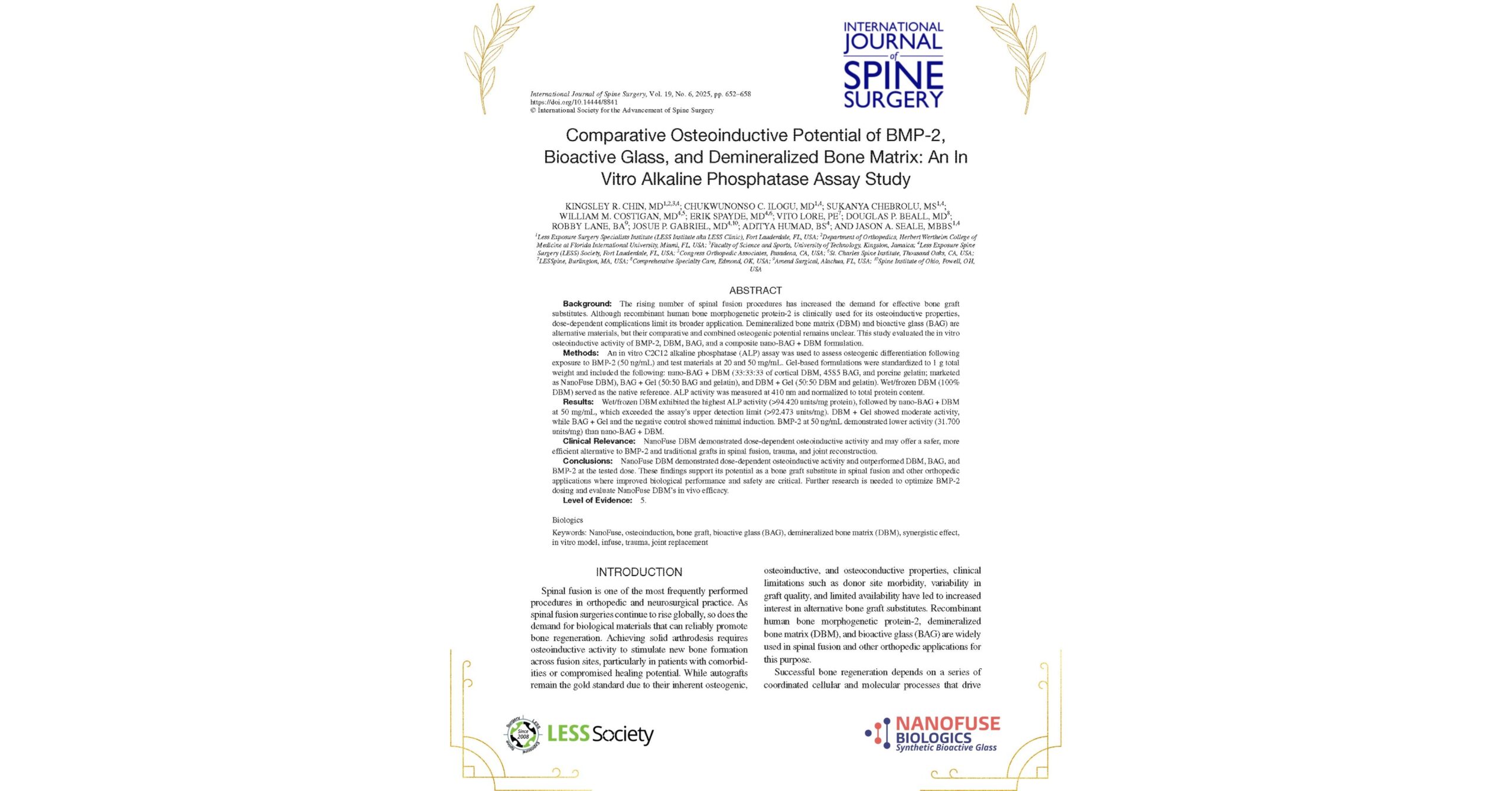
A recent peer-reviewed study published in the International Journal of Spine Surgery has revealed that the NanoFuse® bioactive glass–demineralized bone matrix (DBM) composite demonstrates superior osteoinductive activity compared to either DBM or bioactive glass alone. This breakthrough has significant implications for its application in spinal fusion procedures, offering a promising alternative in the field of bone regeneration.
The study, titled “Comparative Osteoinductive Potential of BMP-2, Bioactive Glass, and Demineralized Bone Matrix: An In Vitro Alkaline Phosphatase Assay Study,” appears in Volume 19, Issue 6, published in December 2025. It indicates that NanoFuse is the first bioactive glass–DBM composite shown to achieve enhanced osteoinductive synergy, a critical milestone for developing safer materials for spinal surgeries.
Study Insights and Methodology
The objective of the research was to assess how the release of bioactive ions influences early osteogenic differentiation when bioactive glass is positioned near DBM. While DBM is known for its osteoinductive properties, its biologic activity can vary significantly. In contrast, bioactive glass releases osteostimulatory ions but lacks the organic signaling matrix found in DBM.
The findings underscore that the NanoFuse composite produced significantly higher alkaline phosphatase activity, an essential marker of early osteoblastic differentiation, compared to either DBM or bioactive glass alone. This supports the rationale for using a composite approach in bone regeneration.
Dr. Martin Crous, PhD, a leading expert in osteobiologics research, remarked on the study’s importance, stating, “This study provides compelling evidence that bioactive ions released in proximity to DBM can significantly enhance osteoinductive signaling.” He emphasized that the findings suggest a potential for the composite to be more effective than DBM alone, offering a cost-effective and predictable alternative to growth-factor-based strategies.
Clinical Perspectives and Future Implications
Professor Kingsley R. Chin, MD, MBA, an orthopedic spinal surgeon and senior author of the study, highlighted the primary goal of the research. “The aim was to understand the biology rather than make commercial comparisons,” he stated. “The data clearly show that combining bioactive glass with DBM yields a stronger, more consistent early osteoinductive response than either material on its own.”
Dr. Erik Spayde, an orthopedic spine surgeon and coauthor, noted the clinical relevance of the findings. “As surgeons, we continuously balance biologic efficacy with safety,” Dr. Spayde explained. “These results reinforce our belief that materials-based biologics can deliver meaningful osteogenic activity without the risks associated with more aggressive interventions.”
Dr. William M. Costigan, MD, another coauthor, emphasized the importance of consistency in biologic performance. “One of the most compelling aspects of this study is the reliability of the osteoinductive response,” he stated. “Reducing variability is critical, especially as more fusion procedures move into outpatient settings.”
Vito Lore, coauthor and technology lead, pointed out that the demonstrated biologic performance is suitable for real-world clinical applications. “This technology has received FDA approval, is supplied in sterile packaging, and has a five-year shelf life,” he noted. These factors are essential for widespread clinical adoption, enabling efficient distribution and application in various surgical environments without compromising biologic integrity.
The implications of this research extend beyond the laboratory. As the medical community continues to explore safer and more effective solutions for spinal fusion, the findings from this study add to a growing body of evidence supporting materials-based osteoinduction as a viable strategy for bone regeneration.
The study evaluated osteoinductive activity using a well-established in vitro C2C12 alkaline phosphatase assay, allowing for a direct comparison of osteogenic differentiation across materials under controlled conditions.
As NanoFuse Biologics continues to develop next-generation synthetic biologics, the company is committed to building a robust foundation of peer-reviewed evidence that underscores its role in modern spine care and bone regeneration.

Albert Camus’ Insightful Quote on Human Identity Resurfaces

Drone Strikes and Missile Attacks Disrupt UAE Amid Rising Tensions

Japanese Yen Rises Sharply Against US Dollar Ahead of Key Decisions

Priyanka Chopra and Nick Jonas Avoid Near Miss en Route to Oscars

Gujarat Vaccinates Over 11 Lakh Infants in Major Health Drive

Alexandre Singh Wins Oscar, Celebrates Immigrant Heritage

Lok Sabha Speaker Issues Warning Over Placards in Parliament

Global Electrosurgical Devices Market Expands to $10.2 Billion by 2034

North Zone Dominates Cricket; SJAM-1 Shines in Table Tennis

SBI Announces QIP Floor Price at ₹811.05 Per Share

Cept Unveils ₹3.1 Crore Urban Mobility Plan for Sustainable Growth

Comparing Subscription Prices: Spotify, Apple Music, and YouTube Music in India

New Blood Group Discovered in South Indian Woman at Rotary Centre

Konkani Cultural Organisation to Host Pearl Jubilee in Abu Dhabi

Torrential Rains Cause Flash Flooding in New York and New Jersey

Nothing Headphone 1 Review: A Bold Contender in Audio Design

Air India Crash Investigation Highlights Boeing Fuel Switch Concerns

Indian Stock Market Rebounds: Sensex and Nifty Rise After Four-Day Decline
-
 World1 year ago
SBI Announces QIP Floor Price at ₹811.05 Per Share
-
 Lifestyle1 year ago
Cept Unveils ₹3.1 Crore Urban Mobility Plan for Sustainable Growth
-
 Science12 months ago
Comparing Subscription Prices: Spotify, Apple Music, and YouTube Music in India
-
 Science12 months ago
New Blood Group Discovered in South Indian Woman at Rotary Centre
-
 Top Stories1 year ago
Konkani Cultural Organisation to Host Pearl Jubilee in Abu Dhabi
-
 World1 year ago
Torrential Rains Cause Flash Flooding in New York and New Jersey
-
 Science1 year ago
Nothing Headphone 1 Review: A Bold Contender in Audio Design
-
 Top Stories1 year ago
Air India Crash Investigation Highlights Boeing Fuel Switch Concerns
-
 Business1 year ago
Indian Stock Market Rebounds: Sensex and Nifty Rise After Four-Day Decline
-

 Sports12 months ago
Broad Advocates for Bowling Change Ahead of Final Test Against India
-

 Sports12 months ago
Cristian Totti Retires at 19: Pressure of Fame Takes Toll
-

 Politics1 year ago
Abandoned Doberman Finds New Home After Journey to Prague