
Top Stories
India and US Set to Sign Key Trade Agreement by Mid-March

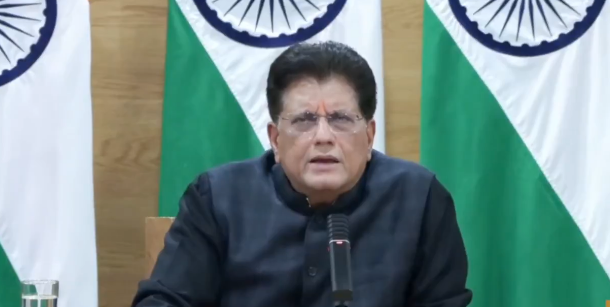
The governments of India and the United States are poised to sign a significant bilateral trade agreement by mid-March, according to Piyush Goyal, India’s Minister of Commerce and Industry. The first tranche of this agreement will lead to a reduction in import duties on Indian goods entering the US, enhancing trade relations between the two countries.
During a press briefing in New Delhi, Goyal indicated that the two nations expect to finalize and sign a joint statement on the agreement within the next four to five days. Following this, tariffs imposed by the US on Indian imports will decrease to 18 percent. Currently, Indian goods face a 50 percent import duty, which includes a 25 percent reciprocal tariff and an additional 25 percent levy aimed at penalizing purchases of Russian crude oil.
Details of the Trade Agreement
Goyal emphasized that the first tranche of this bilateral trade agreement (BTA) is nearly complete. He stated, “We expect that in the next 4-5 days, we will finalize and sign a joint statement between the US and India. Based on that, the first phase of this partnership will begin.” The formal agreement is expected to be drafted within a month to a month and a half, with the aim of being signed by March 15, 2024.
The reduction of tariffs to 18 percent will be enacted through an executive order from the US government, set to take effect shortly after the joint statement is signed. Goyal clarified that this agreement does not entail any investment commitments, while Rajesh Agrawal, Commerce Secretary, noted that the legal framework will empower India to lower tariffs on US goods.
Agrawal explained, “Indian tariff reductions will happen only after a legal agreement,” specifying that Indian tariffs are classified as Most Favoured Nation (MFN) levies, while US import duties are executive tariffs. Goyal mentioned, “We hope to do things fast because there are further concessions that we will get after the legal agreement.”
Future Trade Prospects
In discussing the anticipated trade volume, Goyal projected a target of USD 500 billion in purchases from the US, driven by India’s rapid growth rates. He outlined that the country will require substantial quantities of energy, data center equipment, and information and communication technology products to sustain this growth.
“Our steel capacity is going to double from today’s 140 million tonnes to about 300 million tonnes in the next few years,” Goyal stated, revealing that the projected need for imports from the US is substantial. He highlighted India’s aircraft demand, with current orders placed on Boeing reaching nearly USD 70-80 billion, potentially exceeding USD 100 billion when including engines and spare parts. Additionally, significant investments in data centers are expected, which will drive equipment procurement.
To achieve the USD 500 billion bilateral trade target set for February 2025, Goyal emphasized that India must enhance its exports and strengthen sourcing from the US. Agrawal noted that India’s current global purchases exceed USD 300 billion, and the US is well-positioned to supply a variety of goods, including oil, liquefied petroleum gas (LPG), liquefied natural gas (LNG), aircraft, ICT products, laptops, smartphones, and data center equipment.
As the two countries prepare to sign the joint statement virtually, the implications of this trade agreement could significantly reshape the economic landscape for both nations, fostering deeper ties and mutual benefits in trade.

Albert Camus’ Insightful Quote on Human Identity Resurfaces

Drone Strikes and Missile Attacks Disrupt UAE Amid Rising Tensions

Japanese Yen Rises Sharply Against US Dollar Ahead of Key Decisions

Priyanka Chopra and Nick Jonas Avoid Near Miss en Route to Oscars

Gujarat Vaccinates Over 11 Lakh Infants in Major Health Drive

Alexandre Singh Wins Oscar, Celebrates Immigrant Heritage

Lok Sabha Speaker Issues Warning Over Placards in Parliament

Global Electrosurgical Devices Market Expands to $10.2 Billion by 2034

North Zone Dominates Cricket; SJAM-1 Shines in Table Tennis

SBI Announces QIP Floor Price at ₹811.05 Per Share

Cept Unveils ₹3.1 Crore Urban Mobility Plan for Sustainable Growth

Comparing Subscription Prices: Spotify, Apple Music, and YouTube Music in India

New Blood Group Discovered in South Indian Woman at Rotary Centre

Konkani Cultural Organisation to Host Pearl Jubilee in Abu Dhabi

Torrential Rains Cause Flash Flooding in New York and New Jersey

Nothing Headphone 1 Review: A Bold Contender in Audio Design

Broad Advocates for Bowling Change Ahead of Final Test Against India

Air India Crash Investigation Highlights Boeing Fuel Switch Concerns
-
 World1 year ago
SBI Announces QIP Floor Price at ₹811.05 Per Share
-
 Lifestyle1 year ago
Cept Unveils ₹3.1 Crore Urban Mobility Plan for Sustainable Growth
-
 Science12 months ago
Comparing Subscription Prices: Spotify, Apple Music, and YouTube Music in India
-
 Science1 year ago
New Blood Group Discovered in South Indian Woman at Rotary Centre
-
 Top Stories1 year ago
Konkani Cultural Organisation to Host Pearl Jubilee in Abu Dhabi
-
 World1 year ago
Torrential Rains Cause Flash Flooding in New York and New Jersey
-
 Science1 year ago
Nothing Headphone 1 Review: A Bold Contender in Audio Design
-
 Sports1 year ago
Broad Advocates for Bowling Change Ahead of Final Test Against India
-
 Top Stories1 year ago
Air India Crash Investigation Highlights Boeing Fuel Switch Concerns
-

 Business1 year ago
Indian Stock Market Rebounds: Sensex and Nifty Rise After Four-Day Decline
-

 Sports1 year ago
Cristian Totti Retires at 19: Pressure of Fame Takes Toll
-

 Politics1 year ago
Abandoned Doberman Finds New Home After Journey to Prague