
Science
Scientists Uncover Manganese Blue in Jackson Pollock’s Artwork

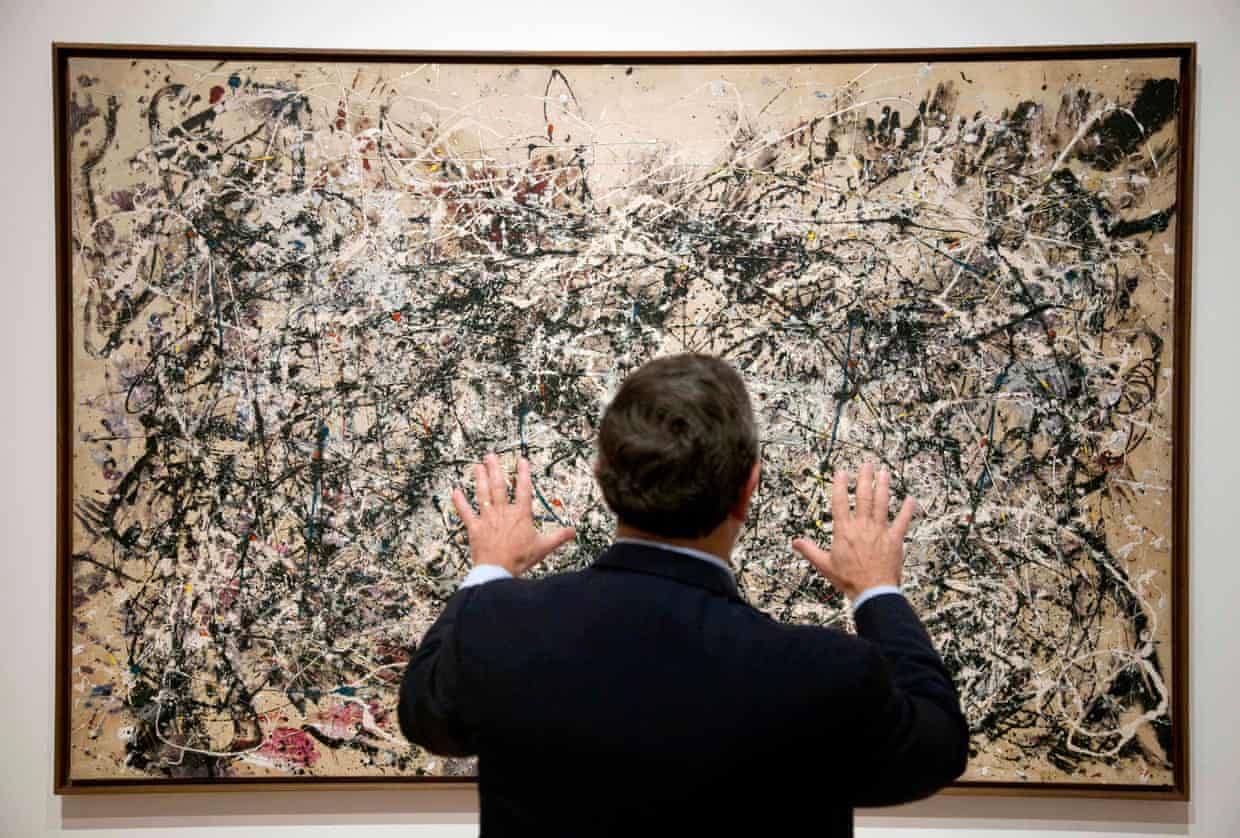
Scientists have made a significant discovery regarding the blue color used in one of Jackson Pollock’s iconic paintings, revealing that the artist employed a synthetic pigment known as manganese blue. This finding, confirmed through advanced chemical analysis, marks the first time the specific origin of this vibrant hue has been documented.
The artwork in question, titled Number 1A, 1948, is currently displayed at the Museum of Modern Art in New York. The painting features Pollock’s characteristic style, with paint dripped and splattered across a canvas measuring almost 9 feet (approximately 2.7 metersProceedings of the National Academy of Sciences, researchers took scrapings of the blue paint and utilized lasers to analyze the light scattered by the paint’s molecules. This technique enabled them to create a unique chemical fingerprint for the color, confirming it as manganese blue.
Edward Solomon, a professor at Stanford University and co-author of the study, expressed the importance of understanding the molecular origins of such striking colors. “It’s really interesting to understand where some striking color comes from on a molecular level,” he stated.
Manganese blue, once popular among artists and also used to color swimming pool cement, was phased out by the 1990s due to environmental concerns. While previous research had suggested the potential use of this pigment in Pollock’s work, the new study provides definitive evidence by analyzing samples directly from the canvas. Gene Hall, a researcher from Rutgers University who has studied Pollock’s paintings, noted, “I’m pretty convinced that it could be manganese blue.”
The research team went further by examining the chemical structure of the pigment to understand how it produces such a vivid shade. Scientists often study the chemical composition of art materials to aid in the conservation of old paintings and to detect forgeries. Pollock’s technique, which frequently involved pouring paint directly onto the canvas rather than mixing it on a palette, allows for more precise sampling.
To unravel this artistic mystery, the researchers employed a variety of scientific tools, paralleling Pollock’s own methods of alternating techniques, such as dripping paint using a stick or applying it directly from the can. While the chaotic appearance of Pollock’s work often leads to interpretations of randomness, study co-author Abed Haddad, an assistant conservation scientist at the Museum of Modern Art, clarified that Pollock viewed his artistry as methodical. “I actually see a lot of similarities between the way that we worked and the way that Jackson Pollock worked on the painting,” Haddad remarked.
This study not only sheds light on Pollock’s artistic choices but also underscores the intersection of art and science, demonstrating how modern techniques can enhance our understanding of historical artworks. Through this research, the legacy of Jackson Pollock continues to be explored and appreciated, reminding us of the vibrant colors that define his work.

Albert Camus’ Insightful Quote on Human Identity Resurfaces

Drone Strikes and Missile Attacks Disrupt UAE Amid Rising Tensions

Japanese Yen Rises Sharply Against US Dollar Ahead of Key Decisions

Priyanka Chopra and Nick Jonas Avoid Near Miss en Route to Oscars

Gujarat Vaccinates Over 11 Lakh Infants in Major Health Drive

Alexandre Singh Wins Oscar, Celebrates Immigrant Heritage

Lok Sabha Speaker Issues Warning Over Placards in Parliament

Global Electrosurgical Devices Market Expands to $10.2 Billion by 2034

North Zone Dominates Cricket; SJAM-1 Shines in Table Tennis

SBI Announces QIP Floor Price at ₹811.05 Per Share

Cept Unveils ₹3.1 Crore Urban Mobility Plan for Sustainable Growth

Comparing Subscription Prices: Spotify, Apple Music, and YouTube Music in India

New Blood Group Discovered in South Indian Woman at Rotary Centre

Konkani Cultural Organisation to Host Pearl Jubilee in Abu Dhabi

Torrential Rains Cause Flash Flooding in New York and New Jersey

Nothing Headphone 1 Review: A Bold Contender in Audio Design

Air India Crash Investigation Highlights Boeing Fuel Switch Concerns

Broad Advocates for Bowling Change Ahead of Final Test Against India
-
 World1 year ago
SBI Announces QIP Floor Price at ₹811.05 Per Share
-
 Lifestyle1 year ago
Cept Unveils ₹3.1 Crore Urban Mobility Plan for Sustainable Growth
-
 Science1 year ago
Comparing Subscription Prices: Spotify, Apple Music, and YouTube Music in India
-
 Science1 year ago
New Blood Group Discovered in South Indian Woman at Rotary Centre
-
 Top Stories1 year ago
Konkani Cultural Organisation to Host Pearl Jubilee in Abu Dhabi
-
 World1 year ago
Torrential Rains Cause Flash Flooding in New York and New Jersey
-
 Science1 year ago
Nothing Headphone 1 Review: A Bold Contender in Audio Design
-
 Top Stories1 year ago
Air India Crash Investigation Highlights Boeing Fuel Switch Concerns
-
 Sports1 year ago
Broad Advocates for Bowling Change Ahead of Final Test Against India
-

 Business1 year ago
Indian Stock Market Rebounds: Sensex and Nifty Rise After Four-Day Decline
-

 Sports1 year ago
Cristian Totti Retires at 19: Pressure of Fame Takes Toll
-

 Politics1 year ago
Abandoned Doberman Finds New Home After Journey to Prague