
Science
James Watson, Pioneering DNA Scientist, Passes Away at 97

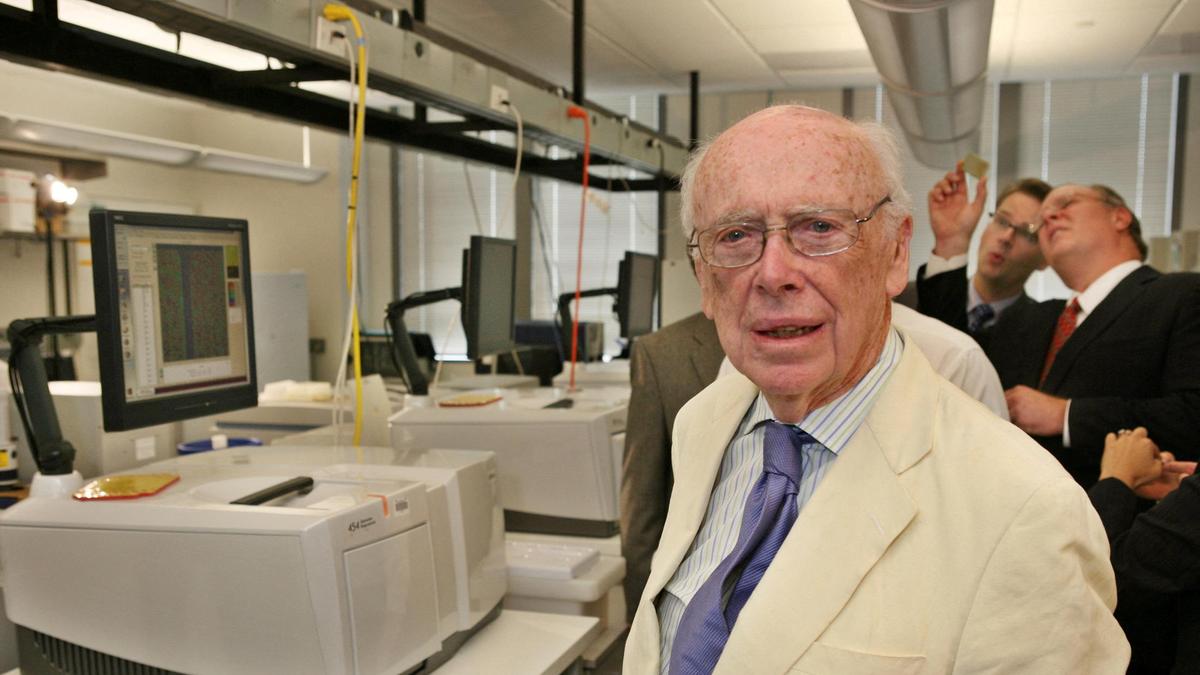
James Watson, the Nobel Prize-winning biologist renowned for his role in discovering the structure of DNA, has died at the age of 97. His passing was announced by the Cold Spring Harbor Laboratory on November 7, 2025. Watson died on Thursday while receiving hospice care on Long Island, New York, marking the end of a complex legacy that intertwined significant scientific achievement with controversial personal views.
Watson’s Scientific Contributions
Watson’s most notable achievement came in 1953 when he and his research partner, Francis Crick, unveiled the double-helix structure of DNA. This groundbreaking discovery, made with the assistance of X-ray images from Rosalind Franklin and Maurice Wilkins, revolutionized biology and paved the way for advancements in genetics, medicine, and forensics. Their work not only earned them the Nobel Prize in Physiology or Medicine in 1962 but also transformed our understanding of genetic coding and protein synthesis.
Born on April 6, 1928, in Chicago, Illinois, Watson demonstrated academic promise early on, winning a scholarship to the University of Chicago at 15. He completed his degree in zoology in 1947 and later earned his Ph.D. from Indiana University in 1950. His fascination with DNA’s structure began during his time in Europe, specifically at the University of Cambridge and later in Copenhagen.
Watson and Crick’s iconic model of DNA, resembling a twisting ladder, provided insights into how DNA can replicate, answering a fundamental question in genetics. Their findings were published in the journal Nature in April-May 1953, receiving widespread acclaim.
Controversies and Retirement
Despite his monumental contributions to science, Watson’s later years were marred by controversy due to his statements on race and intelligence. In an interview with The Sunday Times, he expressed troubling views, suggesting that intelligence levels differ among races. These remarks led to significant backlash and eventually resulted in his retirement from public life in 2007. The Cold Spring Harbor Laboratory distanced itself from Watson in 2020, stripping him of his emeritus status following further statements that reignited criticism.
Beyond his controversial remarks, Watson’s scientific career continued to evolve. He served as a professor at Harvard University for fifteen years and later became the director of Cold Spring Harbor Laboratory, transforming it into a leading center for molecular biology research. From 1988 to 1992, he played a pivotal role in the Human Genome Project, overseeing the mapping of genes in human chromosomes.
Watson’s legacy is undeniably significant, characterized by both his groundbreaking scientific achievements and his problematic views. He leaves behind a complex legacy that continues to evoke discussion in both scientific and ethical domains.

Albert Camus’ Insightful Quote on Human Identity Resurfaces

Drone Strikes and Missile Attacks Disrupt UAE Amid Rising Tensions

Japanese Yen Rises Sharply Against US Dollar Ahead of Key Decisions

Priyanka Chopra and Nick Jonas Avoid Near Miss en Route to Oscars

Gujarat Vaccinates Over 11 Lakh Infants in Major Health Drive

Alexandre Singh Wins Oscar, Celebrates Immigrant Heritage

Lok Sabha Speaker Issues Warning Over Placards in Parliament

Global Electrosurgical Devices Market Expands to $10.2 Billion by 2034

North Zone Dominates Cricket; SJAM-1 Shines in Table Tennis

SBI Announces QIP Floor Price at ₹811.05 Per Share

Cept Unveils ₹3.1 Crore Urban Mobility Plan for Sustainable Growth

Comparing Subscription Prices: Spotify, Apple Music, and YouTube Music in India

New Blood Group Discovered in South Indian Woman at Rotary Centre

Konkani Cultural Organisation to Host Pearl Jubilee in Abu Dhabi

Torrential Rains Cause Flash Flooding in New York and New Jersey

Nothing Headphone 1 Review: A Bold Contender in Audio Design

Air India Crash Investigation Highlights Boeing Fuel Switch Concerns

Broad Advocates for Bowling Change Ahead of Final Test Against India
-
 World1 year ago
SBI Announces QIP Floor Price at ₹811.05 Per Share
-
 Lifestyle1 year ago
Cept Unveils ₹3.1 Crore Urban Mobility Plan for Sustainable Growth
-
 Science1 year ago
Comparing Subscription Prices: Spotify, Apple Music, and YouTube Music in India
-
 Science1 year ago
New Blood Group Discovered in South Indian Woman at Rotary Centre
-
 Top Stories1 year ago
Konkani Cultural Organisation to Host Pearl Jubilee in Abu Dhabi
-
 World1 year ago
Torrential Rains Cause Flash Flooding in New York and New Jersey
-
 Science1 year ago
Nothing Headphone 1 Review: A Bold Contender in Audio Design
-
 Top Stories1 year ago
Air India Crash Investigation Highlights Boeing Fuel Switch Concerns
-
 Sports1 year ago
Broad Advocates for Bowling Change Ahead of Final Test Against India
-

 Business1 year ago
Indian Stock Market Rebounds: Sensex and Nifty Rise After Four-Day Decline
-

 Sports1 year ago
Cristian Totti Retires at 19: Pressure of Fame Takes Toll
-

 Politics1 year ago
Abandoned Doberman Finds New Home After Journey to Prague