
Science
ISRO Advances Mega Rocket Development for Lunar Missions

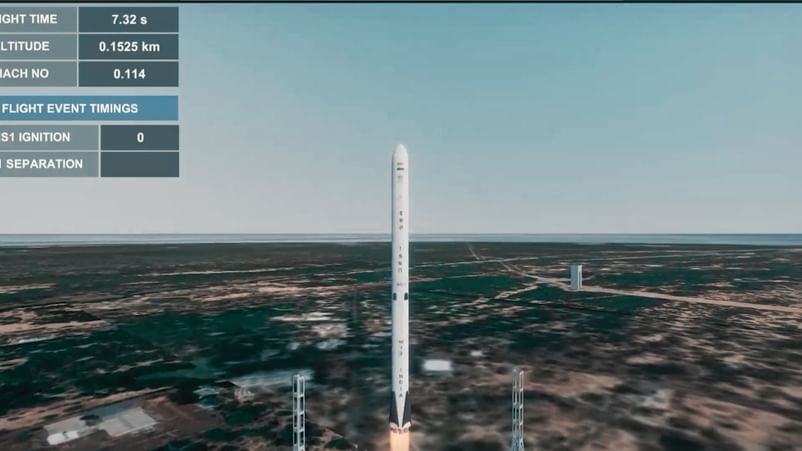
The Indian Space Research Organisation (ISRO) has confirmed the development of two significant rocket projects, the Next Generation Launch Vehicle (NGLV) and the Large Moon Launch Vehicle (LMLV). This announcement was made by ISRO Chairman V Narayanan during the Emerging Science, Technology and Innovation Conclave (ESTIC 2025) held at ISRO headquarters in Bengaluru.
Narayanan highlighted the evolution of India’s launch capabilities, stating, “Our first launch vehicle had a capability of only 35 kg, which we successfully accomplished in 1980. Today, we are discussing something around 30,000 kg to Low Earth Orbit through the next generation launcher.” The NGLV design features a reusable first-stage booster, a move that received approval from the Union Cabinet last year.
The Chairman elaborated on the ambitious plans for the LMLV, which is intended to support India’s future crewed lunar missions. “The honorable Prime Minister has provided guidelines for building a launcher capable of lifting between 75,000 kg and 80,000 kg. We are still in the conceptual phase; the design has not yet been finalized,” he said. The LMLV is envisioned as a towering structure, approximately 100 meters tall, with a liftoff mass ranging from 2,600 to 3,000 tons and a diameter of 6.5 meters.
The rocket’s first stage will utilize a cluster of seven LOX-Methane engines, complemented by strap-on boosters. The second stage is set to feature two LOX-Methane engines, along with a cryogenic upper stage powered by two LOX-LH2 engines.
ISRO’s mission to the Moon will utilize the LMLV as the heaviest rocket in its fleet, designed to inject 31,000 kg into translunar orbit. The plan includes deploying two of these super heavy-lift rockets for the lunar mission, with one carrying the Earth Departing Stage (EDS) and the other transporting a stack comprising the Crew Module, Support Module, and Lunar Module.
Upon reaching lunar orbit, the Gaganyatris, or crew members, will transfer from the Crew Module to the lander, conduct surface exploration, and then return to the Crew Module, discarding the Lunar Module before heading back to Earth. ISRO aims to send a crewed orbiter and two uncrewed landers between 2036 and 2040, followed by a crewed lunar mission scheduled for 2040.
This development signifies a major leap for India’s space exploration efforts, marking a pivotal moment in the nation’s journey toward lunar exploration and beyond.

Albert Camus’ Insightful Quote on Human Identity Resurfaces

Drone Strikes and Missile Attacks Disrupt UAE Amid Rising Tensions

Japanese Yen Rises Sharply Against US Dollar Ahead of Key Decisions

Priyanka Chopra and Nick Jonas Avoid Near Miss en Route to Oscars

Gujarat Vaccinates Over 11 Lakh Infants in Major Health Drive

Alexandre Singh Wins Oscar, Celebrates Immigrant Heritage

Lok Sabha Speaker Issues Warning Over Placards in Parliament

Global Electrosurgical Devices Market Expands to $10.2 Billion by 2034

North Zone Dominates Cricket; SJAM-1 Shines in Table Tennis

SBI Announces QIP Floor Price at ₹811.05 Per Share

Cept Unveils ₹3.1 Crore Urban Mobility Plan for Sustainable Growth

Comparing Subscription Prices: Spotify, Apple Music, and YouTube Music in India

New Blood Group Discovered in South Indian Woman at Rotary Centre

Konkani Cultural Organisation to Host Pearl Jubilee in Abu Dhabi

Torrential Rains Cause Flash Flooding in New York and New Jersey

Nothing Headphone 1 Review: A Bold Contender in Audio Design

Broad Advocates for Bowling Change Ahead of Final Test Against India

Air India Crash Investigation Highlights Boeing Fuel Switch Concerns
-
 World1 year ago
SBI Announces QIP Floor Price at ₹811.05 Per Share
-
 Lifestyle1 year ago
Cept Unveils ₹3.1 Crore Urban Mobility Plan for Sustainable Growth
-
 Science12 months ago
Comparing Subscription Prices: Spotify, Apple Music, and YouTube Music in India
-
 Science1 year ago
New Blood Group Discovered in South Indian Woman at Rotary Centre
-
 Top Stories1 year ago
Konkani Cultural Organisation to Host Pearl Jubilee in Abu Dhabi
-
 World1 year ago
Torrential Rains Cause Flash Flooding in New York and New Jersey
-
 Science1 year ago
Nothing Headphone 1 Review: A Bold Contender in Audio Design
-
 Sports1 year ago
Broad Advocates for Bowling Change Ahead of Final Test Against India
-
 Top Stories1 year ago
Air India Crash Investigation Highlights Boeing Fuel Switch Concerns
-

 Business1 year ago
Indian Stock Market Rebounds: Sensex and Nifty Rise After Four-Day Decline
-

 Sports1 year ago
Cristian Totti Retires at 19: Pressure of Fame Takes Toll
-

 Politics1 year ago
Abandoned Doberman Finds New Home After Journey to Prague