
Politics
Punjab and Haryana High Court Rejects Pension Cuts for Lokayuktas

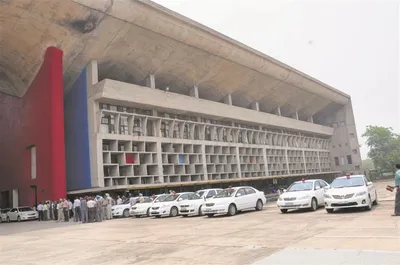
The Punjab and Haryana High Court has invalidated the Haryana government’s decision to reduce pensions from the salaries of former judges appointed as Lokayuktas. This ruling reinforces that pensions earned as retired High Court judges are constitutional rights that cannot be diminished or “neutralised.”
Justice Sandeep Moudgil presided over the case and emphasized that the Haryana Lokayukta Act of 2002 establishes the salary for Lokayuktas equivalent to that of a sitting High Court judge, with no provisions allowing for pension deductions. The court found the state’s action unconstitutional, discriminatory, and untenable. As a result, it directed the government to release full arrears along with interest.
The ruling stemmed from a writ petition filed by Justice NK Sud and another former judge who had served as Lokayuktas for fixed five-year terms. They challenged an order issued on August 18, 2022, in which the state refused to pay their full salary, citing pension deductions.
In his ruling, Justice Moudgil posed a critical question: “Could the pension drawn by the petitioners be legally deducted from the salary during their tenure as Lokayuktas under the Haryana Lokayukta Act, 2002?” He clarified that this issue transcended mere administrative concerns and was fundamentally a matter of constitutional law.
The court found that the state lacked authority to make such deductions. Justice Moudgil stated, “Where the Constitution and a parliamentary enactment occupy the field, the executive interpretation must yield.” He highlighted that the critical issue was not whether the petitioners received a “double benefit,” but whether the law permitted the state to infringe upon a constitutionally protected entitlement.
Rejecting the state’s arguments, Justice Moudgil declared that a judge’s pension is not merely a concession. “The pension payable to a retired High Court Judge is a vested and indefeasible right accruing from past constitutional service,” he asserted, emphasizing that it should not be linked to subsequent remuneration unless explicitly stated by law.
Justice Moudgil further warned that allowing pension deductions would directly contravene constitutional protections. He dismissed the state’s comparison of this situation to government re-employment, stating, “Appointment as a Judge of the High Court is a constitutional appointment and not a service under the government.” The principles applicable to state employees cannot be applied mechanically to judicial appointments.
He concluded that deducing pensions would amount to “doing indirectly what is impermissible directly,” violating Section 6(5) of the Act. The court found the state’s claim of financial burden or double benefit to be legally unsound. Consequently, Justice Moudgil ordered the government to pay all consequential arrears, along with interest at a rate of 6 percent, within four weeks.
This ruling underscores the judiciary’s commitment to upholding constitutional rights and ensuring that retired judges receive their entitled benefits without unwarranted deductions.

Albert Camus’ Insightful Quote on Human Identity Resurfaces

Drone Strikes and Missile Attacks Disrupt UAE Amid Rising Tensions

Japanese Yen Rises Sharply Against US Dollar Ahead of Key Decisions

Priyanka Chopra and Nick Jonas Avoid Near Miss en Route to Oscars

Gujarat Vaccinates Over 11 Lakh Infants in Major Health Drive

Alexandre Singh Wins Oscar, Celebrates Immigrant Heritage

Lok Sabha Speaker Issues Warning Over Placards in Parliament

Global Electrosurgical Devices Market Expands to $10.2 Billion by 2034

North Zone Dominates Cricket; SJAM-1 Shines in Table Tennis

SBI Announces QIP Floor Price at ₹811.05 Per Share

Cept Unveils ₹3.1 Crore Urban Mobility Plan for Sustainable Growth

Comparing Subscription Prices: Spotify, Apple Music, and YouTube Music in India

New Blood Group Discovered in South Indian Woman at Rotary Centre

Konkani Cultural Organisation to Host Pearl Jubilee in Abu Dhabi

Torrential Rains Cause Flash Flooding in New York and New Jersey

Nothing Headphone 1 Review: A Bold Contender in Audio Design

Air India Crash Investigation Highlights Boeing Fuel Switch Concerns

Broad Advocates for Bowling Change Ahead of Final Test Against India
-
 World1 year ago
SBI Announces QIP Floor Price at ₹811.05 Per Share
-
 Lifestyle1 year ago
Cept Unveils ₹3.1 Crore Urban Mobility Plan for Sustainable Growth
-
 Science1 year ago
Comparing Subscription Prices: Spotify, Apple Music, and YouTube Music in India
-
 Science1 year ago
New Blood Group Discovered in South Indian Woman at Rotary Centre
-
 Top Stories1 year ago
Konkani Cultural Organisation to Host Pearl Jubilee in Abu Dhabi
-
 World1 year ago
Torrential Rains Cause Flash Flooding in New York and New Jersey
-
 Science1 year ago
Nothing Headphone 1 Review: A Bold Contender in Audio Design
-
 Top Stories1 year ago
Air India Crash Investigation Highlights Boeing Fuel Switch Concerns
-
 Sports1 year ago
Broad Advocates for Bowling Change Ahead of Final Test Against India
-

 Business1 year ago
Indian Stock Market Rebounds: Sensex and Nifty Rise After Four-Day Decline
-

 Sports1 year ago
Cristian Totti Retires at 19: Pressure of Fame Takes Toll
-

 Politics1 year ago
Abandoned Doberman Finds New Home After Journey to Prague