
Health
Srinivas University Empowers Educators on Neurodevelopmental Disorders

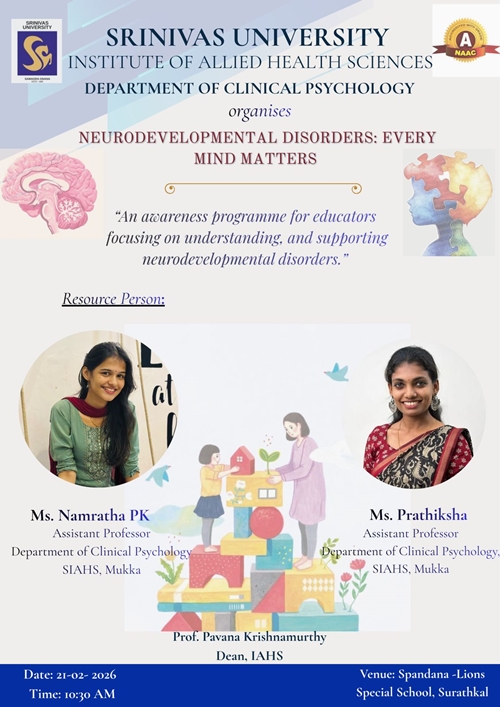
On March 2, 2024, the Department of Clinical Psychology at Srinivas University in Mangaluru hosted an awareness programme titled “Neurodevelopmental Disorders: Every Mind Matters.” This initiative aimed to enhance the understanding of neurodevelopmental disorders among educators at Spandana–Lions Special School, focusing on equipping them with practical tools to support children in classroom settings.
The programme, conducted under the auspices of the Institute of Allied Health Sciences (SIAHS), was facilitated by assistant professors Namratha P K and Prathiksha. The session received guidance from Dr. Bhagyashree Bhandary, with logistical support from Prof. Pavana Krishnamurthy, the dean of SIAHS, and Asha N, the course coordinator. This collaboration ensured a well-organized event that met its educational goals.
The primary objectives included deepening teachers’ knowledge of neurodevelopmental disorders and enabling them to recognize early signs of behavioral and developmental concerns. The initiative also sought to introduce effective classroom strategies for managing and supporting children with special needs. By fostering inclusive educational practices, the programme encouraged sensitivity towards the diverse learning profiles of students.
During the interactive session, educators engaged with topics such as Autism Spectrum Disorder, Attention-Deficit/Hyperactivity Disorder, Specific Learning Disorder, and Intellectual Developmental Disorder. Facilitators outlined early warning signs, clarified misconceptions, and addressed common challenges faced in classrooms. Real-life examples and case studies connected theoretical concepts with practical teaching experiences, enriching the learning environment.
Participants benefited from detailed discussions on the characteristics of various disorders, practical case analyses, and the sharing of evidence-based classroom management strategies. A question-and-answer segment allowed educators to raise specific concerns related to student behavior and academic performance, making the session both participatory and contextually relevant.
Feedback from participants indicated a positive response to the initiative. Many educators reported increased clarity in identifying developmental concerns and expressed greater confidence in implementing supportive strategies within their classrooms. The programme not only dispelled misconceptions but also reinforced a commitment to inclusive and child-centered education.
This initiative aligns with sustainable development goals, particularly Goal 4, which promotes equitable and inclusive quality education, as well as Goal 17, emphasizing collaborative engagement between institutions. By reinforcing partnerships and community outreach, the programme highlighted the importance of collective efforts in advancing child mental health and inclusive education.
Overall, the awareness programme marked a significant step toward empowering educators with the knowledge and practical skills necessary to support children with neurodevelopmental disorders effectively. The emphasis on early identification, informed intervention, and collaborative action plays a crucial role in building inclusive learning environments for all students.

Albert Camus’ Insightful Quote on Human Identity Resurfaces

Drone Strikes and Missile Attacks Disrupt UAE Amid Rising Tensions

Japanese Yen Rises Sharply Against US Dollar Ahead of Key Decisions

Priyanka Chopra and Nick Jonas Avoid Near Miss en Route to Oscars

Gujarat Vaccinates Over 11 Lakh Infants in Major Health Drive

Alexandre Singh Wins Oscar, Celebrates Immigrant Heritage

Lok Sabha Speaker Issues Warning Over Placards in Parliament

Global Electrosurgical Devices Market Expands to $10.2 Billion by 2034

North Zone Dominates Cricket; SJAM-1 Shines in Table Tennis

SBI Announces QIP Floor Price at ₹811.05 Per Share

Cept Unveils ₹3.1 Crore Urban Mobility Plan for Sustainable Growth

Comparing Subscription Prices: Spotify, Apple Music, and YouTube Music in India

New Blood Group Discovered in South Indian Woman at Rotary Centre

Konkani Cultural Organisation to Host Pearl Jubilee in Abu Dhabi

Torrential Rains Cause Flash Flooding in New York and New Jersey

Nothing Headphone 1 Review: A Bold Contender in Audio Design

Air India Crash Investigation Highlights Boeing Fuel Switch Concerns

Broad Advocates for Bowling Change Ahead of Final Test Against India
-
 World1 year ago
SBI Announces QIP Floor Price at ₹811.05 Per Share
-
 Lifestyle1 year ago
Cept Unveils ₹3.1 Crore Urban Mobility Plan for Sustainable Growth
-
 Science1 year ago
Comparing Subscription Prices: Spotify, Apple Music, and YouTube Music in India
-
 Science1 year ago
New Blood Group Discovered in South Indian Woman at Rotary Centre
-
 Top Stories1 year ago
Konkani Cultural Organisation to Host Pearl Jubilee in Abu Dhabi
-
 World1 year ago
Torrential Rains Cause Flash Flooding in New York and New Jersey
-
 Science1 year ago
Nothing Headphone 1 Review: A Bold Contender in Audio Design
-
 Top Stories1 year ago
Air India Crash Investigation Highlights Boeing Fuel Switch Concerns
-
 Sports1 year ago
Broad Advocates for Bowling Change Ahead of Final Test Against India
-

 Business1 year ago
Indian Stock Market Rebounds: Sensex and Nifty Rise After Four-Day Decline
-

 Sports1 year ago
Cristian Totti Retires at 19: Pressure of Fame Takes Toll
-

 Politics1 year ago
Abandoned Doberman Finds New Home After Journey to Prague