
Health
Leaders Seek Team Input but Fear Impact on Their Authority

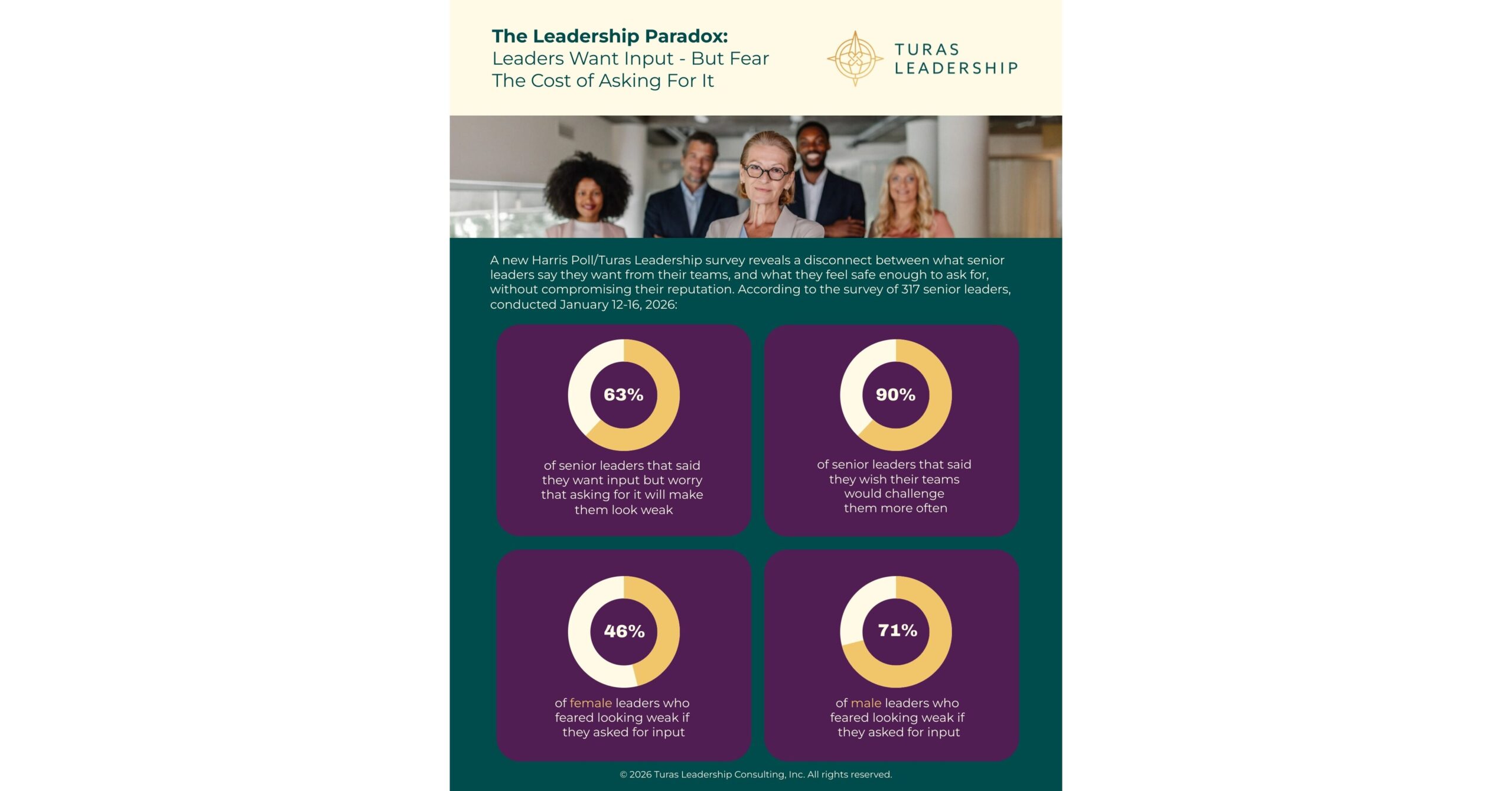
A recent survey conducted by the Harris Poll on behalf of Turas Leadership Consulting reveals a significant gap between what senior leaders desire from their teams and their willingness to seek out that input. The survey, which included responses from 317 business leaders in the United States, indicates that 63% of senior leaders would be more inclined to request team input for major decisions if they did not fear it would undermine their authority.
The findings also highlight a pronounced gender divide in this reluctance. Male leaders, at 71%, are notably more concerned about the repercussions of soliciting input than their female counterparts, only 46% of whom express similar concerns. This disparity raises questions about the dynamics of leadership and communication within organizations, suggesting that psychological safety may be deteriorating, particularly among those at the top.
Emily Scherberth, Founder and CEO of Turas Leadership Consulting, remarked, “This data suggests that psychological safety may be breaking down at the leadership level first. When leaders don’t feel safe enough to model vulnerability, openness, curiosity, and shared decision-making, those behaviors may not take root anywhere else.”
Understanding the Disconnect
The survey results align with broader workforce trends. According to a 2024 study, 63% of Gen Z employees and 52% of Millennials reported feeling uncomfortable expressing their opinions at work. This lack of confidence in voicing dissent or providing constructive feedback underscores a critical disconnect between leadership intentions and employee experiences. Additionally, a survey of 21,000 employees found that only 27% believe their leaders consistently encourage and recognize suggestions for improvement.
These statistics reveal a deeper issue within organizations. While leaders express a strong belief in collaboration and challenge, many lack the psychological safety necessary to initiate these practices. This situation creates a paradox where both leaders and employees feel constrained in their ability to communicate openly.
Research from the Harvard Business Review further corroborates these findings, indicating that middle managers often feel less psychologically secure than the employees they oversee. This dynamic suggests that the safety leaders create for their teams is not reciprocated at the leadership level.
Addressing Leadership Development
The pressures on leaders are mounting. A separate study indicated that 80% of leaders feel increased pressure to ensure their organizations’ long-term success. Furthermore, 71% of C-suite leaders have considered leaving their positions to safeguard their mental well-being. These challenges highlight the need for leaders to embody modern leadership qualities—such as openness, vulnerability, and collaboration—while navigating an exceptionally volatile business landscape.
Scherberth emphasizes that the issue is not merely one of skill or will, but rather how organizations approach leadership development in the face of complexity and uncertainty. “We can’t just teach leaders what to do; we also need to help them build the inner capacity to do it sustainably, under increasingly difficult circumstances, when it matters most,” she stated.
Turas Leadership advocates for a reimagining of leadership development, focusing on enhancing leaders’ capacities to confront their own authority models and deepen their self-awareness. By doing so, leaders can create an environment conducive to transformation throughout the organization.
For those interested in assessing their leadership capacity, Turas Leadership offers a Leadership Capacity Assessment. A comprehensive analysis of this research is available in their white paper, titled “The Leadership Paradox.”
The data from the Harris Poll/Turas survey, conducted from January 12 to 16, 2026, has a sampling precision of +/- 5.4 percentage points at a 95% confidence level, providing a robust insight into the current state of leadership dynamics.
In summary, the survey findings highlight the urgent need for organizations to foster psychological safety at all levels of leadership, ensuring that leaders can confidently seek input and create a more engaged and productive workplace culture.

Albert Camus’ Insightful Quote on Human Identity Resurfaces

Drone Strikes and Missile Attacks Disrupt UAE Amid Rising Tensions

Japanese Yen Rises Sharply Against US Dollar Ahead of Key Decisions

Priyanka Chopra and Nick Jonas Avoid Near Miss en Route to Oscars

Gujarat Vaccinates Over 11 Lakh Infants in Major Health Drive

Alexandre Singh Wins Oscar, Celebrates Immigrant Heritage

Lok Sabha Speaker Issues Warning Over Placards in Parliament

Global Electrosurgical Devices Market Expands to $10.2 Billion by 2034

North Zone Dominates Cricket; SJAM-1 Shines in Table Tennis

SBI Announces QIP Floor Price at ₹811.05 Per Share

Cept Unveils ₹3.1 Crore Urban Mobility Plan for Sustainable Growth

New Blood Group Discovered in South Indian Woman at Rotary Centre

Konkani Cultural Organisation to Host Pearl Jubilee in Abu Dhabi

Torrential Rains Cause Flash Flooding in New York and New Jersey

Nothing Headphone 1 Review: A Bold Contender in Audio Design

Indian Stock Market Rebounds: Sensex and Nifty Rise After Four-Day Decline

Air India Crash Investigation Highlights Boeing Fuel Switch Concerns

Broad Advocates for Bowling Change Ahead of Final Test Against India
-
 World12 months ago
SBI Announces QIP Floor Price at ₹811.05 Per Share
-
 Lifestyle12 months ago
Cept Unveils ₹3.1 Crore Urban Mobility Plan for Sustainable Growth
-
 Science12 months ago
New Blood Group Discovered in South Indian Woman at Rotary Centre
-
 Top Stories12 months ago
Konkani Cultural Organisation to Host Pearl Jubilee in Abu Dhabi
-
 World12 months ago
Torrential Rains Cause Flash Flooding in New York and New Jersey
-
 Science12 months ago
Nothing Headphone 1 Review: A Bold Contender in Audio Design
-
 Business12 months ago
Indian Stock Market Rebounds: Sensex and Nifty Rise After Four-Day Decline
-
 Top Stories12 months ago
Air India Crash Investigation Highlights Boeing Fuel Switch Concerns
-
 Sports12 months ago
Broad Advocates for Bowling Change Ahead of Final Test Against India
-

 Sports12 months ago
Cristian Totti Retires at 19: Pressure of Fame Takes Toll
-

 Politics12 months ago
Abandoned Doberman Finds New Home After Journey to Prague
-

 Lifestyle12 months ago
Villagers Unite to Raise ₹45 Lakh for Water Solutions in Vadgam