
Business
SARC Davos Dialogue 2026 Examines Trade Dynamics and India’s Role

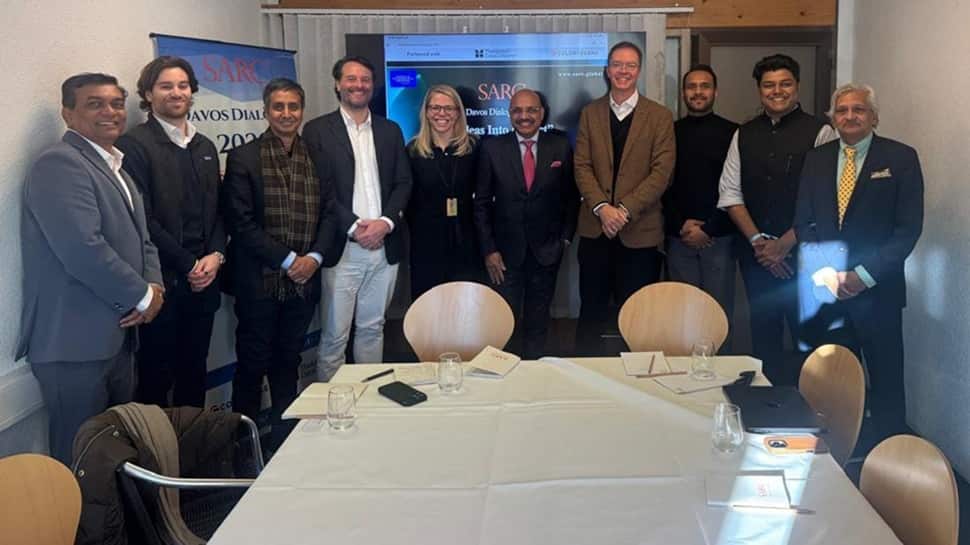
A pivotal discussion at the Davos Dialogue 2026, hosted by SARC Global, explored the intricate relationship between strategic autonomy and global trade efficiency. As financial restrictions, sanctions, and trade controls redefine international commerce, the dialogue underscored the importance of compliance and institutional credibility. The closed-door sessions addressed the evolving dynamics of global trade and the implications for countries like India.
During the discussions, a significant emphasis was placed on how increasing sanctions and compliance pressures often drive trade underground, leading to a burgeoning shadow economy. In contrast, India’s approach supports formalisation, aiming to integrate more economic activity into legitimate channels. This strategy was highlighted in the session titled “Competitive Federalism: Which Indian States Will Win the Next Decade?” which examined how regulatory certainty and infrastructure readiness will influence India’s capacity to capitalise on global trade re-routing.
Chairman and Global Leader of SARC Global, Sunil Kumar Gupta, led the roundtable, which featured notable moderators such as Namrata Singh Abrol, Founder of The Humanists Collective, and Ranu Gupta, Co-Founder and CEO of SARC Global. Gupta remarked, “India’s journey toward a Viksit Bharat @2047 is being carried forward by execution at scale—where compliance strengthens confidence, openness expands opportunity, and growth is built on systems designed to perform under stress.”
As the global economy shifts, the discussions also revolved around whether it is feasible to achieve strategic autonomy without compromising on efficiency, innovation, or openness. This question gains urgency as climate risk and policy volatility become defining characteristics of the global economic landscape. Participants noted that climate change is a systemic supply-chain risk, which necessitates a recalibration of industrial policy, trade competitiveness, and capital allocation. Extreme weather events, carbon regulations, and ESG-linked finance were cited as critical factors reshaping these priorities.
A sector-specific approach emerged, emphasizing that strategic autonomy should be tailored rather than ideological. Key sectors such as energy, semiconductors, pharmaceuticals, food systems, defence, and digital infrastructure require enhanced resilience, while others still benefit from global integration. The dialogue also included discussions on India’s regulated alternative settlement mechanisms, which have become increasingly relevant in the current economic context.
The session concluded with a consensus that India’s model, which combines trade regulation, compliance capacity, and strategic restraint, effectively limits the growth of shadow trade. This model not only supports export credibility but also enhances tax realisation and attracts manufacturing inflows. As the world navigates complex trade realities, India’s approach may serve as a valuable case study for balancing strategic autonomy with the demands of a rapidly changing global economy.

Albert Camus’ Insightful Quote on Human Identity Resurfaces

Drone Strikes and Missile Attacks Disrupt UAE Amid Rising Tensions

Japanese Yen Rises Sharply Against US Dollar Ahead of Key Decisions

Priyanka Chopra and Nick Jonas Avoid Near Miss en Route to Oscars

Gujarat Vaccinates Over 11 Lakh Infants in Major Health Drive

Alexandre Singh Wins Oscar, Celebrates Immigrant Heritage

Lok Sabha Speaker Issues Warning Over Placards in Parliament

Global Electrosurgical Devices Market Expands to $10.2 Billion by 2034

North Zone Dominates Cricket; SJAM-1 Shines in Table Tennis

SBI Announces QIP Floor Price at ₹811.05 Per Share

Cept Unveils ₹3.1 Crore Urban Mobility Plan for Sustainable Growth

Comparing Subscription Prices: Spotify, Apple Music, and YouTube Music in India

New Blood Group Discovered in South Indian Woman at Rotary Centre

Konkani Cultural Organisation to Host Pearl Jubilee in Abu Dhabi

Torrential Rains Cause Flash Flooding in New York and New Jersey

Nothing Headphone 1 Review: A Bold Contender in Audio Design

Air India Crash Investigation Highlights Boeing Fuel Switch Concerns

Broad Advocates for Bowling Change Ahead of Final Test Against India
-
 World1 year ago
SBI Announces QIP Floor Price at ₹811.05 Per Share
-
 Lifestyle1 year ago
Cept Unveils ₹3.1 Crore Urban Mobility Plan for Sustainable Growth
-
 Science1 year ago
Comparing Subscription Prices: Spotify, Apple Music, and YouTube Music in India
-
 Science1 year ago
New Blood Group Discovered in South Indian Woman at Rotary Centre
-
 Top Stories1 year ago
Konkani Cultural Organisation to Host Pearl Jubilee in Abu Dhabi
-
 World1 year ago
Torrential Rains Cause Flash Flooding in New York and New Jersey
-
 Science1 year ago
Nothing Headphone 1 Review: A Bold Contender in Audio Design
-
 Top Stories1 year ago
Air India Crash Investigation Highlights Boeing Fuel Switch Concerns
-
 Sports1 year ago
Broad Advocates for Bowling Change Ahead of Final Test Against India
-

 Business1 year ago
Indian Stock Market Rebounds: Sensex and Nifty Rise After Four-Day Decline
-

 Sports1 year ago
Cristian Totti Retires at 19: Pressure of Fame Takes Toll
-

 Politics1 year ago
Abandoned Doberman Finds New Home After Journey to Prague