
Science
Newly Hatched Chickens Show Bouba/Kiki Effect in Groundbreaking Study

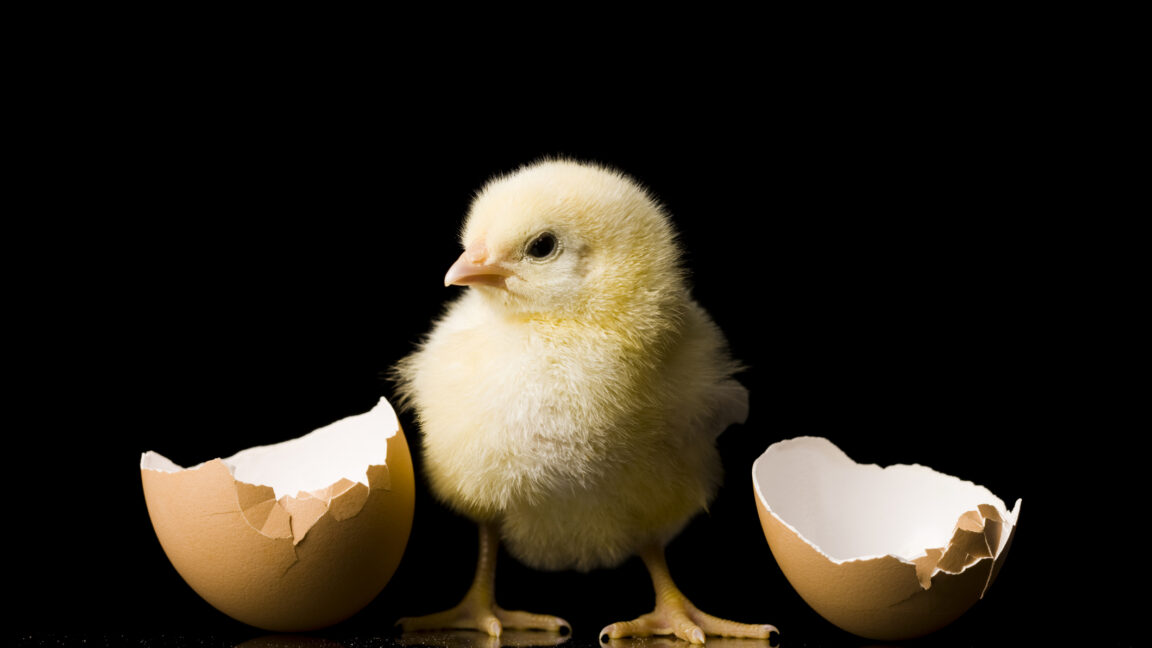
Research has revealed that newly hatched chickens demonstrate a sound association similar to that observed in humans, specifically linking the sounds “bouba” with round shapes and “kiki” with spiky ones. This finding, published in the journal Science, adds a new dimension to our understanding of the bouba/kiki effect, a phenomenon first documented in 1947.
The bouba/kiki effect has long intrigued scientists. It was initially noted that people associate certain sounds with specific shapes, leading to extensive studies on the topic. Early theories suggested that these associations were tied to linguistic familiarity, but subsequent research indicated that this tendency transcends language and is likely a universal human trait. Infants as young as four months have shown these associations, yet efforts to identify the effect among other primates yielded no conclusive evidence.
In a recent study led by Italian researchers Maria Loconsole, Silvia Benavides-Varela, and Lucia Regolin, the team sought to explore whether the bouba/kiki effect extends beyond primates to other species. Their focus shifted to newly hatched chickens, which, despite being only one to three days old, are fully mobile and capable of interacting with their environment.
The researchers conducted control experiments with silence and classical music to establish a baseline for the chicks’ preferences. Notably, when the word “bouba” was played, approximately 80 percent of the chicks gravitated towards a rounded shape. Conversely, when “kiki” was introduced, this number plummeted to just 25 percent, with more chicks choosing the spiky shape instead. These outcomes were more pronounced in the three-day-old chicks but were also evident in those tested just one day after hatching.
The researchers attribute these findings to a mechanism known as “crossmodal correspondence,” where one sensory input influences the perception of another. This phenomenon is commonly observed in humans, such as associating high-pitched sounds with small objects and low-pitched sounds with larger ones. Interestingly, while this effect has been documented in various animals, such as dogs and tortoises, it had not been previously observed in chickens.
The implications of this research suggest that the bouba/kiki effect is not exclusive to species with complex language systems. Instead, it highlights that even animals like chickens can exhibit similar sound-object associations. The absence of this effect in previously tested primates may be due to the complex motivations of adult animals, which can obscure instinctual preferences.
This study not only broadens our understanding of sound associations in the animal kingdom but also challenges the notion that such cognitive abilities are unique to humans. As ongoing research continues to explore the depths of animal cognition, findings like those from Loconsole and her team pave the way for a more nuanced understanding of how different species perceive and interact with their environments.

Albert Camus’ Insightful Quote on Human Identity Resurfaces

Drone Strikes and Missile Attacks Disrupt UAE Amid Rising Tensions

Japanese Yen Rises Sharply Against US Dollar Ahead of Key Decisions

Priyanka Chopra and Nick Jonas Avoid Near Miss en Route to Oscars

Gujarat Vaccinates Over 11 Lakh Infants in Major Health Drive

Alexandre Singh Wins Oscar, Celebrates Immigrant Heritage

Lok Sabha Speaker Issues Warning Over Placards in Parliament

Global Electrosurgical Devices Market Expands to $10.2 Billion by 2034

North Zone Dominates Cricket; SJAM-1 Shines in Table Tennis

SBI Announces QIP Floor Price at ₹811.05 Per Share

Cept Unveils ₹3.1 Crore Urban Mobility Plan for Sustainable Growth

New Blood Group Discovered in South Indian Woman at Rotary Centre

Konkani Cultural Organisation to Host Pearl Jubilee in Abu Dhabi

Torrential Rains Cause Flash Flooding in New York and New Jersey

Nothing Headphone 1 Review: A Bold Contender in Audio Design

Air India Crash Investigation Highlights Boeing Fuel Switch Concerns

Indian Stock Market Rebounds: Sensex and Nifty Rise After Four-Day Decline

Broad Advocates for Bowling Change Ahead of Final Test Against India
-
 World1 year ago
SBI Announces QIP Floor Price at ₹811.05 Per Share
-
 Lifestyle1 year ago
Cept Unveils ₹3.1 Crore Urban Mobility Plan for Sustainable Growth
-
 Science12 months ago
New Blood Group Discovered in South Indian Woman at Rotary Centre
-
 Top Stories1 year ago
Konkani Cultural Organisation to Host Pearl Jubilee in Abu Dhabi
-
 World1 year ago
Torrential Rains Cause Flash Flooding in New York and New Jersey
-
 Science1 year ago
Nothing Headphone 1 Review: A Bold Contender in Audio Design
-
 Top Stories1 year ago
Air India Crash Investigation Highlights Boeing Fuel Switch Concerns
-
 Business1 year ago
Indian Stock Market Rebounds: Sensex and Nifty Rise After Four-Day Decline
-
 Sports12 months ago
Broad Advocates for Bowling Change Ahead of Final Test Against India
-

 Sports12 months ago
Cristian Totti Retires at 19: Pressure of Fame Takes Toll
-

 Politics1 year ago
Abandoned Doberman Finds New Home After Journey to Prague
-

 Lifestyle1 year ago
Villagers Unite to Raise ₹45 Lakh for Water Solutions in Vadgam