
Science
DRDO Achieves Milestone with Gaganyaan Parachute Tests

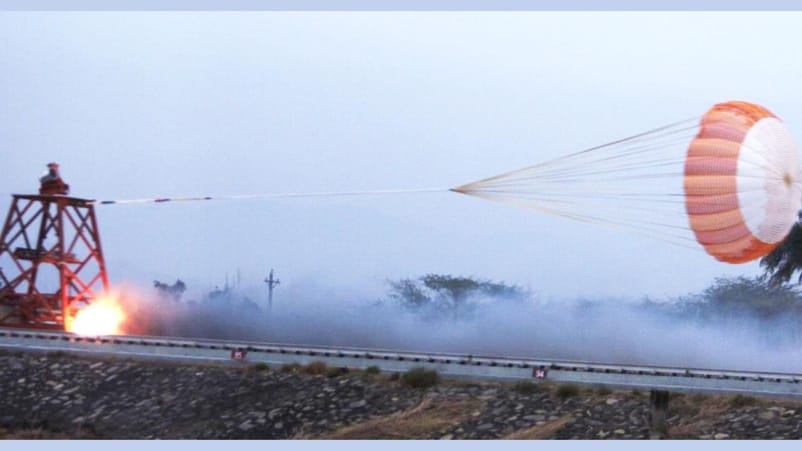
The Defence Research and Development Organisation (DRDO) has achieved a significant milestone by successfully testing the drogue parachutes designed for the Gaganyaan crew module. Conducted on February 18, 2026, at the Rail Track Rocket Sled (RTRS) facility located within the Terminal Ballistics Research Laboratory (TBRL) in Chandigarh, the tests involved subjecting the parachutes to loads exceeding the maximum expected during flight.
This qualification test was a collaborative effort involving the Vikram Sarabhai Space Centre, the Aerial Delivery Research and Development Establishment (ADRDE), and the Indian Space Research Organisation (ISRO). By successfully testing the drogue parachutes at these elevated loads, DRDO has demonstrated a robust design that incorporates an additional safety margin, enhancing the reliability of the parachute system.
Advancements in Parachute Technology
The drogue parachutes are an integral part of a sophisticated sequence of ten parachutes that will be deployed during the final phase of the Gaganyaan mission. These parachutes play a crucial role in reducing the velocity of the crew module upon reentry, ensuring a safe landing for the astronauts. The parachute deployment sequence begins with apex cover parachutes, which release the protective casing. Following this, the drogue parachutes will be deployed at high speeds to stabilize the crew module and facilitate the deployment of three pilot parachutes.
The successful test at the RTRS facility builds on previous evaluations, including tests conducted in August 2023 and February 2025. These tests assessed the performance of the parachutes in various configurations, ensuring thorough validation of the system’s capabilities. The RTRS facility is specifically designed for high-speed aerodynamic and ballistic evaluations using a rocket-propelled sled, making it ideal for such critical tests.
Significance for India’s Human Spaceflight Program
The Gaganyaan mission aims to send one or two astronauts, referred to as Gaganyatris, into orbit around the Earth using the human-rated Launch Vehicle Mark 3 (HR-LVM3). Upon mission completion, the crew module will reenter the atmosphere, necessitating a highly reliable parachute system to ensure a safe splashdown in the ocean.
The drogue parachutes, capable of operating at tremendous velocities, represent a key component in this complex system. Following the initial parachute deployments, the pilot parachutes will further reduce speed before the main parachutes are released. The innovative two-stage reefing technique employed will enhance safety during the descent.
DRDO’s ongoing testing and development efforts not only highlight India’s growing expertise in aerospace technology but also underscore the nation’s commitment to advancing its human spaceflight capabilities. As preparations for the Gaganyaan mission continue, these successful tests pave the way for future milestones in India’s ambitious space exploration agenda.

Albert Camus’ Insightful Quote on Human Identity Resurfaces

Drone Strikes and Missile Attacks Disrupt UAE Amid Rising Tensions

Japanese Yen Rises Sharply Against US Dollar Ahead of Key Decisions

Priyanka Chopra and Nick Jonas Avoid Near Miss en Route to Oscars

Gujarat Vaccinates Over 11 Lakh Infants in Major Health Drive

Alexandre Singh Wins Oscar, Celebrates Immigrant Heritage

Lok Sabha Speaker Issues Warning Over Placards in Parliament

Global Electrosurgical Devices Market Expands to $10.2 Billion by 2034

North Zone Dominates Cricket; SJAM-1 Shines in Table Tennis

SBI Announces QIP Floor Price at ₹811.05 Per Share

Cept Unveils ₹3.1 Crore Urban Mobility Plan for Sustainable Growth

New Blood Group Discovered in South Indian Woman at Rotary Centre

Konkani Cultural Organisation to Host Pearl Jubilee in Abu Dhabi

Torrential Rains Cause Flash Flooding in New York and New Jersey

Nothing Headphone 1 Review: A Bold Contender in Audio Design

Air India Crash Investigation Highlights Boeing Fuel Switch Concerns

Indian Stock Market Rebounds: Sensex and Nifty Rise After Four-Day Decline

Broad Advocates for Bowling Change Ahead of Final Test Against India
-
 World1 year ago
SBI Announces QIP Floor Price at ₹811.05 Per Share
-
 Lifestyle1 year ago
Cept Unveils ₹3.1 Crore Urban Mobility Plan for Sustainable Growth
-
 Science12 months ago
New Blood Group Discovered in South Indian Woman at Rotary Centre
-
 Top Stories1 year ago
Konkani Cultural Organisation to Host Pearl Jubilee in Abu Dhabi
-
 World1 year ago
Torrential Rains Cause Flash Flooding in New York and New Jersey
-
 Science1 year ago
Nothing Headphone 1 Review: A Bold Contender in Audio Design
-
 Top Stories1 year ago
Air India Crash Investigation Highlights Boeing Fuel Switch Concerns
-
 Business1 year ago
Indian Stock Market Rebounds: Sensex and Nifty Rise After Four-Day Decline
-
 Sports12 months ago
Broad Advocates for Bowling Change Ahead of Final Test Against India
-

 Sports12 months ago
Cristian Totti Retires at 19: Pressure of Fame Takes Toll
-

 Politics1 year ago
Abandoned Doberman Finds New Home After Journey to Prague
-
 Lifestyle1 year ago
Villagers Unite to Raise ₹45 Lakh for Water Solutions in Vadgam