
Science
AIIA Combines Ayurveda and Digital Anatomy for Enhanced Learning

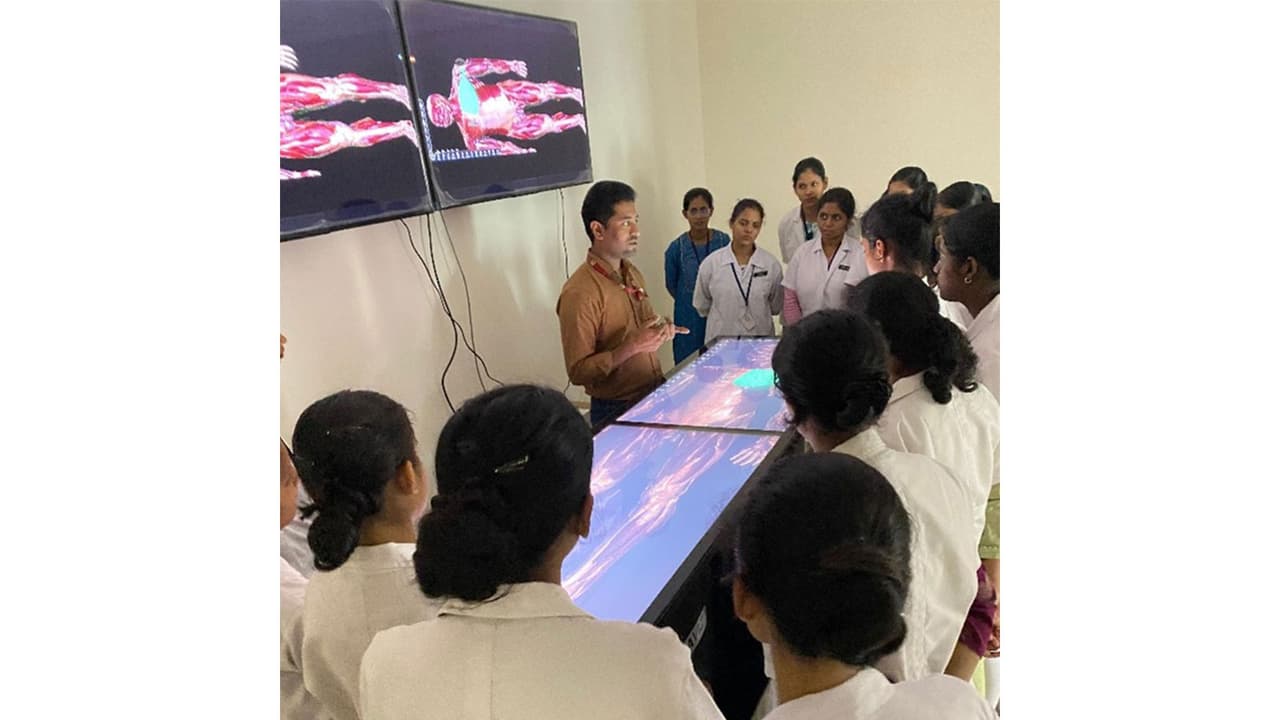
The All India Institute of Ayurveda (AIIA) is revolutionizing the educational experience for medical students by integrating traditional Ayurvedic practices with cutting-edge digital anatomy technology. This innovative approach utilizes a Virtual Dissection Table, enabling students to explore human anatomy in an interactive and immersive way.
Innovative Learning through Virtual Dissection
Students at AIIA can now visualize complex body structures layer by layer, enhancing their understanding of anatomical relationships. Dr. Ashutosh Kumar Yadav, an Associate Professor in the Department of Rachana Sharir, explained, “In this dissection table, all the body structures are visualized at once, from superficial to deeper structures. This technology allows students to study each component in detail before engaging in actual cadaveric dissection.”
The Virtual Dissection Table provides a comprehensive view of the human body, facilitating a deeper grasp of the anatomical intricacies. According to Dr. Yadav, students can learn about individual organs and their connections in three dimensions, which is particularly beneficial prior to participating in traditional dissection practices. This method not only prepares students for cadaveric dissection but also enhances their confidence and competence.
Bridging Tradition and Modernity
AIIA has designed its curriculum to blend Ayurvedic anatomical concepts with modern educational technologies. This combination aims to deepen students’ understanding of human anatomy. Dr. Yadav noted, “Before cadaveric dissection, students learn about body parts layer by layer through the Virtual Dissection Table. In actual dissection, they open the cranium to access cranial nerves, but the virtual dissection allows them to see all structures simultaneously, making it more advantageous.”
This integration reflects a growing trend within medical education to adopt technological advancements that complement traditional learning methods. The use of digital tools is proving crucial in preparing future healthcare professionals.
The AIIA also engages in ethical practices concerning body donations for research purposes. The institute has received ten bodies from families who voluntarily donated them after their loved ones passed away due to accidents or other circumstances. Recently, AIIA received the body of a fetus who was under five months old. The family opted for termination after discovering a congenital deformity, specifically a septal defect in the heart, and chose to donate the fetus for research.
Dr. Yadav elaborated on the process, stating, “After identifying the congenital deformity, the family decided on medical termination of pregnancy. I provided them with an application for donation, and both parents agreed to contribute the fetus for research.” This commitment to research underscores the AIIA’s dedication to advancing medical knowledge through ethical practices.
By combining Ayurvedic wisdom with modern technology, AIIA is setting a new standard for medical education in India. As students embrace this innovative approach, they are better equipped to understand human anatomy and prepare for their future roles in healthcare.

Albert Camus’ Insightful Quote on Human Identity Resurfaces

Drone Strikes and Missile Attacks Disrupt UAE Amid Rising Tensions

Japanese Yen Rises Sharply Against US Dollar Ahead of Key Decisions

Priyanka Chopra and Nick Jonas Avoid Near Miss en Route to Oscars

Gujarat Vaccinates Over 11 Lakh Infants in Major Health Drive

Alexandre Singh Wins Oscar, Celebrates Immigrant Heritage

Lok Sabha Speaker Issues Warning Over Placards in Parliament

Global Electrosurgical Devices Market Expands to $10.2 Billion by 2034

North Zone Dominates Cricket; SJAM-1 Shines in Table Tennis

SBI Announces QIP Floor Price at ₹811.05 Per Share

Cept Unveils ₹3.1 Crore Urban Mobility Plan for Sustainable Growth

Comparing Subscription Prices: Spotify, Apple Music, and YouTube Music in India

New Blood Group Discovered in South Indian Woman at Rotary Centre

Konkani Cultural Organisation to Host Pearl Jubilee in Abu Dhabi

Torrential Rains Cause Flash Flooding in New York and New Jersey

Nothing Headphone 1 Review: A Bold Contender in Audio Design

Air India Crash Investigation Highlights Boeing Fuel Switch Concerns

Indian Stock Market Rebounds: Sensex and Nifty Rise After Four-Day Decline
-
 World1 year ago
SBI Announces QIP Floor Price at ₹811.05 Per Share
-
 Lifestyle1 year ago
Cept Unveils ₹3.1 Crore Urban Mobility Plan for Sustainable Growth
-
 Science12 months ago
Comparing Subscription Prices: Spotify, Apple Music, and YouTube Music in India
-
 Science12 months ago
New Blood Group Discovered in South Indian Woman at Rotary Centre
-
 Top Stories1 year ago
Konkani Cultural Organisation to Host Pearl Jubilee in Abu Dhabi
-
 World1 year ago
Torrential Rains Cause Flash Flooding in New York and New Jersey
-
 Science1 year ago
Nothing Headphone 1 Review: A Bold Contender in Audio Design
-
 Top Stories1 year ago
Air India Crash Investigation Highlights Boeing Fuel Switch Concerns
-
 Business1 year ago
Indian Stock Market Rebounds: Sensex and Nifty Rise After Four-Day Decline
-

 Sports12 months ago
Broad Advocates for Bowling Change Ahead of Final Test Against India
-

 Sports12 months ago
Cristian Totti Retires at 19: Pressure of Fame Takes Toll
-

 Politics1 year ago
Abandoned Doberman Finds New Home After Journey to Prague