
World
Trump’s Manifest Destiny Rhetoric Resurfaces in Arctic Policy

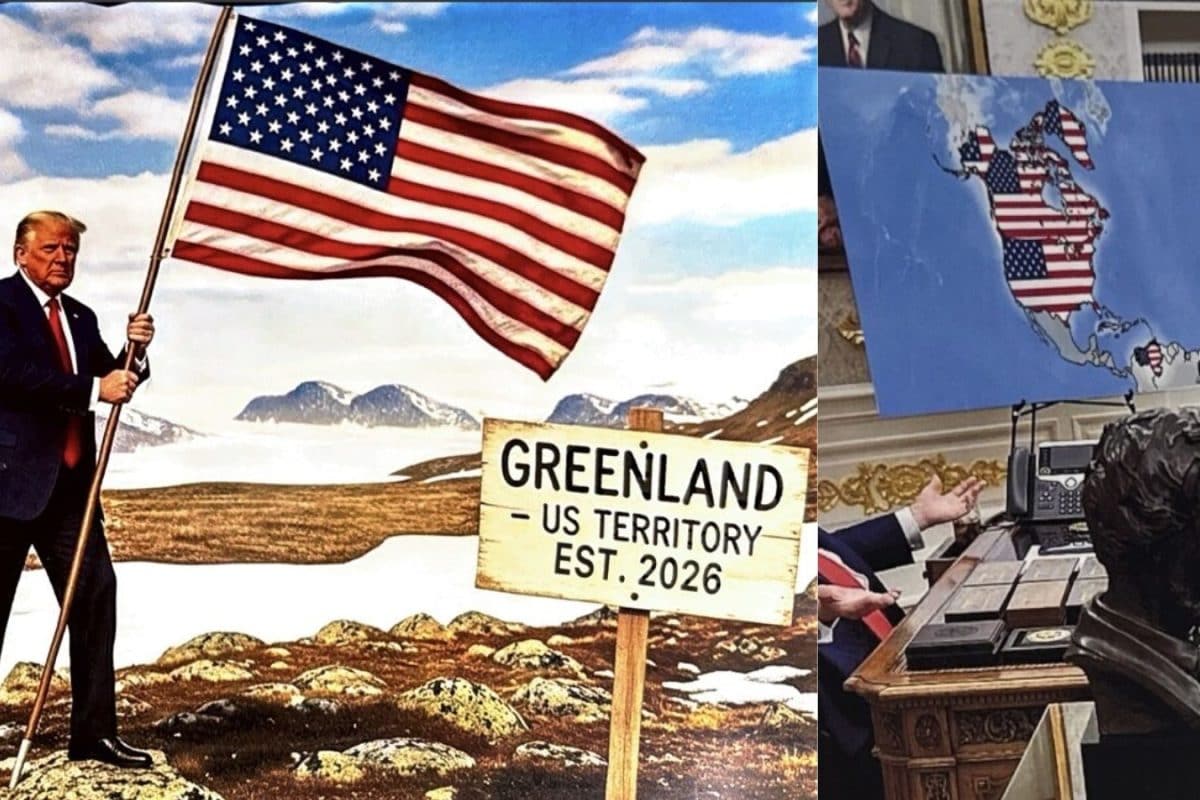
US President Donald Trump has reignited discussions surrounding the concept of Manifest Destiny, linking it to renewed interest in Greenland and the broader Arctic region. This doctrine, which justified American territorial expansion in the 19th century, is being invoked in the context of modern geopolitical competition and has raised concerns among allies, particularly in Canada and Europe.
The shift in rhetoric became apparent following Trump’s January 20, 2025 inauguration speech, where he pledged to pursue the United States’ “Manifest Destiny into the stars.” This historical ideology, which once fueled America’s westward expansion, now finds relevance as the Arctic emerges as a key area of global rivalry. Analysts note that Trump’s invocation of this concept has significant implications for US relations with Greenland and Canada.
Shifting Narratives Around Arctic Sovereignty
In the past year, senior US officials have altered their language about the Arctic, moving from a partnership-based approach to one focused on possession. This shift was highlighted in early 2025 when Vice President JD Vance led an uninvited delegation to Greenland, an overture rejected by local authorities. Rather than interpreting this as a diplomatic rebuff, Trump intensified his rhetoric, asserting, “We’ll get Greenland. Yeah, 100%.” This declaration alarmed Copenhagen and raised questions about Washington’s strategic intentions.
The conversation has also drawn in Canada. Trump has previously described the US–Canada border as “artificial” and has suggested that Canada could become the 51st state. In response, former Prime Minister Justin Trudeau firmly rejected such notions, stating there “isn’t a snowball’s chance in hell” of that occurring. Nevertheless, concerns have grown among Canadian officials that Trump may view Canada as a target for his expansionist agenda, particularly regarding Arctic sovereignty and the Northwest Passage.
The renewed focus on these northern territories can be traced back to the historic implications of Manifest Destiny, which underscored a belief in American exceptionalism and territorial entitlement.
Understanding Manifest Destiny and Its Modern Relevance
Manifest Destiny emerged in the 1840s as a belief that the US was destined to expand across North America. Coined by journalist John L. O’Sullivan in 1845, the term justified territorial acquisition as both inevitable and morally righteous. Under President James K. Polk, this ideology propelled significant territorial gains, including Texas and California, but it also had devastating impacts on Indigenous populations.
The concept did not merely encapsulate westward expansion; it also included aspirations to absorb British North America, which is now Canada, and extend influence into the Arctic. During the mid-19th century, American leaders speculated about the political unification of the continent, with some advocating for the purchase of Greenland from Denmark as a strategic move to solidify control over the North.
Despite the failed attempts to acquire Greenland in the past, including a secret offer from the US post-World War II, the idea lay dormant until Trump revived it in 2025. During his second inauguration, he reiterated the notion of expanding US territory, a departure from the more alliance-focused foreign policy of previous decades.
Implications for NATO and Global Relations
The revival of Manifest Destiny rhetoric has prompted a notable reaction from NATO allies. Denmark, which manages Greenland’s foreign affairs, has categorically rejected any suggestions of US acquisition. European governments have expressed concerns about the implications of such rhetoric, emphasizing the principles of sovereignty and territorial integrity that govern international relations.
In January 2025, the United States faced a rare backlash during an emergency meeting of the UN Security Council, where European nations reaffirmed their commitment to defending the norms of sovereignty in light of Trump’s statements regarding Greenland.
As Arctic geopolitics evolve, the implications of Trump’s revival of Manifest Destiny will likely shape not only US relations with Greenland and Canada but also the cohesion of NATO and the stability of North America. Whether this ideology remains a symbolic reference or develops into a more concrete policy direction will be closely monitored in the coming years.

Albert Camus’ Insightful Quote on Human Identity Resurfaces

Drone Strikes and Missile Attacks Disrupt UAE Amid Rising Tensions

Japanese Yen Rises Sharply Against US Dollar Ahead of Key Decisions

Priyanka Chopra and Nick Jonas Avoid Near Miss en Route to Oscars

Gujarat Vaccinates Over 11 Lakh Infants in Major Health Drive

Alexandre Singh Wins Oscar, Celebrates Immigrant Heritage

Lok Sabha Speaker Issues Warning Over Placards in Parliament

Global Electrosurgical Devices Market Expands to $10.2 Billion by 2034

North Zone Dominates Cricket; SJAM-1 Shines in Table Tennis

SBI Announces QIP Floor Price at ₹811.05 Per Share

Cept Unveils ₹3.1 Crore Urban Mobility Plan for Sustainable Growth

New Blood Group Discovered in South Indian Woman at Rotary Centre

Konkani Cultural Organisation to Host Pearl Jubilee in Abu Dhabi

Torrential Rains Cause Flash Flooding in New York and New Jersey

Nothing Headphone 1 Review: A Bold Contender in Audio Design

Indian Stock Market Rebounds: Sensex and Nifty Rise After Four-Day Decline

Air India Crash Investigation Highlights Boeing Fuel Switch Concerns

Broad Advocates for Bowling Change Ahead of Final Test Against India
-
 World12 months ago
SBI Announces QIP Floor Price at ₹811.05 Per Share
-
 Lifestyle12 months ago
Cept Unveils ₹3.1 Crore Urban Mobility Plan for Sustainable Growth
-
 Science12 months ago
New Blood Group Discovered in South Indian Woman at Rotary Centre
-
 Top Stories12 months ago
Konkani Cultural Organisation to Host Pearl Jubilee in Abu Dhabi
-
 World12 months ago
Torrential Rains Cause Flash Flooding in New York and New Jersey
-
 Science12 months ago
Nothing Headphone 1 Review: A Bold Contender in Audio Design
-
 Business12 months ago
Indian Stock Market Rebounds: Sensex and Nifty Rise After Four-Day Decline
-
 Top Stories12 months ago
Air India Crash Investigation Highlights Boeing Fuel Switch Concerns
-
 Sports12 months ago
Broad Advocates for Bowling Change Ahead of Final Test Against India
-

 Sports12 months ago
Cristian Totti Retires at 19: Pressure of Fame Takes Toll
-

 Politics12 months ago
Abandoned Doberman Finds New Home After Journey to Prague
-

 Lifestyle12 months ago
Villagers Unite to Raise ₹45 Lakh for Water Solutions in Vadgam