
Science
DRDO Executes High-Speed Rocket-Sled Test for Fighter Escape System

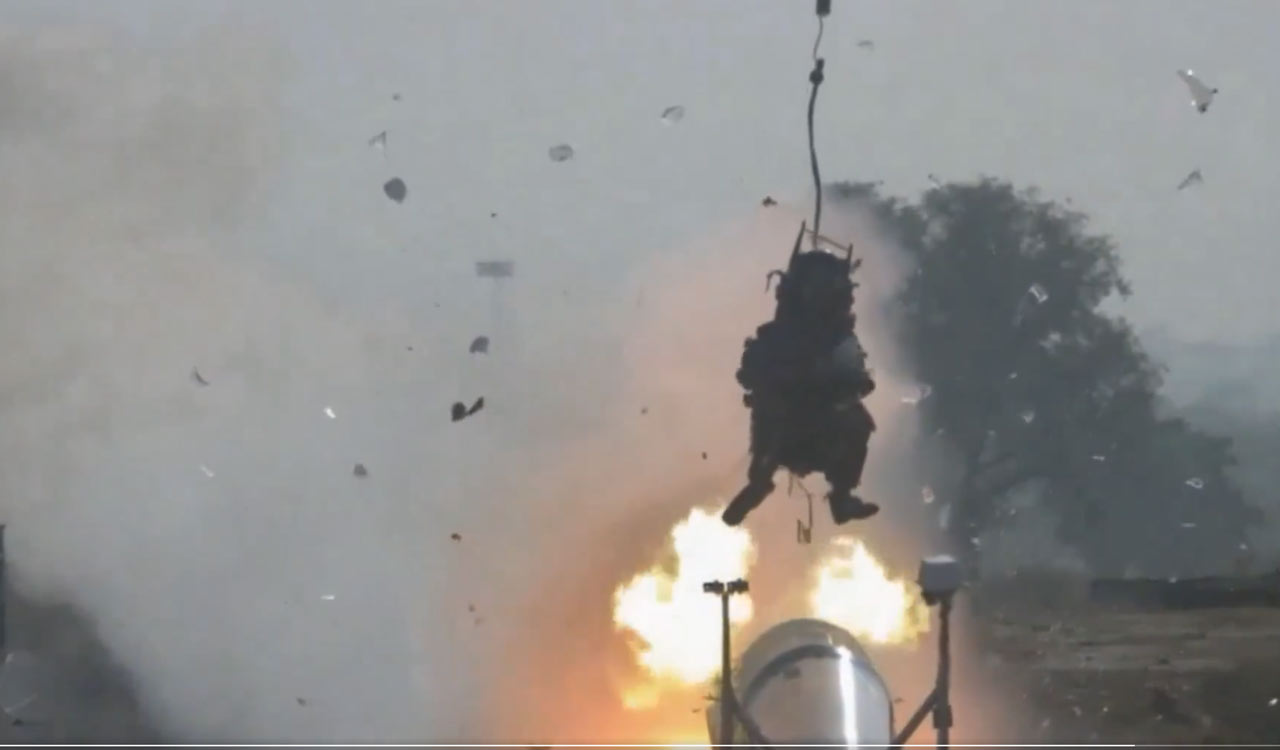
The Defence Research and Development Organisation (DRDO) achieved a significant milestone on December 2, 2025, by successfully conducting a high-speed rocket-sled test of a fighter aircraft escape system at the Rail Track Rocket Sled (RTRS) facility in Chandigarh. This advancement marks a crucial step towards enhancing India’s self-reliance in defence technology.
The dynamic test validated essential components of the aircrew escape system, including the canopy severance, ejection sequencing, and the complete recovery of the aircrew at a controlled velocity of 800 km/h. According to a press statement, the test was executed in collaboration with the Aeronautical Development Agency (ADA) and Hindustan Aeronautics Limited (HAL).
A dual-sled configuration was employed to carry the forebody section of the Light Combat Aircraft (LCA). The sophisticated dual-sled system utilized phased firing of multiple solid-propellant rocket motors, achieving the precise velocity profile necessary for a realistic simulation. This setup allowed for a thorough evaluation of the ejection seat performance under conditions that closely mimic real-world scenarios.
Data collection during the test was facilitated by an instrumented anthropomorphic test dummy, which recorded vital information regarding loads, moments, and accelerations experienced during the ejection phase. The entire sequence, from “canopy fragilisation” to the aircrew’s safe recovery, was captured through both high-speed onboard imaging and ground-based systems.
Significance of the Test
Unlike static tests, this dynamic ejection trial represents the most rigorous method for assessing ejection seat efficacy under realistic conditions. The successful execution of this test positions India among a select group of nations capable of conducting such advanced evaluations entirely in-house.
Senior officials from the Indian Air Force (IAF), the Institute of Aerospace Medicine, and various certifying agencies were present to witness the test. Defence Minister Rajnath Singh extended his congratulations to the DRDO, IAF, ADA, HAL, and industry partners, emphasizing that this accomplishment is a significant milestone in India’s journey toward self-reliance in defence capabilities.
Dr Samir V Kamat, Secretary of the Department of Defence R&D and Chairman of DRDO, also expressed his heartfelt congratulations to the entire team for the flawless execution of this complex demonstration.
Future Implications
With this successful test, India strengthens its ability to design, develop, and certify world-class pilot escape systems independently. This progress not only enhances the safety of aircrew operating indigenous combat aircraft but also underscores the nation’s growing stature in the field of advanced aerospace technology.
As India continues to advance its defence capabilities, this achievement illustrates the commitment to achieving self-reliance and developing indigenous solutions that meet global standards. The DRDO’s ongoing efforts in this area are expected to contribute significantly to the future of India’s defence landscape.

Albert Camus’ Insightful Quote on Human Identity Resurfaces

Drone Strikes and Missile Attacks Disrupt UAE Amid Rising Tensions

Japanese Yen Rises Sharply Against US Dollar Ahead of Key Decisions

Priyanka Chopra and Nick Jonas Avoid Near Miss en Route to Oscars

Gujarat Vaccinates Over 11 Lakh Infants in Major Health Drive

Alexandre Singh Wins Oscar, Celebrates Immigrant Heritage

Lok Sabha Speaker Issues Warning Over Placards in Parliament

Global Electrosurgical Devices Market Expands to $10.2 Billion by 2034

North Zone Dominates Cricket; SJAM-1 Shines in Table Tennis

SBI Announces QIP Floor Price at ₹811.05 Per Share

Cept Unveils ₹3.1 Crore Urban Mobility Plan for Sustainable Growth

New Blood Group Discovered in South Indian Woman at Rotary Centre

Konkani Cultural Organisation to Host Pearl Jubilee in Abu Dhabi

Torrential Rains Cause Flash Flooding in New York and New Jersey

Nothing Headphone 1 Review: A Bold Contender in Audio Design

Indian Stock Market Rebounds: Sensex and Nifty Rise After Four-Day Decline

Broad Advocates for Bowling Change Ahead of Final Test Against India

Air India Crash Investigation Highlights Boeing Fuel Switch Concerns
-
 World11 months ago
SBI Announces QIP Floor Price at ₹811.05 Per Share
-
 Lifestyle11 months ago
Cept Unveils ₹3.1 Crore Urban Mobility Plan for Sustainable Growth
-
 Science10 months ago
New Blood Group Discovered in South Indian Woman at Rotary Centre
-
 Top Stories11 months ago
Konkani Cultural Organisation to Host Pearl Jubilee in Abu Dhabi
-
 World11 months ago
Torrential Rains Cause Flash Flooding in New York and New Jersey
-
 Science11 months ago
Nothing Headphone 1 Review: A Bold Contender in Audio Design
-
 Business11 months ago
Indian Stock Market Rebounds: Sensex and Nifty Rise After Four-Day Decline
-
 Sports10 months ago
Broad Advocates for Bowling Change Ahead of Final Test Against India
-
 Top Stories11 months ago
Air India Crash Investigation Highlights Boeing Fuel Switch Concerns
-

 Sports10 months ago
Cristian Totti Retires at 19: Pressure of Fame Takes Toll
-

 Politics11 months ago
Abandoned Doberman Finds New Home After Journey to Prague
-

 Top Stories11 months ago
Patna Bank Manager Abhishek Varun Found Dead in Well