
World
India Dismisses Claims of Secret Doval-Rubio Meeting on Trade

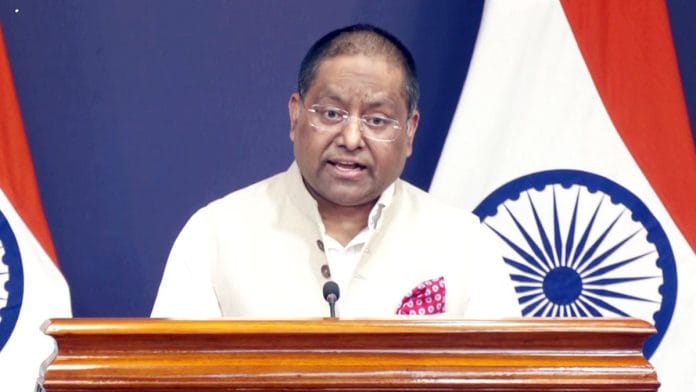
New Delhi has firmly rejected a Bloomberg report alleging that National Security Adviser Ajit Doval held a secret meeting with his American counterpart, Marco Rubio, aimed at improving diplomatic ties and advancing trade negotiations. During a regular press briefing on Thursday, Randhir Jaiswal, spokesperson for the Ministry of External Affairs (MEA), stated, “Regarding the report by Bloomberg, I would like to say that there is absolutely no basis for that report. No such meeting or no such visit has taken place.”
The denial from the Indian government comes in the wake of Bloomberg’s claims that Doval had visited the United States shortly after Prime Minister Narendra Modi met with Chinese President Xi Jinping and Russian President Vladimir Putin at the Shanghai Cooperation Organisation (SCO) summit in Tianjin. The report suggested the visit was intended to convey New Delhi’s desire to move past the tensions that arose following the conclusion of Operation Sindoor.
According to the report, Doval emphasized that India would not be intimidated by U.S. President Donald Trump and his administration. It further suggested that India was willing to wait out the current U.S. administration, given past experiences with “hostile” American administrations. The report also noted that shortly after this alleged meeting, Trump reached out to Modi to extend birthday wishes on September 16.
In a significant diplomatic development, India and the United States announced on Monday a reduction in tariffs from 50 percent to 18 percent, following a call between Modi and Trump. The U.S. president claimed that a trade agreement had been reached, allowing India to lower tariffs in several areas to zero, while American tariffs would decrease to 18 percent.
India has made it clear that any trade deal must safeguard its sensitive agricultural and dairy sectors. Current discussions suggest that India may offer similar concessions as seen in its free trade agreements with the European Union and New Zealand, which would allow for the import of certain agricultural products under specific conditions.
During a media interaction on Thursday, Piyush Goyal, India’s Commerce and Industry Minister, announced that the first phase of the trade agreement is expected to be signed within the next 30 to 45 days. A joint statement outlining the agreement’s broad contours is anticipated soon, while the legal framework is expected to be formalized in March.
This emerging trade agreement signifies a thaw in the traditionally strained India-U.S. relations that have been evident in recent years. The relationship saw significant tension following a contentious phone call between Modi and Trump in June 2025, during which Modi asserted that neither the U.S. nor its threats of tariffs led to a ceasefire with Pakistan after Operation Sindoor. Trump has consistently claimed that the U.S. played a role in bringing about this pause, a narrative supported by Islamabad.
The imposition of punitive tariffs of 25 percent on Indian goods by the U.S. at the end of August 2025, combined with existing reciprocal tariffs, had resulted in a total tariff rate of 50 percent, one of the highest imposed globally by the U.S. However, with the anticipated trade agreement, these rates are set to be significantly reduced.
As negotiations continue, the international community will be watching closely to see how these developments will reshape India-U.S. relations and affect their broader strategic interests.

Owaisi Challenges Government After Supreme Court Stays UGC Regulations

Canada’s Stephen Gogolev Shines with Olympic Debut in Milan

Punjab Governor Hosts First Samaadhaan Shivir for Residents

Delhi Police Arrest 82 for Brandishing Weapons Online

Rajiv Swagruha Corporation Secures ₹56 Crore from Plot Auction

Hania Aamir and Asim Azhar Spark Wedding Rumours for 2026

Saquon Barkley Offers Nerve-Handling Tips Ahead of Super Bowl 2026

Awareness Programme Tackles PCOD Among Young Women in Hyderabad

India Boosts Defence Budget to ₹7.85 Lakh Crore Amid Military Shift

SBI Announces QIP Floor Price at ₹811.05 Per Share

Cept Unveils ₹3.1 Crore Urban Mobility Plan for Sustainable Growth

New Blood Group Discovered in South Indian Woman at Rotary Centre

Torrential Rains Cause Flash Flooding in New York and New Jersey

Konkani Cultural Organisation to Host Pearl Jubilee in Abu Dhabi

Nothing Headphone 1 Review: A Bold Contender in Audio Design

Broad Advocates for Bowling Change Ahead of Final Test Against India

Air India Crash Investigation Highlights Boeing Fuel Switch Concerns

Indian Stock Market Rebounds: Sensex and Nifty Rise After Four-Day Decline
-
 World7 months ago
SBI Announces QIP Floor Price at ₹811.05 Per Share
-
 Lifestyle7 months ago
Cept Unveils ₹3.1 Crore Urban Mobility Plan for Sustainable Growth
-
 Science6 months ago
New Blood Group Discovered in South Indian Woman at Rotary Centre
-
 World7 months ago
Torrential Rains Cause Flash Flooding in New York and New Jersey
-
 Top Stories7 months ago
Konkani Cultural Organisation to Host Pearl Jubilee in Abu Dhabi
-
 Science7 months ago
Nothing Headphone 1 Review: A Bold Contender in Audio Design
-
 Sports6 months ago
Broad Advocates for Bowling Change Ahead of Final Test Against India
-
 Top Stories7 months ago
Air India Crash Investigation Highlights Boeing Fuel Switch Concerns
-
 Business7 months ago
Indian Stock Market Rebounds: Sensex and Nifty Rise After Four-Day Decline
-

 Sports6 months ago
Cristian Totti Retires at 19: Pressure of Fame Takes Toll
-

 Politics7 months ago
Abandoned Doberman Finds New Home After Journey to Prague
-
 Top Stories7 months ago
Patna Bank Manager Abhishek Varun Found Dead in Well