
Science
NASA Confirms 3I/ATLAS is a Comet, Not an Alien Probe

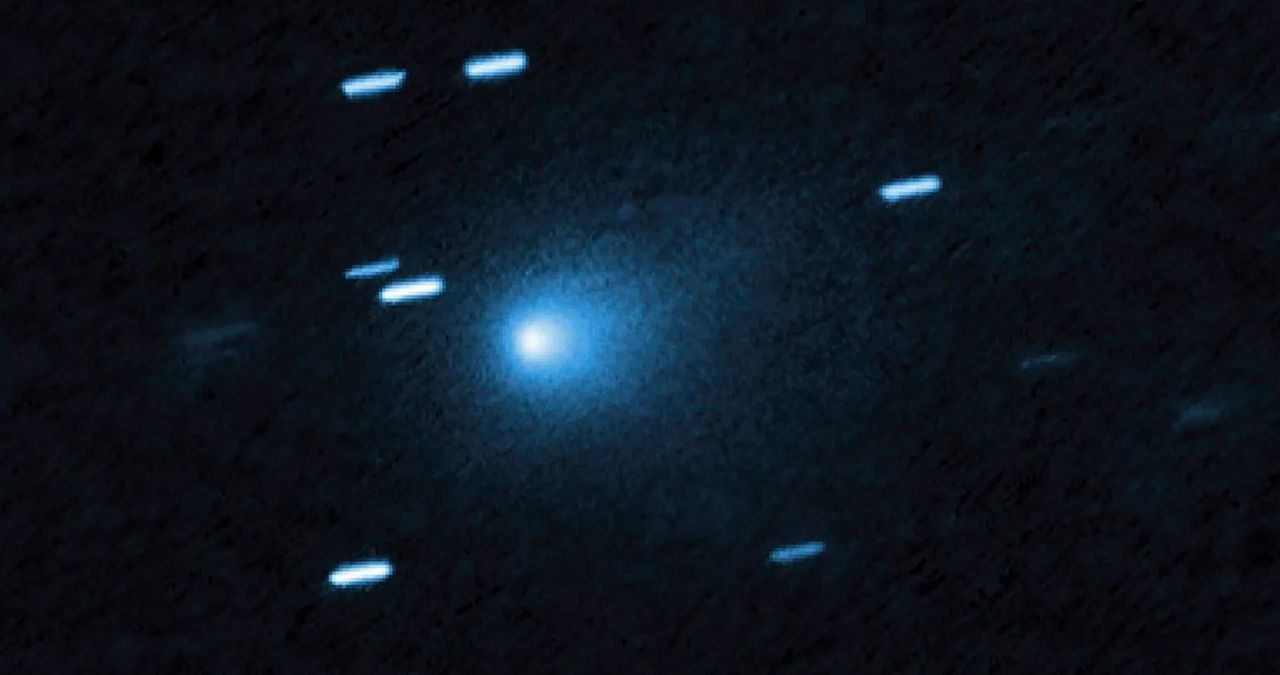
An interstellar object known as 3I/ATLAS has captivated the public’s imagination with speculation about its origins. After weeks of silence during the US government’s 43-day shutdown, NASA has confirmed that this celestial body is indeed a comet. On November 19, 2025, the agency released a series of images captured by multiple spacecraft near Mars, dispelling rumors that suggested it could be an alien mothership.
The release of the images marked a significant moment for scientists and enthusiasts alike. Amit Kshatriya, NASA’s associate administrator, made a clear statement regarding the object’s identity: “It looks and behaves like a comet.” This sentiment was reinforced by Nicky Fox, head of NASA’s science mission directorate, who noted, “We certainly haven’t seen any techno signatures or anything from it that would lead us to believe it was anything other than a comet.”
Scientific Analysis of 3I/ATLAS
Despite the agency’s reassurances, the enigmatic characteristics of 3I/ATLAS have fueled ongoing intrigue. Some scientists have observed that the comet possesses unusual chemical ratios and reflects light in ways that do not align with typical solar-system comets. While these anomalies have sparked curiosity, experts caution against jumping to conclusions about extraterrestrial origins.
Oxford astrophysicist Chris Lintott firmly dismissed the alien probe theory, stating, “The idea that 3I/ATLAS could be an alien spacecraft is simply nonsense… you might as well argue that the moon is made of cheese.” This perspective underscores the scientific community’s commitment to evidence-based conclusions.
The Role of Public Interest
The fascination with 3I/ATLAS has been amplified by comments from Harvard astrophysicist Avi Loeb, who previously suggested that the object might be an “alien probe” due to its non-gravitational motion and distinct blue glow observed near the Sun. Such statements have contributed to a viral wave of speculation across social media platforms.
NASA’s recent imagery was described as providing a multi-faceted view of the comet, akin to glimpses of a baseball from different seats in a stadium. Each image, while partial, helps researchers piece together a more comprehensive understanding of this cosmic visitor before it journeys back into the depths of space.
As interest in 3I/ATLAS continues to grow, NASA remains focused on using these observations to advance our understanding of interstellar objects and their trajectories. The agency has committed to sharing ongoing research and findings with the public, reinforcing a collaborative approach to space exploration.
For those keen to explore the latest images and learn more about 3I/ATLAS, NASA has provided resources on its official channels, inviting both the scientific community and the general public to engage with this remarkable event in our solar system.

Swiss Voters Reject Hefty Inheritance Tax Amid Public Opposition

Archaeologists Uncover 2,000-Year-Old Papyrus in Egyptian Coffin

Bijan Robinson Dominates Week 13, Davante Adams Sets New Record

Stockton Mass Shooting Claims Four Lives; Mayor Issues Stark Warning

Health Insights for December 1, 2025: Wellness Predictions for All Signs

Indian Government Supports Air Passengers in ₹50,000 Crore Suit

Shehbaz Badesha Eliminated from Bigg Boss 19; Amaal Mallik Reacts

India to Introduce New Cess on Tobacco and Pan Masala Products

Ram Kamal Mukherjee Celebrates Cinema at IFFI 2025

SBI Announces QIP Floor Price at ₹811.05 Per Share

Cept Unveils ₹3.1 Crore Urban Mobility Plan for Sustainable Growth

New Blood Group Discovered in South Indian Woman at Rotary Centre

Torrential Rains Cause Flash Flooding in New York and New Jersey

Konkani Cultural Organisation to Host Pearl Jubilee in Abu Dhabi

Broad Advocates for Bowling Change Ahead of Final Test Against India

Nothing Headphone 1 Review: A Bold Contender in Audio Design

Air India Crash Investigation Highlights Boeing Fuel Switch Concerns

Indian Stock Market Rebounds: Sensex and Nifty Rise After Four-Day Decline
-
 World5 months ago
SBI Announces QIP Floor Price at ₹811.05 Per Share
-
 Lifestyle5 months ago
Cept Unveils ₹3.1 Crore Urban Mobility Plan for Sustainable Growth
-
 Science4 months ago
New Blood Group Discovered in South Indian Woman at Rotary Centre
-
 World5 months ago
Torrential Rains Cause Flash Flooding in New York and New Jersey
-
 Top Stories5 months ago
Konkani Cultural Organisation to Host Pearl Jubilee in Abu Dhabi
-
 Sports4 months ago
Broad Advocates for Bowling Change Ahead of Final Test Against India
-
 Science5 months ago
Nothing Headphone 1 Review: A Bold Contender in Audio Design
-
 Top Stories5 months ago
Air India Crash Investigation Highlights Boeing Fuel Switch Concerns
-
 Business5 months ago
Indian Stock Market Rebounds: Sensex and Nifty Rise After Four-Day Decline
-

 Sports4 months ago
Cristian Totti Retires at 19: Pressure of Fame Takes Toll
-

 Politics5 months ago
Abandoned Doberman Finds New Home After Journey to Prague
-

 Top Stories5 months ago
Patna Bank Manager Abhishek Varun Found Dead in Well