
Politics
India Tests Advanced Mk-II(A) Laser Weapon, Boosts Defense Capabilities

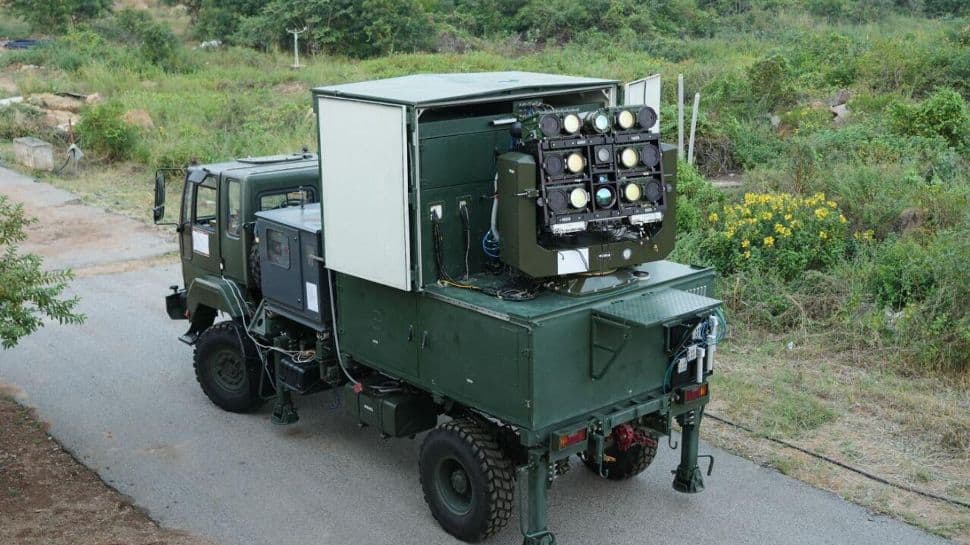
The Defence Research and Development Organisation (DRDO) of India successfully tested its new 30-kilowatt Mk-II(A) Directed Energy Weapon (DEW) in Kurnool, Andhra Pradesh, marking a significant advancement in the nation’s defense technology. This test, conducted in April 2025, showcased the system’s ability to disable various aerial threats, including fixed-wing platforms, drone swarms, and surveillance sensors, at a distance of five kilometers.
The global landscape of warfare is increasingly defined by advanced technologies, and countries such as the United States, China, Israel, and Russia have been at the forefront of this evolution for years. India’s recent test demonstrates its commitment to joining this elite group, focusing particularly on DEWs that utilize concentrated energy beams to intercept fast-moving threats.
Cost-Effectiveness and Strategic Implications
Laser weapons are seen as a cost-effective alternative to traditional missile systems. Each shot from a laser DEW is significantly cheaper compared to generating conventional missiles, enabling nations to deploy these systems in larger quantities. The Mk-II(A) relies on light-speed targeting, allowing for instantaneous reactions to incoming drones and missiles, which is crucial in modern combat scenarios.
While the Mk-II(A) is not yet capable of intercepting ballistic missiles, it represents a pivotal step for India in the realm of advanced laser technology. In contrast, Israel is developing more powerful 300-kilowatt lasers designed to intercept such missiles. The successful testing of the Mk-II(A) confirms India’s emergence as a notable player in the global laser weapon domain, with plans to integrate these systems into its armed forces within the next two years.
The DRDO is also working on the 300-kilowatt ‘Surya’ laser DEW, anticipated to intercept high-speed missiles at distances of up to 20 kilometers, further enhancing India’s defensive capabilities.
How Directed Energy Weapons Function
Directed Energy Weapons replace conventional explosives with concentrated energy sources, such as lasers, microwaves, or particle beams. The Mk-II(A) has demonstrated its ability to neutralize targets almost instantaneously, generating intense heat to destroy critical components. Microwave DEWs can target multiple drones in a wide area, while particle beam technology, still in early stages, holds promise for causing molecular-level damage.
The advantages of DEWs include low operational costs, rapid response times, and minimal risk to surrounding areas. Countries globally are advancing in this field; for instance, the US Navy employs laser systems like LaWS and HELIOS, while Israel’s Iron Beam effectively intercepts low-cost rockets and mortars. With the Mk-II(A), India asserts its presence in this competitive landscape.
Addressing Emerging Threats
The testing of the Mk-II(A) comes at a critical time, especially with rising drone and missile threats from neighboring countries like China and Pakistan. Recent conflicts, such as the Russia-Ukraine war, have highlighted how inexpensive swarm drones can overwhelm traditional air defenses.
Despite its potential, laser technology faces challenges, including susceptibility to adverse weather conditions such as rain, fog, and humidity, which can weaken laser effectiveness. Additionally, the development of compact mobile power systems remains a technical hurdle, as high-energy lasers require substantial energy sources. Initial development costs are also significant.
Moreover, adversaries are actively developing countermeasures against DEWs, such as reflective coatings and improved electronic hardening. Yet, the potential integration of laser weapons into tanks, ships, fighter jets, and satellites could significantly elevate India’s defensive capabilities.
India’s advancements in DEWs send a strong strategic message. The successful test of the Mk-II(A) is not merely a technological milestone; it underscores India’s intent to remain at the forefront of future warfare developments. By 2027, the anticipated deployment of advanced systems like the ‘Surya’ and robust multi-layer air defenses could transform India’s position in the global defense technology arena, redefining the future of military engagement.

Priyanka Gandhi Vadra Pays Tribute to Sreenivasan, Remembering His Legacy

Stephen Hawking’s Legacy: Redefining Existence and Consciousness

Mandaviya Celebrates First Anniversary of Fit India Cycling Initiative

India Condemns Misleading Claims Over Delhi Protest at Bangladesh Mission

Indian Researchers Uncover Chemical Secrets of Ageing Stars

Nick Wright Critiques Victor Wembanyama’s Comments on OKC Thunder

Amitabh Bachchan Struggles with Film Title on KBC; Kartik Aaryan, Ananya Panday Join Him

Midwives in Kashmir Deliver Hope Amid Isolation and Change

Vaccination During Pregnancy: A Vital Shield for Mother and Child

SBI Announces QIP Floor Price at ₹811.05 Per Share

Cept Unveils ₹3.1 Crore Urban Mobility Plan for Sustainable Growth

New Blood Group Discovered in South Indian Woman at Rotary Centre

Torrential Rains Cause Flash Flooding in New York and New Jersey

Konkani Cultural Organisation to Host Pearl Jubilee in Abu Dhabi

Nothing Headphone 1 Review: A Bold Contender in Audio Design

Broad Advocates for Bowling Change Ahead of Final Test Against India

Air India Crash Investigation Highlights Boeing Fuel Switch Concerns

Indian Stock Market Rebounds: Sensex and Nifty Rise After Four-Day Decline
-
 World5 months ago
SBI Announces QIP Floor Price at ₹811.05 Per Share
-
 Lifestyle5 months ago
Cept Unveils ₹3.1 Crore Urban Mobility Plan for Sustainable Growth
-
 Science5 months ago
New Blood Group Discovered in South Indian Woman at Rotary Centre
-
 World5 months ago
Torrential Rains Cause Flash Flooding in New York and New Jersey
-
 Top Stories5 months ago
Konkani Cultural Organisation to Host Pearl Jubilee in Abu Dhabi
-
 Science5 months ago
Nothing Headphone 1 Review: A Bold Contender in Audio Design
-
 Sports5 months ago
Broad Advocates for Bowling Change Ahead of Final Test Against India
-
 Top Stories5 months ago
Air India Crash Investigation Highlights Boeing Fuel Switch Concerns
-
 Business5 months ago
Indian Stock Market Rebounds: Sensex and Nifty Rise After Four-Day Decline
-

 Sports5 months ago
Cristian Totti Retires at 19: Pressure of Fame Takes Toll
-

 Politics5 months ago
Abandoned Doberman Finds New Home After Journey to Prague
-

 Top Stories5 months ago
Patna Bank Manager Abhishek Varun Found Dead in Well