
Health
Punjab Expands Technology-Driven Maternal Care to Lower Mortality Rate

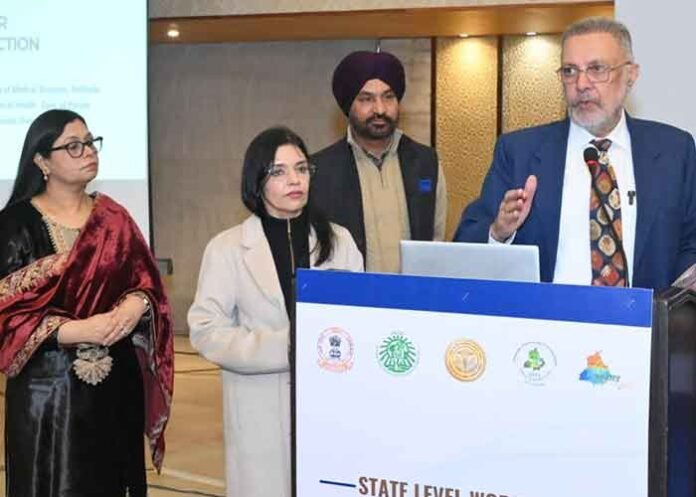
Punjab is taking significant steps to enhance women’s healthcare by expanding technological interventions aimed at reducing the state’s Maternal Mortality Rate (MMR). Health and Family Welfare Minister Dr Balbir Singh announced this initiative during a recent workshop focusing on “Tech Interventions for Maternal Mortality Reduction.” This event, held under the auspices of Mission Tandrust Punjab, aims to integrate proven technologies across government health facilities.
Currently, Punjab’s MMR stands at 95 deaths per 100,000 live births, exceeding the national average of 88. Dr Singh emphasized the importance of adopting best clinical practices among healthcare professionals to reach the sustainable development goal of lowering the MMR to 70. He urged all medical officers to prioritize healthcare for pregnant women, highlighting the significance of nutritional guidance and early health monitoring.
Leveraging Technology for Better Outcomes
The workshop was organized by the Punjab State Council for Science and Technology (PSCST), in collaboration with AIIMS Bathinda and the Punjab Department of Health and Family Welfare. During the event, Er Pritpal Singh, Executive Director of PSCST, noted that pilot projects introducing Non-Pneumatic Anti-Shock Garments (NASG) and Uterine Balloon Tamponade (UBT) in twelve districts have successfully saved over 300 mothers suffering from critical post-partum hemorrhage (PPH).
Dr Aditi Salaria, Director of Health Services (Family Welfare) in Punjab, reinforced the need for early identification of danger signs and standardized referral protocols. She called on gynaecologists and Auxiliary Nurse Midwives (ANMs) to adopt these initiatives with a focused approach, ensuring timely medical interventions.
Training and Collaboration for Effective Implementation
Project Leaders Dr Lajya Devi Goyal, Dean of Research at AIIMS Bathinda, and Dr Dapinder Kaur Bakshi, Joint Director of PSCST, shared their insights on implementing these life-saving technologies at the district level. They discussed the availability of necessary devices at delivery points and the hands-on training for healthcare workers, which have contributed to a notable decrease in maternal complications.
The workshop featured presentations from Dr Parneet Kaur of GMC Patiala and Dr Parveen Rajora of GMC Faridkot, who shared their experiences with clinical outcomes in their districts. Attendees received practical training on NASG and UBT, enhancing their skills to better serve mothers in critical need.
The event was attended by various healthcare professionals, including doctors, nurses, and health officials from all 23 districts of Punjab. The collaborative effort reflects the state’s commitment to improving maternal health and reducing fatalities through innovative technological solutions.
As Punjab moves forward with this expansion, the focus remains on leveraging technology to save lives and ensure safe childbirth for all mothers in the region.

Albert Camus’ Insightful Quote on Human Identity Resurfaces

Drone Strikes and Missile Attacks Disrupt UAE Amid Rising Tensions

Japanese Yen Rises Sharply Against US Dollar Ahead of Key Decisions

Priyanka Chopra and Nick Jonas Avoid Near Miss en Route to Oscars

Gujarat Vaccinates Over 11 Lakh Infants in Major Health Drive

Alexandre Singh Wins Oscar, Celebrates Immigrant Heritage

Lok Sabha Speaker Issues Warning Over Placards in Parliament

Global Electrosurgical Devices Market Expands to $10.2 Billion by 2034

North Zone Dominates Cricket; SJAM-1 Shines in Table Tennis

SBI Announces QIP Floor Price at ₹811.05 Per Share

Cept Unveils ₹3.1 Crore Urban Mobility Plan for Sustainable Growth

New Blood Group Discovered in South Indian Woman at Rotary Centre

Konkani Cultural Organisation to Host Pearl Jubilee in Abu Dhabi

Torrential Rains Cause Flash Flooding in New York and New Jersey

Nothing Headphone 1 Review: A Bold Contender in Audio Design

Indian Stock Market Rebounds: Sensex and Nifty Rise After Four-Day Decline

Air India Crash Investigation Highlights Boeing Fuel Switch Concerns

Broad Advocates for Bowling Change Ahead of Final Test Against India
-
 World12 months ago
SBI Announces QIP Floor Price at ₹811.05 Per Share
-
 Lifestyle12 months ago
Cept Unveils ₹3.1 Crore Urban Mobility Plan for Sustainable Growth
-
 Science12 months ago
New Blood Group Discovered in South Indian Woman at Rotary Centre
-
 Top Stories12 months ago
Konkani Cultural Organisation to Host Pearl Jubilee in Abu Dhabi
-
 World12 months ago
Torrential Rains Cause Flash Flooding in New York and New Jersey
-
 Science12 months ago
Nothing Headphone 1 Review: A Bold Contender in Audio Design
-
 Business12 months ago
Indian Stock Market Rebounds: Sensex and Nifty Rise After Four-Day Decline
-
 Top Stories12 months ago
Air India Crash Investigation Highlights Boeing Fuel Switch Concerns
-
 Sports12 months ago
Broad Advocates for Bowling Change Ahead of Final Test Against India
-

 Sports12 months ago
Cristian Totti Retires at 19: Pressure of Fame Takes Toll
-

 Politics12 months ago
Abandoned Doberman Finds New Home After Journey to Prague
-

 Lifestyle12 months ago
Villagers Unite to Raise ₹45 Lakh for Water Solutions in Vadgam