
Science
Young Innovator Transforms Sugarcane Farming in Uttar Pradesh

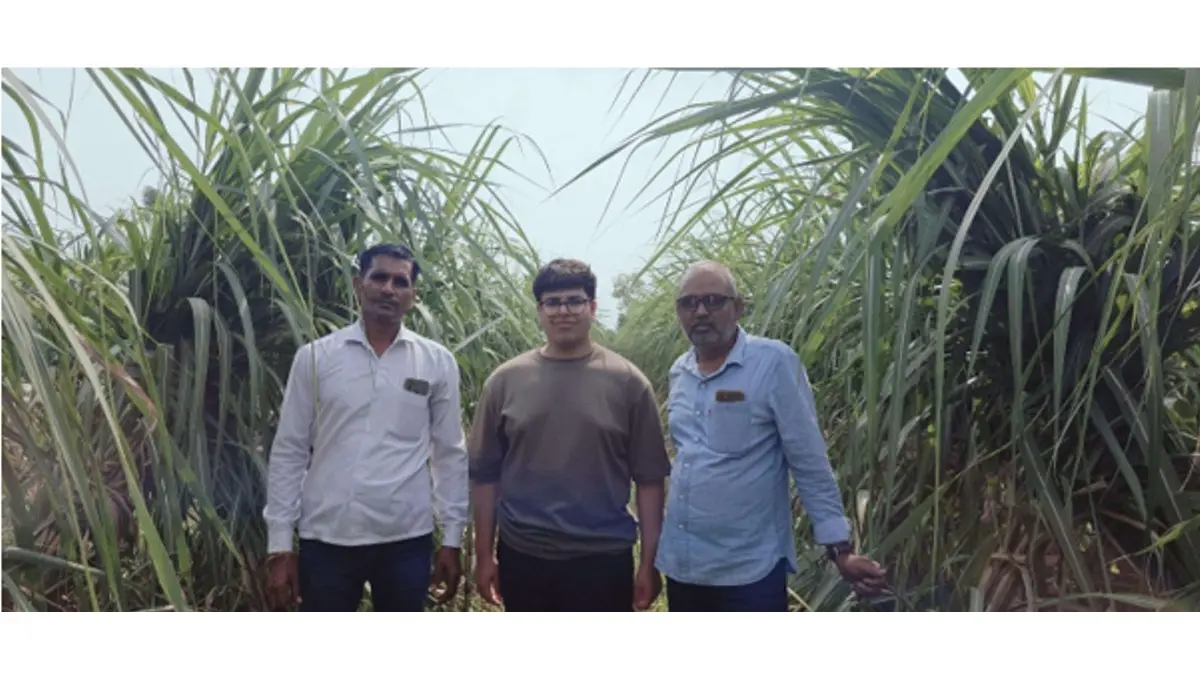
Project 101 (Ek Sau Ek), founded by Yash Sawhney, is making significant strides in enhancing sugarcane productivity and improving rural livelihoods in Bulandshahr, Uttar Pradesh. Launched in 2023, the initiative has expanded its reach from 100 farmers in 26 villages to 1,000 farmers across 45 villages, reflecting the growing demand for effective, scientifically backed agricultural practices.
Innovative Agricultural Practices Transform Yield
The foundation of Project 101 was inspired by Sawhney’s research on agricultural interventions aimed at optimizing sugarcane cultivation. His fieldwork highlighted that simple, accessible methods such as trench planting, balanced nutrient management, and integrated pest management could significantly enhance both yield and income for farmers. Unfortunately, many farmers lacked the necessary knowledge and resources to implement these techniques.
To address these challenges, Project 101 provides practical solutions that respect traditional agricultural wisdom while integrating modern scientific approaches. Key interventions include trench planting with 4-foot row spacing, which promotes better crop tillering and allows for intercropping, thus diversifying income sources. The project also advocates for furrow irrigation, which has demonstrated a reduction in water usage by approximately 30%.
Soil health is a priority, with initiatives such as bio-composting and mulching improving organic carbon levels and decreasing the practice of crop-residue burning. Additionally, soil testing supports balanced fertilizer application, while techniques like earthing-up with potash enhance root systems and juice quality. Single-bud planting, combined with treatments such as Trichoderma-based applications, has led to notable improvements in seed efficiency and germination rates.
Results and Community Impact
Initial results from the project have shown promising outcomes. For instance, single-bud planting has yielded savings of 30% to 70% in seed material. Germination rates have improved to between 70% and 76%, compared to around 40% in control plots, leading to an increase of 8% to 15% in millable cane counts. Farmers have reported taller crops, with increases of 11% to 23% in height and 5% to 9% in girth, alongside reductions in insect damage and diseases such as Red Rot.
These advancements have resulted in meaningful cost savings and are expected to be further validated by ongoing yield and sucrose data collection. The project’s expansion signifies a model of collaboration and accessibility, emphasizing farmer-led adoption of innovative techniques.
In addition to agricultural training, Project 101 also prioritizes broader rural support by partnering with Haqdarshak. This collaboration helps farmers access government schemes, subsidies, healthcare, and essential services. Educational materials, including pamphlets on sustainable practices authored by Sawhney, have reached over 200,000 farmers, while a bilingual booklet has been distributed to 5,000 farmers, further promoting verified scientific information.
As Project 101 continues to grow, it exemplifies how integrating modern agricultural science with traditional practices can transform rural livelihoods. For the 1,000 participating farmers in Bulandshahr, this initiative represents a pathway toward a more prosperous and sustainable agricultural future.

US Federal Reserve to Announce Interest Rate Decision Today

Melania Trump Reacts Strongly to TikTok Pastor’s Revelations

Udupi Implements Full EPF and ESI for Grama Panchayat Staff

Telugu Film ‘Sahakutumbaanaam’ Unveils Official Trailer

Dr. Shiran Shetty Advances Cancer Care with Training in Japan

Karnataka Yakshagana Academy Announces 2025 Awards for Excellence

India Appoints Rahul Rasgotra as Mauritius National Security Advisor

Yogi Adityanath Warns Against Divisive Forces in Society

Government Considers Voluntary Provident Fund Contributions

SBI Announces QIP Floor Price at ₹811.05 Per Share

Cept Unveils ₹3.1 Crore Urban Mobility Plan for Sustainable Growth

New Blood Group Discovered in South Indian Woman at Rotary Centre

Torrential Rains Cause Flash Flooding in New York and New Jersey

Konkani Cultural Organisation to Host Pearl Jubilee in Abu Dhabi

Broad Advocates for Bowling Change Ahead of Final Test Against India

Nothing Headphone 1 Review: A Bold Contender in Audio Design

Air India Crash Investigation Highlights Boeing Fuel Switch Concerns

Indian Stock Market Rebounds: Sensex and Nifty Rise After Four-Day Decline
-
 World5 months ago
SBI Announces QIP Floor Price at ₹811.05 Per Share
-
 Lifestyle5 months ago
Cept Unveils ₹3.1 Crore Urban Mobility Plan for Sustainable Growth
-
 Science4 months ago
New Blood Group Discovered in South Indian Woman at Rotary Centre
-
 World5 months ago
Torrential Rains Cause Flash Flooding in New York and New Jersey
-
 Top Stories5 months ago
Konkani Cultural Organisation to Host Pearl Jubilee in Abu Dhabi
-
 Sports4 months ago
Broad Advocates for Bowling Change Ahead of Final Test Against India
-
 Science5 months ago
Nothing Headphone 1 Review: A Bold Contender in Audio Design
-
 Top Stories5 months ago
Air India Crash Investigation Highlights Boeing Fuel Switch Concerns
-
 Business5 months ago
Indian Stock Market Rebounds: Sensex and Nifty Rise After Four-Day Decline
-

 Sports4 months ago
Cristian Totti Retires at 19: Pressure of Fame Takes Toll
-

 Politics5 months ago
Abandoned Doberman Finds New Home After Journey to Prague
-

 Top Stories5 months ago
Patna Bank Manager Abhishek Varun Found Dead in Well