
Science
Scientists Warn of Imminent GLOF Threat from Bhilangana Lake

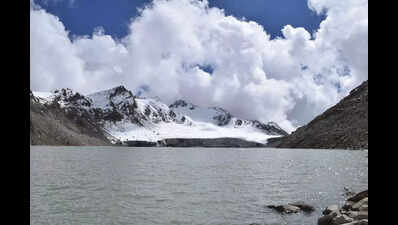
The rapidly expanding Bhilangana Lake in Uttarakhand is raising alarms among scientists due to its potential to trigger a catastrophic Glacial Lake Outburst Flood (GLOF). Located at approximately 4,750 metres in the central Himalayas, the lake’s growth is attributed to rising temperatures and accelerated glacier melt, making it a significant threat to downstream communities and hydropower infrastructure.
A recent study published in the journal Hydrological Processes warns that the ongoing expansion of Bhilangana Lake could drastically increase the risk of a GLOF, which could release millions of cubic metres of water in mere minutes. Conducted by researchers from notable institutions including the Wadia Institute of Himalayan Geology (WIHG) in Dehradun, the National Geophysical Research Institute (NGRI) in Hyderabad, and Jawaharlal Nehru University in Delhi, the research highlights the urgent need for monitoring and hazard assessments in the region.
Study Highlights Rapid Lake Growth
The research utilized satellite imagery, field data, and hydrodynamic modelling to analyze the lake’s evolution from 1968 to 2025. Alarmingly, the study noted that the lake did not exist in 1968 and began forming around 1980. Its growth remained modest until 2001, after which it began to expand exponentially due to significant glacier thinning and retreat.
Pawan Patidar, a senior research fellow at WIHG and the study’s lead author, reported that the parent glacier has diminished by 0.7 km² since the mid-1990s, with thinning rates of up to 0.7 metres per year. Using hydrodynamic simulations, the researchers modeled a worst-case scenario involving a breach of the moraine dam. The results indicated that a GLOF could discharge up to 3,645 cubic metres of water per second, with flow velocities exceeding 30 m/s in upper reaches.
Downstream settlements like Deokhri could face water depths of 11 metres within just 1.2 hours of a breach. Additionally, critical infrastructure, including the Ghuttu, Ghansali, and Bhilangana hydropower stations, could be inundated, facing flood depths exceeding 8–10 metres.
Climate Change as a Driving Factor
The study identified rising temperatures as the primary driver behind the rapid growth of Bhilangana Lake. Researchers documented an annual warming trend of 0.028°C, with maximum and minimum temperatures increasing even more significantly at rates of 0.052°C and 0.050°C, respectively. Notably, warming is most intense during the summer months, particularly between July and August.
The zero-degree isotherm is also shifting higher, now reaching altitudes exceeding 6,400–7,300 metres in summer. Projections indicate that temperatures in the region could rise by as much as 8–11°C by 2100, which may further accelerate glacier retreat and contribute to the formation of additional glacial lakes.
The study also identified several over-deepened zones in the basin that could evolve into future lakes, compounding the long-term hazard potential for the area. The authors emphasized the urgent need for early-warning systems and ongoing monitoring, especially as the Bhilangana valley is home to numerous hydropower projects crucial to Uttarakhand’s energy supply.
As climate change continues to impact the region, the findings underscore the necessity for immediate action to mitigate the risks posed by glacial lake outburst floods, which could have devastating effects on local communities and infrastructure.

Voter Roll Overhaul Sparks Crisis as BLOs Face Heavy Strain

India Takes Steps to Boost Rare-Earth Magnet Production Amid Dependency

Washington Sundar Struggles at No. 5 in India’s ODI Loss to South Africa

Malaysia’s Anwar Ibrahim Rules Out Major Cabinet Shake-Up

Election Commission Faces Backlash Over Stressful Voter Roll Revisions

Elon Musk Envisions Future Where Money Loses Its Power

Nitesh Rane Critiques Eknath Shinde Amid Rival Campaigning

India Can Lead Global HIV Response as New Treatments Emerge

WNBA and Players Association Extend CBA Negotiations Until January 9

SBI Announces QIP Floor Price at ₹811.05 Per Share

Cept Unveils ₹3.1 Crore Urban Mobility Plan for Sustainable Growth

New Blood Group Discovered in South Indian Woman at Rotary Centre

Torrential Rains Cause Flash Flooding in New York and New Jersey

Konkani Cultural Organisation to Host Pearl Jubilee in Abu Dhabi

Broad Advocates for Bowling Change Ahead of Final Test Against India

Nothing Headphone 1 Review: A Bold Contender in Audio Design

Air India Crash Investigation Highlights Boeing Fuel Switch Concerns

Indian Stock Market Rebounds: Sensex and Nifty Rise After Four-Day Decline
-
 World5 months ago
SBI Announces QIP Floor Price at ₹811.05 Per Share
-
 Lifestyle5 months ago
Cept Unveils ₹3.1 Crore Urban Mobility Plan for Sustainable Growth
-
 Science4 months ago
New Blood Group Discovered in South Indian Woman at Rotary Centre
-
 World5 months ago
Torrential Rains Cause Flash Flooding in New York and New Jersey
-
 Top Stories5 months ago
Konkani Cultural Organisation to Host Pearl Jubilee in Abu Dhabi
-
 Sports4 months ago
Broad Advocates for Bowling Change Ahead of Final Test Against India
-
 Science5 months ago
Nothing Headphone 1 Review: A Bold Contender in Audio Design
-
 Top Stories5 months ago
Air India Crash Investigation Highlights Boeing Fuel Switch Concerns
-
 Business5 months ago
Indian Stock Market Rebounds: Sensex and Nifty Rise After Four-Day Decline
-

 Sports4 months ago
Cristian Totti Retires at 19: Pressure of Fame Takes Toll
-

 Politics5 months ago
Abandoned Doberman Finds New Home After Journey to Prague
-

 Top Stories5 months ago
Patna Bank Manager Abhishek Varun Found Dead in Well