
Science
Astronomers Capture Historic Close-Up of Interstellar Comet 3I/ATLAS

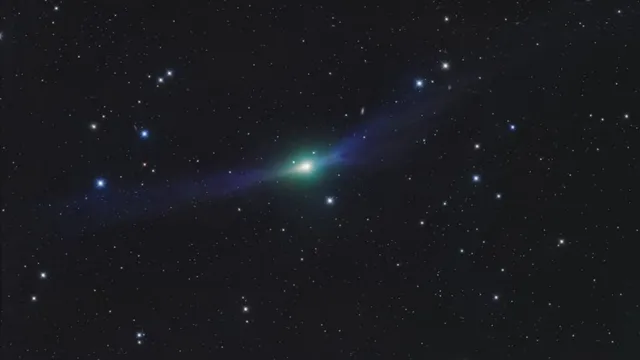
Astronomers have successfully photographed the interstellar comet 3I/ATLAS during its closest approach to Earth on December 19, 2025. This remarkable event allowed scientists to capture stunning images of the comet, which features two distinct tails extending into space. The photo, taken at a remote observatory in Utah, showcases the comet shining brightly, a testament to its origins in another star system.
Discovered earlier this year by NASA’s Asteroid Terrestrial-impact Last Alert System (ATLAS), 3I/ATLAS is only the third known interstellar object to pass through our Solar System, following ‘Oumuamua in 2017 and comet Borisov in 2019. The comet approached Earth at a safe distance of approximately 270 million kilometers, or about 1.8 astronomical units, traveling at a velocity of nearly 68 kilometers per second. Its hyperbolic trajectory confirms that it is not bound to the Sun, indicating its interstellar origin.
Significant Observations and Imaging Techniques
The event marked a key moment for astronomers, as it allowed for detailed observations of the comet. While it reached perihelion, or its closest point to the Sun, on October 29, this flyby provided the best opportunity for Earth-based observations. NASA has emphasized that the comet posed no threat during its passage.
The striking image of 3I/ATLAS was produced by stacking exposures totaling 74 minutes, utilizing a PlaneWave Delta Rho 500 telescope combined with a high-resolution ZWO camera. This advanced imaging technique revealed a bright, active coma surrounding the comet’s nucleus, displaying a straight ion tail formed by solar winds alongside a trailing dust tail. The comet was observed against the backdrop of the Leo constellation, with distant galaxies visible in the background.
Future Research and Implications
Notably, the James Webb Space Telescope has detected high levels of carbon monoxide in the comet, suggesting it formed under extremely cold conditions billions of years ago, potentially around an older star than our Sun. This discovery is significant, as it contributes to the understanding of how comets and planets form in other star systems.
Further observations have also identified X-ray emissions from 3I/ATLAS, a phenomenon previously documented in Solar System comets but never before conclusively observed in an interstellar one. Following its flyby, the comet is now on an outward trajectory, with its next significant encounter expected near the planet Jupiter in March 2026. Eventually, 3I/ATLAS will exit the Solar System, but scientists anticipate that the data collected during this brief passage will provide valuable insights that will take years to analyze.
As astronomers continue to study this extraordinary comet, they hope to unlock further secrets about its origins and the processes that govern the formation of celestial bodies in the universe.

Imran Khan Calls for Nationwide Protests After 17-Year Sentence

Stocks Rise as Markets Stabilize; Analysts Recommend Key Buys

Navigating Tax Implications of Under-Construction and Ready Homes

Dinesh Vijan Reflects on Stree’s Success After Initial Rejection

Discover India’s Top 10 Medical Colleges for MBBS in 2026

Discover Stylish Woollen Pants for Women This Winter Season

Jaishankar Highlights India’s Growing Global Influence at Convocation

India Reforms Nuclear Policy with New SHANTI Act to Boost Capacity

Paige Bueckers and Dominique Malonga Team Up for Unrivaled Action

SBI Announces QIP Floor Price at ₹811.05 Per Share

Cept Unveils ₹3.1 Crore Urban Mobility Plan for Sustainable Growth

New Blood Group Discovered in South Indian Woman at Rotary Centre

Torrential Rains Cause Flash Flooding in New York and New Jersey

Konkani Cultural Organisation to Host Pearl Jubilee in Abu Dhabi

Broad Advocates for Bowling Change Ahead of Final Test Against India

Nothing Headphone 1 Review: A Bold Contender in Audio Design

Air India Crash Investigation Highlights Boeing Fuel Switch Concerns

Indian Stock Market Rebounds: Sensex and Nifty Rise After Four-Day Decline
-
 World5 months ago
SBI Announces QIP Floor Price at ₹811.05 Per Share
-
 Lifestyle5 months ago
Cept Unveils ₹3.1 Crore Urban Mobility Plan for Sustainable Growth
-
 Science5 months ago
New Blood Group Discovered in South Indian Woman at Rotary Centre
-
 World5 months ago
Torrential Rains Cause Flash Flooding in New York and New Jersey
-
 Top Stories5 months ago
Konkani Cultural Organisation to Host Pearl Jubilee in Abu Dhabi
-
 Sports5 months ago
Broad Advocates for Bowling Change Ahead of Final Test Against India
-
 Science5 months ago
Nothing Headphone 1 Review: A Bold Contender in Audio Design
-
 Top Stories5 months ago
Air India Crash Investigation Highlights Boeing Fuel Switch Concerns
-
 Business5 months ago
Indian Stock Market Rebounds: Sensex and Nifty Rise After Four-Day Decline
-

 Sports5 months ago
Cristian Totti Retires at 19: Pressure of Fame Takes Toll
-

 Politics5 months ago
Abandoned Doberman Finds New Home After Journey to Prague
-

 Top Stories5 months ago
Patna Bank Manager Abhishek Varun Found Dead in Well