
Health
Alarming Surge in Cancer Cases in Jammu and Kashmir

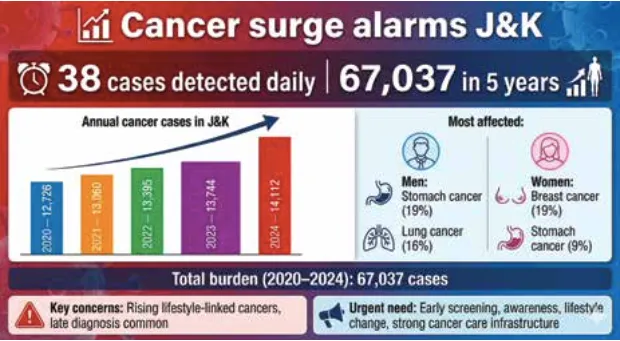
Jammu and Kashmir is experiencing a significant rise in cancer diagnoses, with an average of 38 new cases detected each day. Official data from the Union Health Ministry indicates that the region recorded a staggering 14,112 cancer cases in 2024 alone, contributing to a total of 67,037 cases over the past five years. This alarming trend shows no signs of abating, highlighting a growing public health concern.
The statistics reveal a steady annual increase in cancer cases. In 2020, Jammu and Kashmir reported 12,726 cases, which rose to 13,060 in 2021, 13,395 in 2022, and 13,744 in 2023. The continual rise underscores the urgent need for an effective response to this health crisis.
Gender Disparities and Common Types of Cancer
The data also illustrates distinct patterns in cancer incidence based on gender. Among males, stomach cancer is the most prevalent, accounting for nearly 20 percent of cases, followed closely by lung cancer at 16 percent. For females, breast cancer remains the leading type, constituting 19 percent of all reported cases, with stomach cancer as the second most common, at approximately 9 percent. Esophageal and colon cancers also contribute significantly to the overall cancer burden for both genders.
According to the Indian Council of Medical Research (ICMR), the increase in cancer cases can be attributed to multiple factors. Improved accessibility to diagnostic facilities and enhanced reporting systems have facilitated better detection. Additionally, the region’s rising life expectancy and an aging population are contributing to the growing numbers. Lifestyle factors such as increased tobacco and alcohol use, sedentary habits, and diets high in salt, sugar, and saturated fats have also been identified as significant contributors to the rise in cancer rates.
Government Initiatives and Community Response
In response to the escalating cancer incidence, the Department of Health and Family Welfare is implementing initiatives under the National Programme for Prevention and Control of Non-Communicable Diseases, part of the National Health Mission. This program aims to strengthen screening, early diagnosis, and treatment services while enhancing health infrastructure and resources.
Health officials stress the importance of public awareness and preventive measures to reduce late-stage diagnoses and improve patient outcomes. Medical professionals emphasize that sustained community-level screening and a focus on lifestyle modifications are crucial in combating the rising cancer rates.
As Jammu and Kashmir continues to record nearly four dozen new cancer cases daily, these figures serve as a stark reminder of the urgent need for proactive measures. Enhanced research into risk factors and improved access to specialized care are critical to addressing this growing health crisis. The situation calls for immediate action to improve the health outcomes for residents of the region and to mitigate the impact of cancer on the community.

Karnataka’s D K Shivakumar Advocates Bengaluru-Hyderabad Collaboration

Scientists Reveal How Cells Coordinate Defense and Self-Destruction

Gautam Gambhir Urged to Protect Varun Chakaravarthy’s Mystery

BJP’s Anurag Thakur Calls ‘Vande Mataram’ a National Imperative

Mahua Moitra Challenges PM Modi on Patriotism and Politics

DGCA Reviews IndiGo’s Flight Cancellation Response, Action Pending

Hardik Pandya Eyes T20I Double Milestone Against South Africa

EU’s Costa Urges U.S. to Respect Europe’s Sovereignty

AAP’s Raghav Chadha Critiques Toll Plaza Operations in Rajya Sabha

SBI Announces QIP Floor Price at ₹811.05 Per Share

Cept Unveils ₹3.1 Crore Urban Mobility Plan for Sustainable Growth

New Blood Group Discovered in South Indian Woman at Rotary Centre

Torrential Rains Cause Flash Flooding in New York and New Jersey

Konkani Cultural Organisation to Host Pearl Jubilee in Abu Dhabi

Broad Advocates for Bowling Change Ahead of Final Test Against India

Nothing Headphone 1 Review: A Bold Contender in Audio Design

Air India Crash Investigation Highlights Boeing Fuel Switch Concerns

Indian Stock Market Rebounds: Sensex and Nifty Rise After Four-Day Decline
-
 World5 months ago
SBI Announces QIP Floor Price at ₹811.05 Per Share
-
 Lifestyle5 months ago
Cept Unveils ₹3.1 Crore Urban Mobility Plan for Sustainable Growth
-
 Science4 months ago
New Blood Group Discovered in South Indian Woman at Rotary Centre
-
 World5 months ago
Torrential Rains Cause Flash Flooding in New York and New Jersey
-
 Top Stories5 months ago
Konkani Cultural Organisation to Host Pearl Jubilee in Abu Dhabi
-
 Sports4 months ago
Broad Advocates for Bowling Change Ahead of Final Test Against India
-
 Science5 months ago
Nothing Headphone 1 Review: A Bold Contender in Audio Design
-
 Top Stories5 months ago
Air India Crash Investigation Highlights Boeing Fuel Switch Concerns
-
 Business5 months ago
Indian Stock Market Rebounds: Sensex and Nifty Rise After Four-Day Decline
-

 Sports4 months ago
Cristian Totti Retires at 19: Pressure of Fame Takes Toll
-

 Politics5 months ago
Abandoned Doberman Finds New Home After Journey to Prague
-

 Top Stories5 months ago
Patna Bank Manager Abhishek Varun Found Dead in Well