
World
NASA and ISRO Showcase Interstellar Comet 3I/ATLAS Images

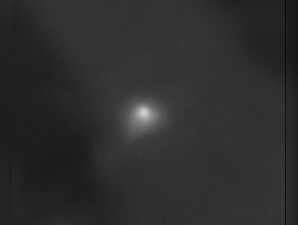
NASA’s recent release of an image of the interstellar comet 3I/ATLAS, captured by the HiRISE camera aboard the Mars Reconnaissance Orbiter, sparked considerable discussion online regarding its clarity and scientific value. The image, taken on October 2, 2025, occurred near the comet’s perihelion, but many observers expressed disappointment, claiming the image lacked the expected resolution.
Social media reactions highlighted the perceived shortcomings of the HiRISE camera, which is primarily designed for detailed imaging of the Martian surface. Users noted that the image appeared blurry and did not meet public expectations. One comment lamented that there was “not much to see,” while others echoed sentiments about the camera’s limitations in capturing distant, fast-moving celestial objects.
The HiRISE camera’s performance can be attributed to the significant distance from which the image was taken. NASA clarified that the comet’s rapid trajectory limited the detail achievable in the final picture. Despite this, the agency emphasized that the data collected remains valuable for tracking the comet’s path and analyzing its post-perihelion behavior.
ISRO Provides Ground-Based Observations
In response to the discussions surrounding the HiRISE image, the Indian Space Research Organisation (ISRO) also shared its own findings on 3I/ATLAS. The Physical Research Laboratory (PRL) utilized a 1.2-meter telescope located at Mount Abu to observe the comet after its perihelion. This ground-based observation occurred between November 12 and 15, 2025, allowing scientists to collect both imaging and spectroscopic data.
The PRL team reported observing a near-circular coma surrounding the comet, a feature resulting from the sublimation of ices as sunlight heats the comet’s nucleus. This process releases gas and dust, forming a cloud that envelops the core. Given the viewing conditions, any dust tail would appear behind the comet from Earth’s perspective.
In addition to imaging, PRL scientists recorded the comet’s spectrum, identifying emission features typical of many comets in the Solar System. The observed bands included CN, C2, and C3, which are critical for studying the molecular composition of the coma.
Production Rate Analysis and Future Observations
The PRL also analyzed the production rate of 3I/ATLAS, which indicates the volume of gas escaping from the nucleus to form the coma. For this comet, the estimated production rates for the major molecular bands were around 10^25 molecules per second. These findings categorize 3I/ATLAS as a “typical comet” within the Solar System.
PRL scientists indicated that observations would continue as 3I/ATLAS moves into darker skies, making it easier to track. The capabilities of the telescope at Mount Abu, operating at an altitude of 1,680 meters, enable extensive studies of Solar System bodies, exoplanets, and other significant astronomical events.
The contrasting approaches of NASA and ISRO highlight the collaborative nature of modern astronomical research, with both organizations contributing valuable insights into the behavior of this intriguing interstellar visitor.

Teaser Released for Upcoming Telugu Film ‘Not All Movies Are The Same: Dual’

Adilabad Reports Declining HIV Cases with Increased Awareness Efforts

Devotees Prepare for Bhaum Pradosh Vrat on December 2, 2025

Zelensky and Macron Discuss Ukraine Ceasefire Amid U.S. Efforts

India Enhances Naval Capabilities with Underwater Drone Development

BTS Star Taehyung’s Rope-Climbing Clip Sparks Viral Frenzy

Shalini’s Journey in ‘The Far Field’ Exposes Privilege’s Cost

Hindustan Unilever Appoints Vandana Suri as New Home Care Executive Director

Virat Kohli Sets New ODI Record, Surpasses Sachin Tendulkar

SBI Announces QIP Floor Price at ₹811.05 Per Share

Cept Unveils ₹3.1 Crore Urban Mobility Plan for Sustainable Growth

New Blood Group Discovered in South Indian Woman at Rotary Centre

Torrential Rains Cause Flash Flooding in New York and New Jersey

Konkani Cultural Organisation to Host Pearl Jubilee in Abu Dhabi

Broad Advocates for Bowling Change Ahead of Final Test Against India

Nothing Headphone 1 Review: A Bold Contender in Audio Design

Air India Crash Investigation Highlights Boeing Fuel Switch Concerns

Indian Stock Market Rebounds: Sensex and Nifty Rise After Four-Day Decline
-
 World5 months ago
SBI Announces QIP Floor Price at ₹811.05 Per Share
-
 Lifestyle5 months ago
Cept Unveils ₹3.1 Crore Urban Mobility Plan for Sustainable Growth
-
 Science4 months ago
New Blood Group Discovered in South Indian Woman at Rotary Centre
-
 World5 months ago
Torrential Rains Cause Flash Flooding in New York and New Jersey
-
 Top Stories5 months ago
Konkani Cultural Organisation to Host Pearl Jubilee in Abu Dhabi
-
 Sports4 months ago
Broad Advocates for Bowling Change Ahead of Final Test Against India
-
 Science5 months ago
Nothing Headphone 1 Review: A Bold Contender in Audio Design
-
 Top Stories5 months ago
Air India Crash Investigation Highlights Boeing Fuel Switch Concerns
-
 Business5 months ago
Indian Stock Market Rebounds: Sensex and Nifty Rise After Four-Day Decline
-

 Sports4 months ago
Cristian Totti Retires at 19: Pressure of Fame Takes Toll
-

 Politics5 months ago
Abandoned Doberman Finds New Home After Journey to Prague
-

 Top Stories5 months ago
Patna Bank Manager Abhishek Varun Found Dead in Well