
Science
Tamil Nadu’s Healthcare Growth Faces Staffing Shortages Amid Surge

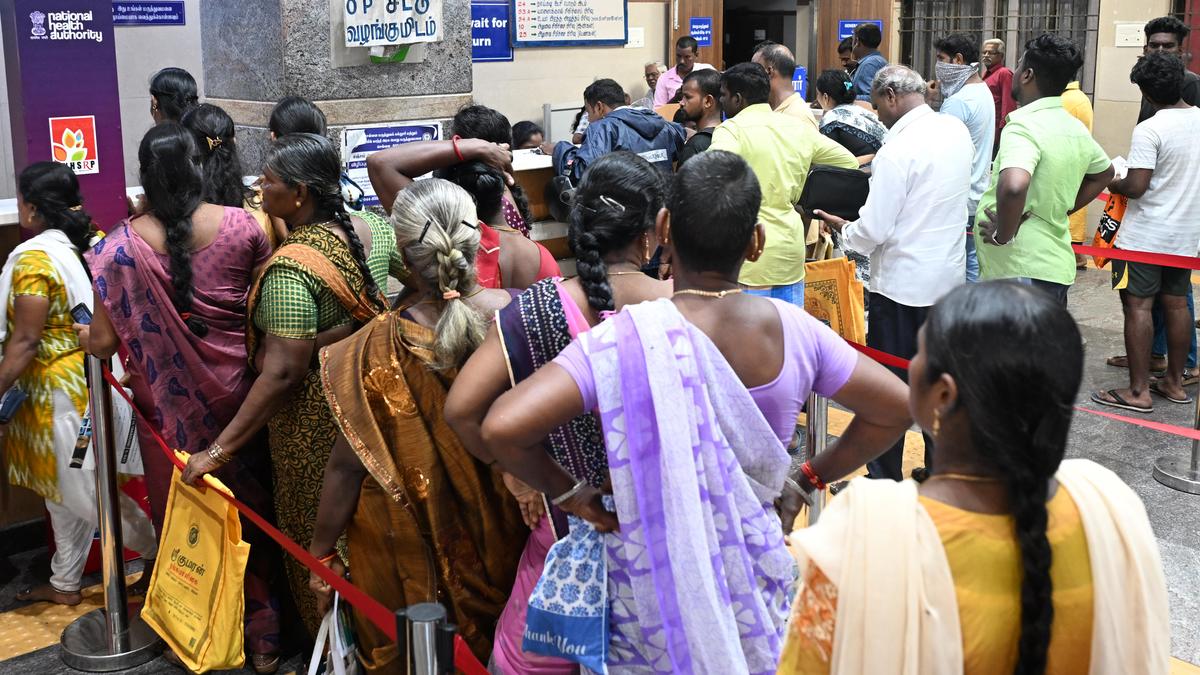
Between the fiscal years of 2021-2022 and 2024-2025, Tamil Nadu has witnessed a significant increase in healthcare demand, with average daily outpatient numbers in public tertiary health facilities rising by 49%. Concurrently, the bed capacity in these facilities expanded by 37%. As patient volumes increase, the question arises: has the state’s health workforce grown sufficiently to meet this demand? Specifically, do government hospitals have an adequate number of doctors, nurses, and other essential health staff to support this expansion?
The state has made considerable strides in enhancing its healthcare infrastructure, now boasting over 11,000 government health facilities. This includes 2,336 primary health centres (PHCs), 8,713 health sub-centres (HSCs), 299 government hospitals, and 36 medical college hospitals. Significant investment has been made in new multi- and super-speciality hospitals, upgrades to existing facilities, and the implementation of various health schemes. However, while infrastructure funding has increased, investment in human resources has not kept pace.
Health administrators have expressed a commitment to achieving “zero vacancy” in the health department. Yet, numerous healthcare professionals argue that the focus on vacancies fails to address a more pressing issue: the insufficient number of personnel, particularly doctors and nurses. Unfilled positions persist alongside a lack of new appointments relative to the burgeoning patient load and the introduction of new facilities and health schemes.
One notable misstep was a restructuring initiative enacted by the previous government, which led to the elimination of nearly 500 doctor positions. Critics contend that this decision not only reduced manpower but also negatively impacted service quality and increased the workload for doctors in government medical colleges. Similarly, the recent redeployment of 572 junior resident posts raises concerns about the potential ramifications on workforce effectiveness.
The trend of relying on contractual appointments rather than permanent positions has become increasingly common within the health sector. A. Ramalingam, secretary of the Service Doctors and Post Graduates Association, emphasized that the department has been redirecting staff, creating new posts by surrendering existing ones, and justifying these actions based on the National Medical Commission’s (NMC) minimum standards for medical education rather than patient care.
Recent government orders illustrate this approach. For instance, a directive dated November 3 approved the creation of 59 new posts for cancer care across 16 tertiary care hospitals, which required surrendering an equal number of posts from various medical institutions. Earlier this year, the state government sanctioned the establishment of 617 new HSCs in rural areas and 25 in urban regions, explicitly stating that no new posts would be created; instead, existing Auxiliary Nurse Midwives would be reassigned.
The absence of new posts extends to the recently opened Government Pentland Multi Super Speciality Hospital in Vellore and peripheral hospitals in Sholinganallur, Salem, and Tirunelveli, which are operational due to the redeployment of doctors from nearby medical college hospitals. Several government orders indicate that new or upgraded facilities should operate with the existing workforce, failing to allocate additional manpower.
K. Senthil, president of the Tamil Nadu Government Doctors Association, highlighted that while the state has nearly 22,000 sanctioned doctor posts, approximately twice that number is needed to meet current demand. He noted that the doctor-patient ratio has remained inadequate for years, emphasizing the necessity for the government to shift its focus from merely constructing new hospitals to proportionately increasing manpower across all levels of healthcare, particularly for nurses.
The nursing workforce faces similar challenges, with significant shortages reported across the state. In a communication dated December 12, the Directorate of Medical Education and Research requested the heads of medical colleges in Karur, Nagapattinam, and Pudukottai to rotate staff nurses to address severe shortages at the Mahatma Gandhi Memorial Government Hospital in Tiruchi. The upgrade of the Government Peripheral Hospital in Periyar Nagar to a 300-bed facility was approved with the creation of 375 posts across various categories, yet many nursing positions were left on a contractual basis, leading to dissatisfaction among staff.
N. Subin, general secretary of the Tamil Nadu Nurses Empowerment Association, emphasized that the nursing shortage has reached critical levels. He described instances where a single nurse is expected to manage an entire floor of patients or multiple wards, which severely compromises patient care. He argued for the immediate creation of 10,000 regular nursing posts and the regularization of approximately 8,000 nurses currently employed on a consolidated pay basis.
The strain on healthcare delivery is particularly pronounced in secondary care institutions, where doctors report that many facilities are understaffed and unable to meet patient needs effectively. P. Saminathan, president of the SDPGA, noted that despite upgrades to several district headquarters hospitals, there has been no corresponding increase in healthcare personnel. The Comprehensive Emergency Obstetrics and Newborn Care (CEmONC) centres, established to enhance maternal and child healthcare, have similarly experienced staffing stagnation since their inception in 2004-2005.
Healthcare professionals have voiced concerns regarding the government’s reluctance to create new posts in light of substantial investments in infrastructure and equipment. A senior surgeon questioned the rationale behind this approach, likening the need for adequate staffing to safety regulations in other professions. The overwhelming patient loads and inadequate staffing lead to burnout among healthcare workers, jeopardizing the quality of care provided.
In response to these mounting concerns, Health Minister Ma. Subramanian acknowledged that while not all posts are regular, several have been created through initiatives such as the National Health Mission. He admitted that there is an uneven distribution of workforce and stated that the government is actively working to fill nearly 400 specialist posts and 1,100 doctor posts through the Medical Services Recruitment Board (MRB). The minister expressed optimism about achieving a “zero vacancy” status by January, pledging to adjust staffing levels in accordance with patient load moving forward.
As Tamil Nadu continues to expand its healthcare infrastructure, the pressing need for a proportional increase in human resources cannot be overstated. Addressing these staffing shortages is critical to ensuring that the state’s healthcare system can effectively support its growing population and maintain a high standard of care.

Jaishankar Highlights India’s Growing Global Influence at Convocation

India Reforms Nuclear Policy with New SHANTI Act to Boost Capacity

Paige Bueckers and Dominique Malonga Team Up for Unrivaled Action

US Seizes Oil Tanker Near Venezuela, Heightening Tensions

Bengaluru Businessman Dies by Suicide After Train Incident

Sagittarius Weekly Horoscope: Financial Stability and Creative Growth

Family Celebrations Predicted for Zodiac Signs on December 21, 2025

Andhra Pradesh Launches Polio Vaccination Campaign for 5.4 Million Children

DIPR-JK Celebrates Winners of Creative Competitions in Srinagar

SBI Announces QIP Floor Price at ₹811.05 Per Share

Cept Unveils ₹3.1 Crore Urban Mobility Plan for Sustainable Growth

New Blood Group Discovered in South Indian Woman at Rotary Centre

Torrential Rains Cause Flash Flooding in New York and New Jersey

Konkani Cultural Organisation to Host Pearl Jubilee in Abu Dhabi

Broad Advocates for Bowling Change Ahead of Final Test Against India

Nothing Headphone 1 Review: A Bold Contender in Audio Design

Air India Crash Investigation Highlights Boeing Fuel Switch Concerns

Indian Stock Market Rebounds: Sensex and Nifty Rise After Four-Day Decline
-
 World5 months ago
SBI Announces QIP Floor Price at ₹811.05 Per Share
-
 Lifestyle5 months ago
Cept Unveils ₹3.1 Crore Urban Mobility Plan for Sustainable Growth
-
 Science5 months ago
New Blood Group Discovered in South Indian Woman at Rotary Centre
-
 World5 months ago
Torrential Rains Cause Flash Flooding in New York and New Jersey
-
 Top Stories5 months ago
Konkani Cultural Organisation to Host Pearl Jubilee in Abu Dhabi
-
 Sports5 months ago
Broad Advocates for Bowling Change Ahead of Final Test Against India
-
 Science5 months ago
Nothing Headphone 1 Review: A Bold Contender in Audio Design
-
 Top Stories5 months ago
Air India Crash Investigation Highlights Boeing Fuel Switch Concerns
-
 Business5 months ago
Indian Stock Market Rebounds: Sensex and Nifty Rise After Four-Day Decline
-

 Sports5 months ago
Cristian Totti Retires at 19: Pressure of Fame Takes Toll
-

 Politics5 months ago
Abandoned Doberman Finds New Home After Journey to Prague
-

 Top Stories5 months ago
Patna Bank Manager Abhishek Varun Found Dead in Well