
Science
Major Genetic Study Reveals First Humans Reached Australia 60,000 Years Ago

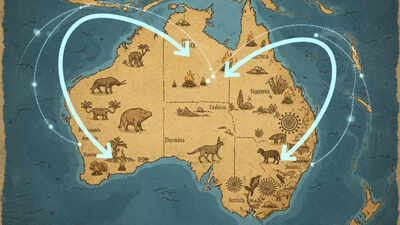
A recent genetic study has clarified the timing and routes of the first human migration to Australia, confirming that modern humans reached the continent approximately 60,000 years ago. This significant finding aligns with archaeological evidence and traditional Aboriginal oral histories, indicating a long-standing human presence in Australia much earlier than previously estimated by some genetic models.
The research, published in the journal Science Advances, involved an analysis of nearly 2,500 ancient and modern genomes from populations across Australia, New Guinea, and the broader Pacific region. This extensive genetic data not only pinpoints the arrival time but also reveals how these early humans traveled to Australia, uncovering two distinct migration routes into the ancient supercontinent known as Sahul.
Two Distinct Migration Routes Identified
The study identifies that the earliest ancestors of both Aboriginal Australians and New Guineans entered Sahul via two separate pathways. One group migrated south through the Indonesian islands towards northern Australia, while another group traversed a northern corridor, likely passing through the Philippines before arriving in New Guinea. These findings support existing oceanographic and archaeological models suggesting multiple viable entry points into Sahul.
Both groups were part of a larger population that migrated out of Africa between 70,000 and 80,000 years ago. Researchers indicate that the ancestors of Australians and New Guineans diverged in South or Southeast Asia thousands of years prior to their eastward progression.
Migration Dependent on Maritime Skills
The findings reinforce the notion that early humans reached Sahul using watercraft, as the region was never fully connected to mainland Asia. Even during the lowest sea levels of the Pleistocene, significant ocean crossings were necessary. The researchers also suggest that migration into Near Oceania, which includes the Bismarck Archipelago and Solomon Islands, occurred around the same time, indicating a pattern of ongoing movement and interaction rather than isolated settlement.
For decades, scholars have debated whether Australia was settled between 47,000 and 51,000 years ago or as early as 65,000 years ago. The new genetic timeline strongly supports the earlier date, providing one of the most precise reconstructions of human arrival and migration across Sahul. This also refines the overall timeline for humanity’s dispersal from Africa, pointing to a major migration event occurring between 50,000 and 70,000 years ago.
Acknowledging Indigenous Histories
The results of this genetic study affirm what many Aboriginal and Torres Strait Islander communities have long asserted: their connection to the land spans back at least 60,000 years. Researchers emphasize that these findings not only bolster the scientific timeline but also underscore the considerable seafaring knowledge required for these early journeys.
Together with archaeological and climatic evidence, this comprehensive genetic analysis provides the clearest understanding yet of one of humanity’s most significant migrations—the moment our species first reached the expansive lands of ancient Australia.

Dakota Johnson Discusses Complex Journey in Hollywood at Festival

Rujuta Diwekar Challenges Anti-Aging Standards in New Video

Discover Indigo’s Revival at Hampi Art Labs’ ‘Blue Futures’ Exhibit

Petro Condemns U.S. Military Presence, Calls for Latin Unity

Scientists Explore Feasibility of Human Life on the Moon by 2026

India Love Sparks Controversy at The Streamer Awards 2025

Explore the Spiritual Power of Anuradha Nakshatra in Love

Discover 10 Transformative Lessons from Martha Beck’s ‘Beyond Anxiety’

Fitness Coach Shares Effective Tips to Lose 1 kg Weekly Before 2026

SBI Announces QIP Floor Price at ₹811.05 Per Share

Cept Unveils ₹3.1 Crore Urban Mobility Plan for Sustainable Growth

New Blood Group Discovered in South Indian Woman at Rotary Centre

Torrential Rains Cause Flash Flooding in New York and New Jersey

Konkani Cultural Organisation to Host Pearl Jubilee in Abu Dhabi

Broad Advocates for Bowling Change Ahead of Final Test Against India

Nothing Headphone 1 Review: A Bold Contender in Audio Design

Air India Crash Investigation Highlights Boeing Fuel Switch Concerns

Indian Stock Market Rebounds: Sensex and Nifty Rise After Four-Day Decline
-
 World5 months ago
SBI Announces QIP Floor Price at ₹811.05 Per Share
-
 Lifestyle5 months ago
Cept Unveils ₹3.1 Crore Urban Mobility Plan for Sustainable Growth
-
 Science4 months ago
New Blood Group Discovered in South Indian Woman at Rotary Centre
-
 World5 months ago
Torrential Rains Cause Flash Flooding in New York and New Jersey
-
 Top Stories5 months ago
Konkani Cultural Organisation to Host Pearl Jubilee in Abu Dhabi
-
 Sports4 months ago
Broad Advocates for Bowling Change Ahead of Final Test Against India
-
 Science5 months ago
Nothing Headphone 1 Review: A Bold Contender in Audio Design
-
 Top Stories5 months ago
Air India Crash Investigation Highlights Boeing Fuel Switch Concerns
-
 Business5 months ago
Indian Stock Market Rebounds: Sensex and Nifty Rise After Four-Day Decline
-

 Sports4 months ago
Cristian Totti Retires at 19: Pressure of Fame Takes Toll
-

 Politics5 months ago
Abandoned Doberman Finds New Home After Journey to Prague
-

 Top Stories5 months ago
Patna Bank Manager Abhishek Varun Found Dead in Well