
World
Sedimentation Reduces Reservoir Capacity by 4,184 Million Cubic Metres

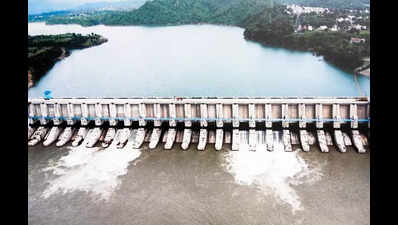
Water storage capacity in reservoirs across Punjab, Himachal Pradesh, and Haryana has significantly declined due to sedimentation, leading to a loss of approximately 4,183.6 million cubic metres (MCM) of storage. This reduction, amounting to nearly one-fifth of the original capacity of 24 dams, has been linked to severe flooding in Punjab, which resulted in the tragic loss of 40 lives and damage to thousands of homes and agricultural land.
Recent assessments conducted by the Union Ministry of Jal Shakti revealed alarming figures regarding the sedimentation levels in these states. The issue was brought to light in the Lok Sabha, following a query from Chandigarh MP Manish Tewari, who requested detailed information on the reservoir-wise losses in gross storage.
The analysis indicated that Punjab’s 14 reservoirs have lost 222.3 MCM, which represents 6.4% of their original storage capacity of 3,479.741 MCM. While the Ranjit Sagar Dam reported a moderate loss of 5.79%, several smaller dams faced severe declines. For example, the Perch Dam has lost an alarming 99.2% of its original storage, while the Mirzapur Dam and Patiari Dam have lost 73.72% and 78.15%, respectively.
Impact of Sedimentation on Flooding and Agriculture
The implications of reduced storage capacities are profound. The floods in Punjab not only resulted in the loss of human life but also led to the death of 7,161 livestock and damaged over 14,065 houses and 190,000 hectares of agricultural land. These figures underscore the direct correlation between sedimentation and the increased risk of flooding in the region.
In Himachal Pradesh, the situation is even more severe. The state has experienced a total loss of 3,960.37 MCM, or approximately 20.97% of its original storage capacity of 18,882.974 MCM. The Bhakra Reservoir alone has lost 2,568 MCM, accounting for 26.02% of its capacity, while the Beas Reservoir has seen a loss of 1,190 MCM (13.88%).
Smaller reservoirs, such as the Baira Dam and Chamera-I Dam, have also faced sharp declines of 81.33% and 50.1%, respectively. Interestingly, some reservoirs like Pandoh and ADHPL have not reported any sedimentation loss.
Government Response and Future Measures
In response to the sedimentation issue, the Punjab government has initiated de-siltation efforts for 13 dams in the Kandi area, utilizing its own funds. Ongoing projects include work at Chohal, Siswan, Saleran, and Thana. Proposals for forest clearance have also been submitted for the remaining nine dams.
The Bhakra Beas Management Board (BBMB) has yet to commence de-siltation at its major reservoirs, including Bhakra and Pong. However, the BBMB is considering a pilot project for the de-siltation of the Bhakra reservoir under the Dam Rehabilitation and Improvement Project (DRIP) Phase-II & III Scheme, envisioned as a revenue-generating model that does not require additional funding.
Most dam-owning agencies in Himachal Pradesh conduct periodic silt removal through flushing operations, typically during the monsoon season. While Punjab and BBMB are participating in the DRIP Phase-II & III, Haryana and Himachal Pradesh are not included in this de-siltation framework.
The Dam Safety Act, 2021, provides a national framework for the surveillance, inspection, and maintenance of large dams to prevent disasters. The Central Water Commission plays a vital role in monitoring live storage in 166 major reservoirs, including those in Punjab and Himachal Pradesh. The commission publishes weekly bulletins to assist with planning for irrigation, drinking water supply, flood management, and drought preparedness.
As sedimentation continues to threaten the integrity and functionality of these critical water resources, ongoing government efforts and public awareness will be crucial in mitigating the risks associated with reduced reservoir capacity.

Malti Chahar Confronts Shehbaz Badesha on Bigg Boss 19 Comments

CAT Orders JKPSC to Submit Deputy Medical Superintendent Records

Srinagar’s Sunday Market Thrives as Winter Demand Soars

Bangladesh Delegation Joins Vijay Diwas Celebrations in India

Join ESPN’s Eric Moody for Live Fantasy Football Q&A This Sunday

IndiGo Faces Flight Cancellations, MoCA Responds with Reforms

German Chancellor Merz and Netanyahu Disagree on Palestinian Statehood

BJP Government Claims Progress in Development and Law Enforcement

Star-Studded Pickleball Showdown at IPBL 2025 Ends in Thrilling Win

SBI Announces QIP Floor Price at ₹811.05 Per Share

Cept Unveils ₹3.1 Crore Urban Mobility Plan for Sustainable Growth

New Blood Group Discovered in South Indian Woman at Rotary Centre

Torrential Rains Cause Flash Flooding in New York and New Jersey

Konkani Cultural Organisation to Host Pearl Jubilee in Abu Dhabi

Broad Advocates for Bowling Change Ahead of Final Test Against India

Nothing Headphone 1 Review: A Bold Contender in Audio Design

Air India Crash Investigation Highlights Boeing Fuel Switch Concerns

Indian Stock Market Rebounds: Sensex and Nifty Rise After Four-Day Decline
-
 World5 months ago
SBI Announces QIP Floor Price at ₹811.05 Per Share
-
 Lifestyle5 months ago
Cept Unveils ₹3.1 Crore Urban Mobility Plan for Sustainable Growth
-
 Science4 months ago
New Blood Group Discovered in South Indian Woman at Rotary Centre
-
 World5 months ago
Torrential Rains Cause Flash Flooding in New York and New Jersey
-
 Top Stories5 months ago
Konkani Cultural Organisation to Host Pearl Jubilee in Abu Dhabi
-
 Sports4 months ago
Broad Advocates for Bowling Change Ahead of Final Test Against India
-
 Science5 months ago
Nothing Headphone 1 Review: A Bold Contender in Audio Design
-
 Top Stories5 months ago
Air India Crash Investigation Highlights Boeing Fuel Switch Concerns
-
 Business5 months ago
Indian Stock Market Rebounds: Sensex and Nifty Rise After Four-Day Decline
-

 Sports4 months ago
Cristian Totti Retires at 19: Pressure of Fame Takes Toll
-

 Politics5 months ago
Abandoned Doberman Finds New Home After Journey to Prague
-

 Top Stories5 months ago
Patna Bank Manager Abhishek Varun Found Dead in Well